1,1 miljard i städnota efter brokollapsen i Baltimore
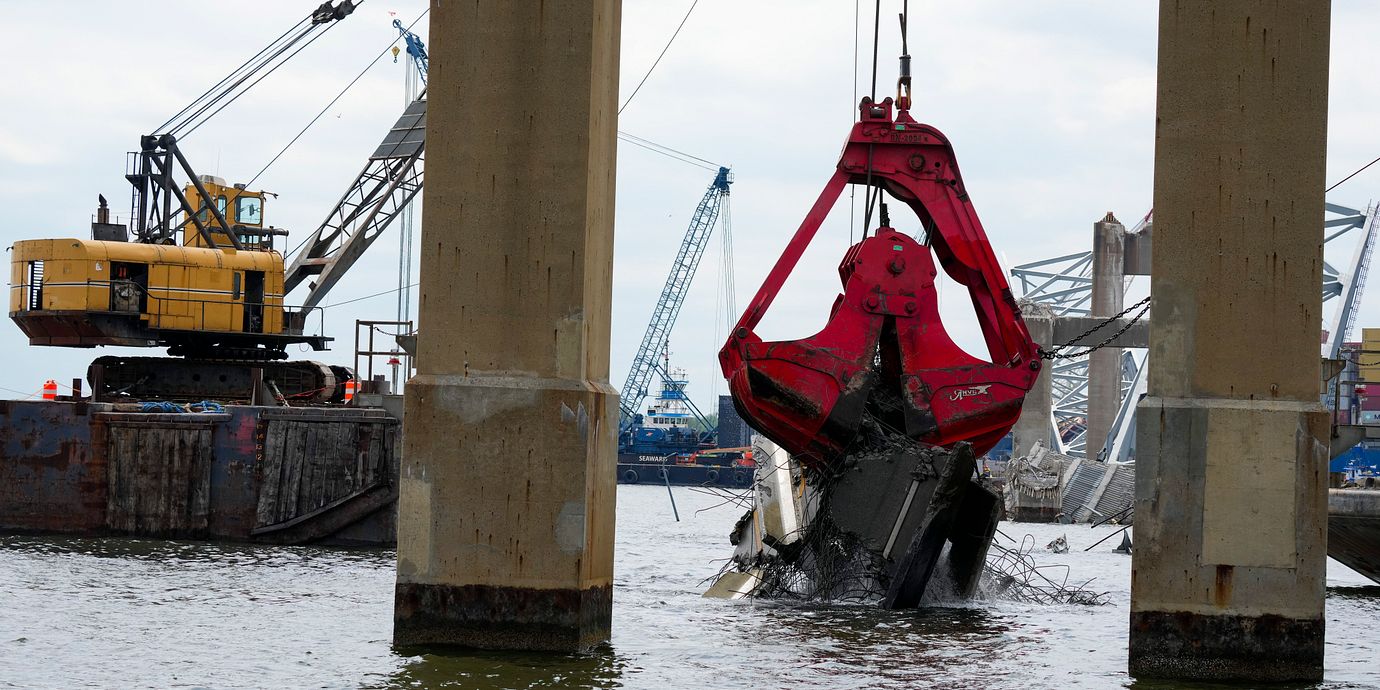
Ägaren till det fartyg som kolliderade med en bro i Baltimore i mars har gått med på en uppgörelse om att betala motsvarande 1,1 miljarder kronor till den amerikanska staten, rapporterar flera medier.
Pengarna ska bland annat täcka kostnaderna för att städa upp efter brons kollaps.
Flera rättsprocesser pågår. Bland annat driver anhöriga till de sex vägarbetare som dog vid händelsen egna rättsliga processer.
bakgrund
Francis Scott Key-bron
Wikipedia (en)
The Francis Scott Key Bridge (informally, Key Bridge or Beltway Bridge) is a partially collapsed bridge in the Baltimore metropolitan area, Maryland. Opened in 1977, it collapsed on March 26, 2024, after a container ship struck one of its piers. Officials have announced plans to replace the bridge by fall 2028.
It was built as a steel arch continuous through truss bridge that spanned the lower Patapsco River and outer Baltimore Harbor/Port in Maryland, United States. Opened on March 23, 1977, it carried the Baltimore Beltway (Interstate 695 or I-695) between Dundalk in Baltimore County and Hawkins Point, an isolated southern neighborhood of Baltimore, while briefly passing through Anne Arundel County.
Initially named the Outer Harbor Crossing, the bridge was renamed in 1976 for poet Francis Scott Key, who wrote the lyrics to "The Star-Spangled Banner", the U.S. national anthem. At 8,636 feet (2,632 m), it was the second-longest bridge in the Baltimore metropolitan area, after the Chesapeake Bay Bridge. Its main span of 1,200 feet (366 m) was the third-longest of any continuous truss in the world.
Operated by the Maryland Transportation Authority (MDTA), the bridge was the outermost of three toll crossings of Baltimore's harbor, along with the Baltimore Harbor and Fort McHenry tunnels. The bridge carried an estimated 11.5 million vehicles annually, including many trucks carrying hazardous materials that are prohibited in the tunnels. The construction of the bridge and its approaches completed the two-decade effort to build I-695, although the bridge roadway was officially a state road: the unsigned Maryland Route 695.
Omni är politiskt obundna och oberoende. Vi strävar efter att ge fler perspektiv på nyheterna. Har du frågor eller synpunkter kring vår rapportering? Kontakta redaktionen