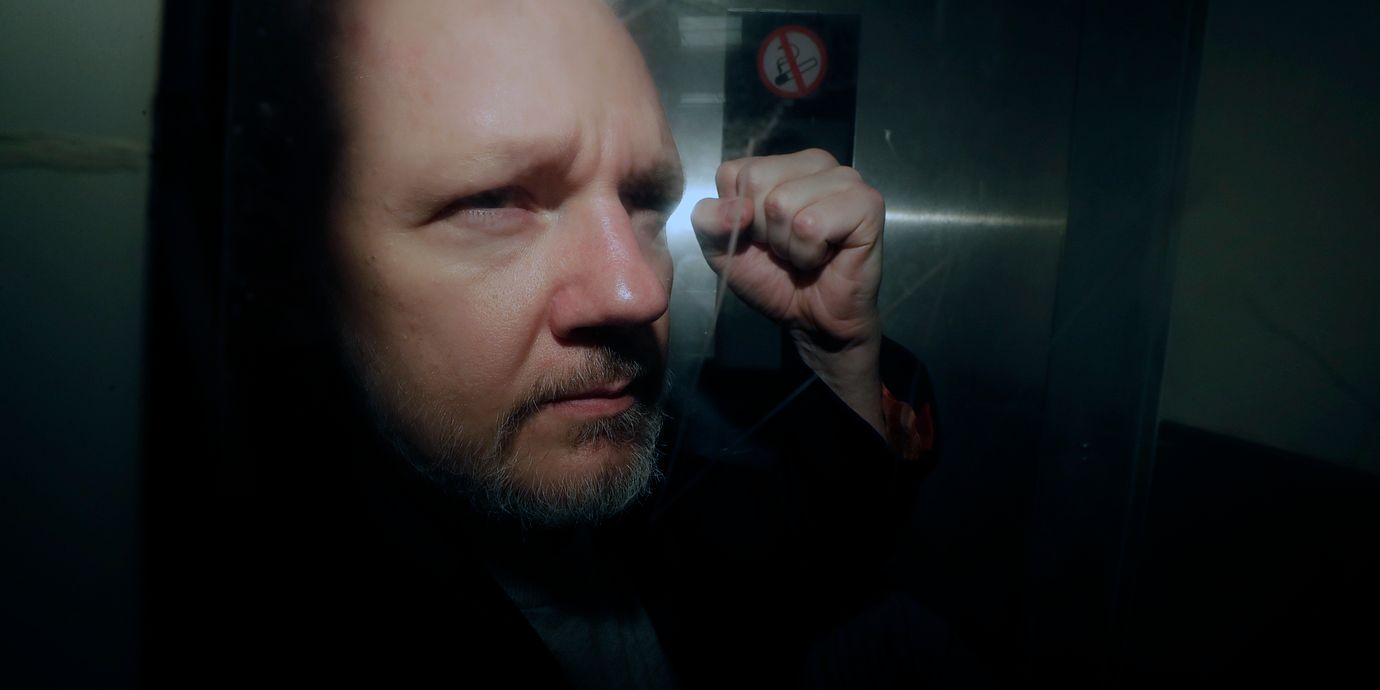
17 nya åtalspunkter mot Julian Assange i USA
Wikileaksgrundaren Julian Assange åtalas på ytterligare 17 punkter i USA, skriver AFP.
Åklagare anklagar bland annat Assange för att ha brutit mot landets spionerilag, den så kallade Espionage act från 1917. Det väcker frågor om var gränserna går för det första tillägget till landets konstitution, som ska skydda den som publicerar material.
– Julian Assange är ingen journalist, säger John Demers på justitiedepartementet till tidningen.
bakgrund
Espionage Act of 1917
Wikipedia (en)
The Espionage Act of 1917 is a United States federal law passed on June 15, 1917, shortly after the U.S. entry into World War I. It has been amended numerous times over the years. It was originally found in Title 50 of the U.S. Code (War) but is now found under Title 18, Crime. Specifically, it is 18 U.S.C. ch. 37 (18 U.S.C. § 792 et seq.)
It was intended to prohibit interference with military operations or recruitment, to prevent insubordination in the military, and to prevent the support of United States enemies during wartime. In 1919, the Supreme Court of the United States unanimously ruled through Schenck v. United States that the act did not violate the freedom of speech of those convicted under its provisions. The constitutionality of the law, its relationship to free speech, and the meaning of its language have been contested in court ever since.
Among those charged with offenses under the Act are German-American socialist congressman and newspaper editor Victor L. Berger, labor leader and five-time Socialist Party of America candidate, Eugene V. Debs, anarchists Emma Goldman and Alexander Berkman, former Watch Tower Bible & Tract Society president Joseph Franklin Rutherford, communists Julius and Ethel Rosenberg, Pentagon Papers whistleblower Daniel Ellsberg, Cablegate whistleblower Chelsea Manning, and National Security Agency (NSA) contractor and whistleblower Edward Snowden. Rutherford's conviction was overturned on appeal. Although the most controversial sections of the Act, a set of amendments commonly called the Sedition Act of 1918, were repealed on March 3, 1921, the original Espionage Act was left intact.
bakgrund
Första tillägget till den amerikanska konstitutionen
Wikipedia (en)
The First Amendment (Amendment I) to the United States Constitution prevents the government from making laws which respect an establishment of religion, prohibit the free exercise of religion, or abridge the freedom of speech, the freedom of the press, the right to peaceably assemble, or the right to petition the government for redress of grievances. It was adopted on December 15, 1791, as one of the ten amendments that constitute the Bill of Rights.
The Bill of Rights was originally proposed to assuage Anti-Federalist opposition to Constitutional ratification. Initially, the First Amendment applied only to laws enacted by the Congress, and many of its provisions were interpreted more narrowly than they are today. Beginning with Gitlow v. New York (1925), the Supreme Court applied the First Amendment to states—a process known as incorporation—through the Due Process Clause of the Fourteenth Amendment.
In Everson v. Board of Education (1947), the Court drew on Thomas Jefferson's correspondence to call for "a wall of separation between church and State", though the precise boundary of this separation remains in dispute. Speech rights were expanded significantly in a series of 20th and 21st-century court decisions which protected various forms of political speech, anonymous speech, campaign financing, pornography, and school speech; these rulings also defined a series of exceptions to First Amendment protections. The Supreme Court overturned English common law precedent to increase the burden of proof for defamation and libel suits, most notably in New York Times Co. v. Sullivan (1964). Commercial speech, however, is less protected by the First Amendment than political speech, and is therefore subject to greater regulation.
The Free Press Clause protects publication of information and opinions, and applies to a wide variety of media. In Near v. Minnesota (1931) and New York Times v. United States (1971), the Supreme Court ruled that the First Amendment protected against prior restraint—pre-publication censorship—in almost all cases. The Petition Clause protects the right to petition all branches and agencies of government for action. In addition to the right of assembly guaranteed by this clause, the Court has also ruled that the amendment implicitly protects freedom of association.
Omni är politiskt obundna och oberoende. Vi strävar efter att ge fler perspektiv på nyheterna. Har du frågor eller synpunkter kring vår rapportering? Kontakta redaktionen