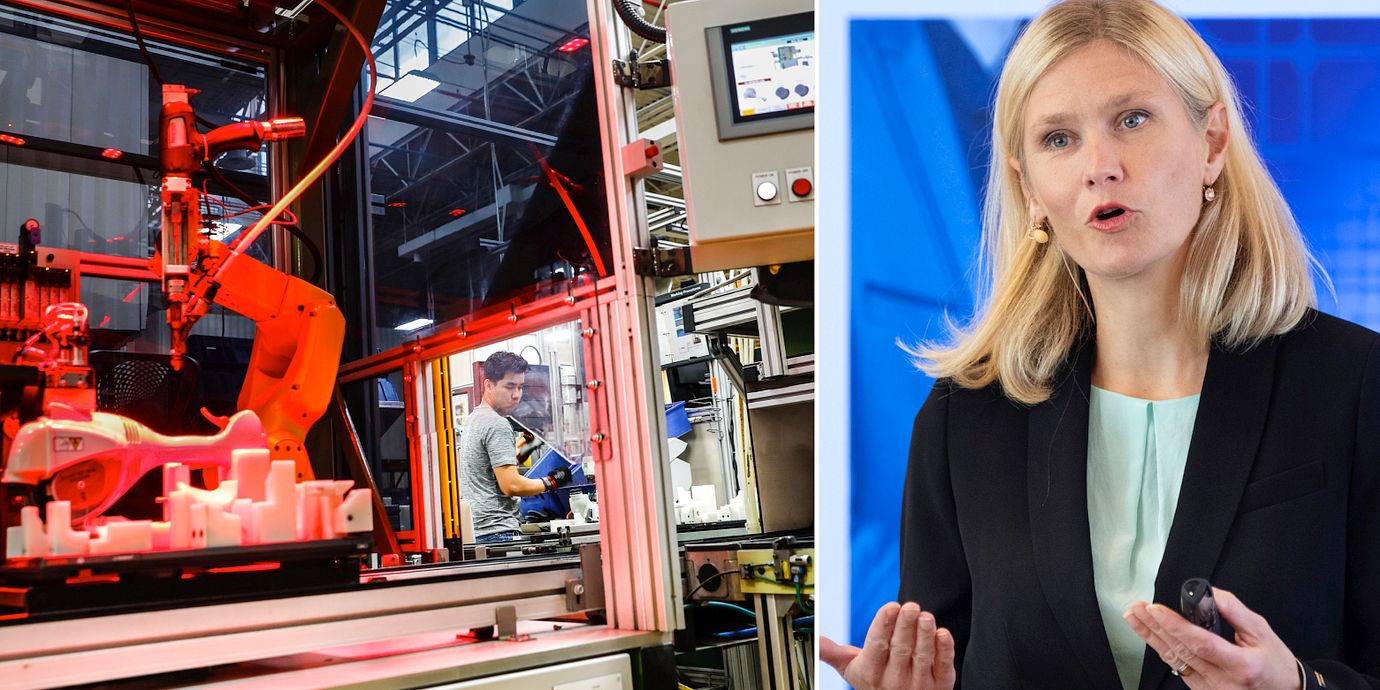
Unionen: 50 000 tjänster kan försvinna inom några år
Coronakrisen har inneburit att automatiseringen och effektiviseringen har tagit ett stort språng. Det säger Katarina Lundahl, chefsekonom på fackförbundet Unionen, till DI.
Enligt Lundahl har krisen lett till att företagen lagt ett större fokus på effektiviseringar genom ny teknik. Inom fem år kan upp till 50 000 heltidstjänster ha försvunnit, främst i tillverkningsindustrin, handeln och kommunikationsbranschen.
Katarina Lundahl lyfter fram vikten av att politiker ser vad som sker och inte bara fokuserar på de som är arbetslösa nu.
– Det är helt centralt att också fokusera på dem som riskerar slås ut.
bakgrund
Automatisering
Wikipedia (en)
Automation, or labor-saving technology is the technology by which a process or procedure is performed with minimal human assistance. Automation or automatic control is the use of various control systems for operating equipment such as machinery, processes in factories, boilers and heat treating ovens, switching on telephone networks, steering and stabilization of ships, aircraft and other applications and vehicles with minimal or reduced human intervention.
Automation covers applications ranging from a household thermostat controlling a boiler, to a large industrial control system with tens of thousands of input measurements and output control signals. In control complexity, it can range from simple on-off control to multi-variable high-level algorithms.
In the simplest type of an automatic control loop, a controller compares a measured value of a process with a desired set value, and processes the resulting error signal to change some input to the process, in such a way that the process stays at its set point despite disturbances. This closed-loop control is an application of negative feedback to a system. The mathematical basis of control theory was begun in the 18th century and advanced rapidly in the 20th.
Automation has been achieved by various means including mechanical, hydraulic, pneumatic, electrical, electronic devices and computers, usually in combination. Complicated systems, such as modern factories, airplanes and ships typically use all these combined techniques. The benefit of automation includes labor savings, savings in electricity costs, savings in material costs, and improvements to quality, accuracy, and precision.
The World Bank's World Development Report 2019 shows evidence that the new industries and jobs in the technology sector outweigh the economic effects of workers being displaced by automation.Job losses and downward mobility blamed on Automation has been cited as one of many factors in the resurgence of nationalist, protectionist and populist politics in the US, UK and France, among other countries since the 2010s.The term automation, inspired by the earlier word automatic (coming from automaton), was not widely used before 1947, when Ford established an automation department. It was during this time that industry was rapidly adopting feedback controllers, which were introduced in the 1930s.
Omni är politiskt obundna och oberoende. Vi strävar efter att ge fler perspektiv på nyheterna. Har du frågor eller synpunkter kring vår rapportering? Kontakta redaktionen