Attentatsmän flydde till borg – höll turister gisslan
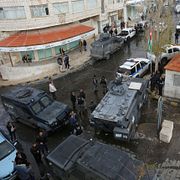
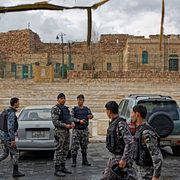
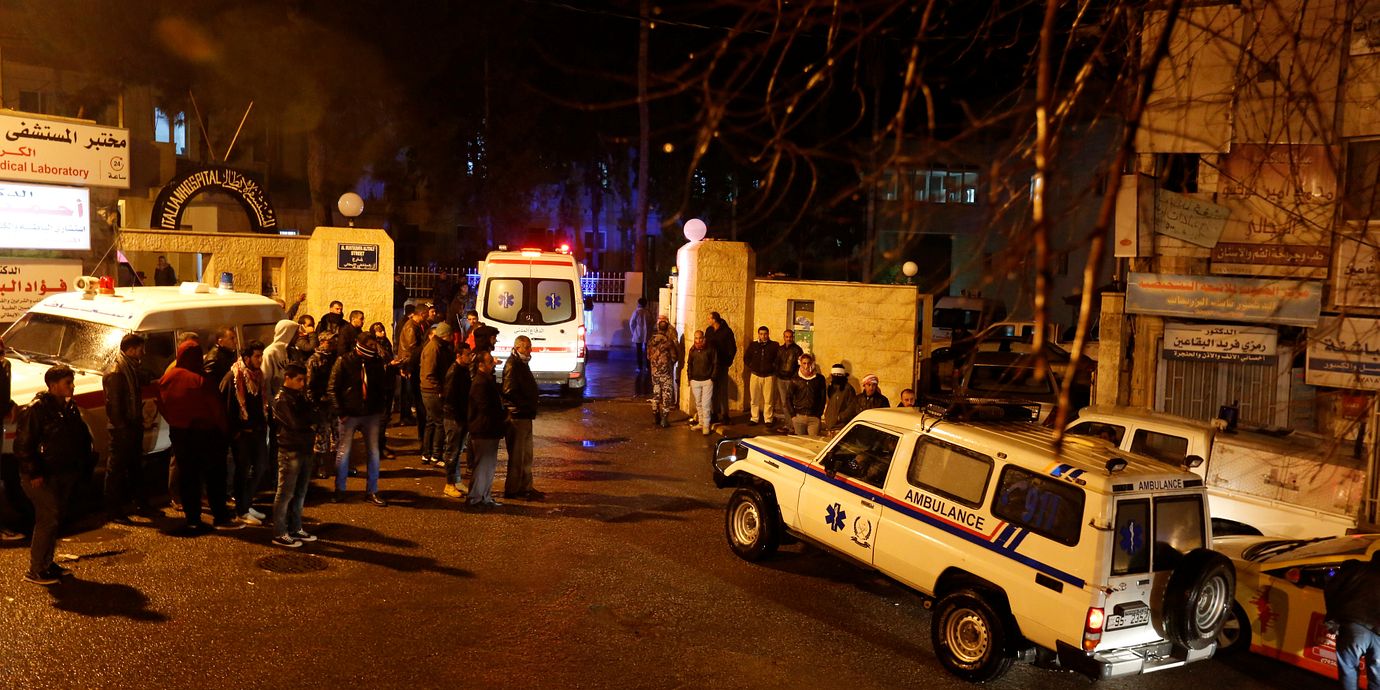
En kanadensisk turist, fyra poliser och två civila jordanier har dödats i väpnade angrepp i staden al-Karak i västra Jordanien. Attentatsmännen tog sin tillflykt till de medeltida borgarna i staden där turister togs som gisslan. Gisslandramat pågick under sju timmar. Stadens huvudvägar spärrades av och en helikopter skickades från huvudstaden Amman för att delta i insatsen. Sent på söndagskvällen uppgav myndigheterna att attacken var över och att fyra attentatsmän dödats vid stormningen av borgen.
Svenska mediers rapportering
bakgrund
Keraks borgar
Wikipedia (en)
Kerak Castle is a large Crusader castle located in al-Karak, Jordan. It is one of the largest crusader castles in the Levant. Construction of the castle began in the 1140s, under Pagan, Fulk, King of Jerusalem's butler. The Crusaders called it Crac des Moabites or "Karak in Moab", as it is frequently referred to in history books.
Pagan was also Lord of Oultrejordain and Kerak Castle became the centre of his power, replacing the weaker castle of Montreal to the south. Because of its position east of the Dead Sea, Kerak Castle was able to control bedouin herders as well as the trade routes from Damascus to Egypt and Mecca. His successors, his nephew Maurice and Philip of Milly, added towers and protected the north and south sides with two deep rock-cut ditches (the southern ditch also serving as a cistern). The most notable Crusader architectural feature surviving is the north wall, into which are built immense arched halls on two levels. These were used for living quarters and stables, but also served as a fighting gallery overlooking the castle approach and for shelter against missiles from siege engines.
In 1176 Raynald of Châtillon gained possession of Kerak Castle after marrying Stephanie of Milly, the widow of Humphrey III of Toron (and daughter-in-law of Humphrey II of Toron). From Kerak Castle, Raynald harassed the trade camel trains and even attempted an attack on Mecca itself. In 1183 Saladin besieged the castle in response to Raynald's attacks. The siege took place during the marriage of Humphrey IV of Toron and Isabella I of Jerusalem, and Saladin, after some negotiations and with a chivalrous intent, agreed not to target their chamber while his siege machines attacked the rest of the castle. The siege was eventually relieved by Baldwin IV of Jerusalem.
After the Battle of Hattin in 1187, Saladin besieged Kerak Castle again and finally captured it in 1189. In 1263, the Mamluk Sultan, Baibars, enlarged and built a tower on the northwest corner.
Kerak Castle was besieged again in 1834 by a rebel leader of the peasants' revolt in Palestine. In 1840, Ibrahim Pasha of Egypt captured the castle and destroyed much of its fortifications. In 1844, his troops, who did not have control over the surrounding countryside, came under siege. They were eventually starved out and many were killed.
During the Ottoman Empire, it played an important role due to its strategic location on the crossroads between the Arabian Peninsula, Egypt and Greater Syria.
In 1893, the Ottoman authorities reestablished control over the area by appointing a mutasarrıf (governor) resident in Kerak Castle with a garrison of 1400, including 200 cavalry. Parts of the castle were reused. Some of the destruction that had occurred to the structure was due to locals removing stones containing potassium nitrate ("saltpetre"), which is used to make gunpowder. Medieval historian Paul Deschamps studied Crusader castles in the 1920s. Amongst the important research done by Deschamps, in 1929 he and architect Francois Anus created the first accurate plans of Kerak Castle.
Omni är politiskt obundna och oberoende. Vi strävar efter att ge fler perspektiv på nyheterna. Har du frågor eller synpunkter kring vår rapportering? Kontakta redaktionen