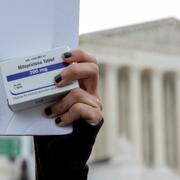
Abortpiller bunkras inför ”reproduktiv apokalyps”
Efterfrågan på abortpiller och könsbekräftande hormonbehandling steg kraftigt i USA när det stod klart att Donald Trump vunnit valet, skriver The Guardian.
Företaget Aid Access, som normalt levererar omkring 9 000 abortpiller i månaden, fick 5 000 beställningar inom loppet av 12 timmar efter Trumps seger. Det är till och med mer än när Roe vs Wade-domen revs upp 2022, enligt grundaren Rebecca Gomperts.
Samtidigt ökade trafiken till sajten Plan C, som liksom Aid Access levererar abortpiller via post, med 625 procent.
– Det är uppenbart att människor försöker planera för den reproduktiva apokalyps som vi förväntar oss kommer att ske under Trumps presidentskap, säger medgrundaren Elisa Wells.
bakgrund
Roe mot Wade
Wikipedia (en)
Roe v. Wade, 410 U.S. 113 (1973), was a landmark decision of the U.S. Supreme Court in which the Court ruled that the Constitution of the United States protected a right to have an abortion. The decision struck down many abortion laws, and it sparked an ongoing abortion debate in the United States about whether, or to what extent, abortion should be legal, who should decide the legality of abortion, and what the role of moral and religious views in the political sphere should be. The decision also shaped debate concerning which methods the Supreme Court should use in constitutional adjudication.
The case was brought by Norma McCorvey—under the legal pseudonym "Jane Roe"—who, in 1969, became pregnant with her third child. McCorvey wanted an abortion but lived in Texas, where abortion was illegal except when necessary to save the mother's life. Her lawyers, Sarah Weddington and Linda Coffee, filed a lawsuit on her behalf in U.S. federal court against her local district attorney, Henry Wade, alleging that Texas's abortion laws were unconstitutional. A special three-judge court of the U.S. District Court for the Northern District of Texas heard the case and ruled in her favor. The parties appealed this ruling to the Supreme Court. In January 1973, the Supreme Court issued a 7–2 decision in McCorvey's favor holding that the Due Process Clause of the Fourteenth Amendment to the United States Constitution provides a fundamental "right to privacy", which protects a pregnant woman's right to an abortion. It also held that the right to abortion is not absolute and must be balanced against the government's interests in protecting women's health and prenatal life. It resolved these competing interests by announcing a pregnancy trimester timetable to govern all abortion regulations in the United States. The Court also classified the right to abortion as "fundamental", which required courts to evaluate challenged abortion laws under the "strict scrutiny" standard, the most stringent level of judicial review in the United States.
The Supreme Court's decision in Roe was among the most controversial in U.S. history. Roe was criticized by some in the legal community, including some who thought that Roe reached the correct result but went about it the wrong way, and some called the decision a form of judicial activism. Others argued that Roe did not go far enough, as it was placed within the framework of civil rights rather than the broader human rights. The decision also radically reconfigured the voting coalitions of the Republican and Democratic parties in the following decades. Anti-abortion politicians and activists sought for decades to restrict abortion or overrule the decision; polls into the 21st century showed that a plurality and a majority, especially into the late 2010s to early 2020s, opposed overruling Roe. Despite criticism of the decision, the Supreme Court reaffirmed Roe's central holding in its 1992 decision, Planned Parenthood v. Casey. Casey overruled Roe's trimester framework and abandoned its "strict scrutiny" standard in favor of an "undue burden" test.
In 2022, the Supreme Court overruled Roe in Dobbs v. Jackson Women's Health Organization on the grounds that the substantive right to abortion was not "deeply rooted in this Nation's history or tradition", nor considered a right when the Due Process Clause was ratified in 1868, and was unknown in U.S. law until Roe.
Omni är politiskt obundna och oberoende. Vi strävar efter att ge fler perspektiv på nyheterna. Har du frågor eller synpunkter kring vår rapportering? Kontakta redaktionen