Hem
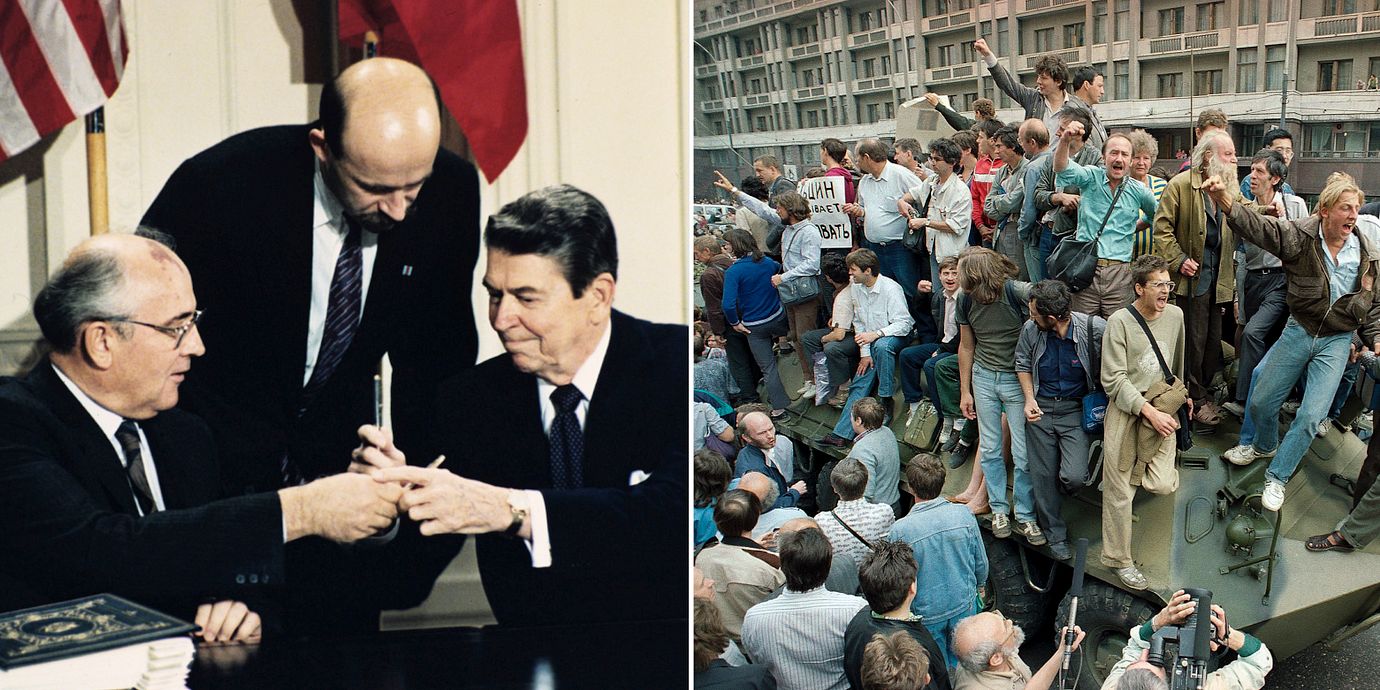
USA:s president Ronald Reagan och Sovjetledaren Michail Gorbatjov 1987/Protester på Röda torget 1991. (AP)

Analyser: Sovjets kollaps bär på lärdomar om kriget

I väst tror många att sanktioner, militära förluster och isolering på sikt kommer få vanliga ryssar att tröttna och tvinga bort Putin – men tanken är historiskt felaktig, skriver författaren och historieprofessorn Vladislav Zubok i Foreign Affairs.

Sovjet gick inte under av nederlaget i Afghanistan eller av pressen från USA och Europa, skriver han.

”I själva verket var det missriktad finanspolitik och en rad politiska snedsteg av Sovjetledaren Gorbatjov som fick landet att självförstöra.”

Detta har Putin lärt sig av, och därför har ekonomiskt kaos uteblivit trots sanktionerna, skriver Zubok, som till vardags arbetar vid London school of economics.

Kriget i Ukraina bör ses i en större historisk kontext av vad som sker när imperier kollapsar. Det skriver Anatol Lieven, vid den amerikanska tankesmedjan Quincy institute for responsible statecraft, i Foreign Policy.

Trots våldet i Ukraina och Tjetjenien har Sovjetunionens kollaps varit långt ifrån en av de blodigaste – varje gång ett imperium kollapsar leder det till våld, antingen direkt eller på sikt, skriver han.

”Konsekvenserna av de habsburgska, osmanska och brittiska rikena – och hur de upplöstes – utspelar sig fortfarande i dag, generationer senare.”
bakgrund
 
Sovjetunionens upplösning
Wikipedia (en)
The dissolution of the Soviet Union (1988–1991) was the process of internal disintegration within the Soviet Union (USSR) which resulted in the end of the country's and the federal government's existence as a sovereign state, thereby resulting in its constituent republics gaining full sovereignty. It brought an end to the General Secretary, Mikhail Gorbachev's (later also President) effort to reform the Soviet political and economic system in an attempt to stop a period of political stalemate and economic backslide. The Soviet Union had experienced internal stagnation and ethnic separatism. The USSR, although a highly centralized state, was made up of 15 republics that served as homelands for different ethnicities. By late 1991, amidst a catastrophic political crisis, with several republics already departing the Union and the waning of centralized power, the leaders of three of its founding members declared that the Soviet Union no longer existed. Eight more republics joined their declaration shortly thereafter. Gorbachev resigned in December 1991 and what was left of the Soviet parliament voted to end itself. Both the Revolutions of 1989 in the Eastern Bloc and the dissolution of the Soviet Union marked the end of the Cold War. The process began with growing unrest in the Union's various constituent national republics developing into an incessant political and legislative conflict between them and the central government. Estonia was the first Soviet republic to declare state sovereignty inside the Union on 16 November 1988. Lithuania was the first republic to declare full independence restored from the Soviet Union by the Act of 11 March 1990 with its Baltic neighbours and the Southern Caucasus republic of Georgia joining it in a course of two months. In August 1991, communist hardliners and military elites tried to overthrow Gorbachev and stop the failing reforms in a coup, but failed. The turmoil led to the government in Moscow losing most of its influence, and many republics proclaiming independence in the following days and months. The secession of the Baltic states was recognized in September 1991. The Belovezh Accords were signed on 8 December by President Boris Yeltsin of Russia, President Kravchuk of Ukraine, and Chairman Shushkevich of Belarus, recognising each other's independence and creating the Commonwealth of Independent States (CIS) instead of the Soviet Union. Kazakhstan was the last nation to leave the Union, proclaiming independence on December 16. All the ex-Soviet republics, with the exception of Georgia and the Baltics, joined the CIS on December 21, signing the Alma-Ata Protocol. On 25 December, Gorbachev resigned and turned over his presidential powers—including control of the nuclear launch codes—to Yeltsin, who was now the first president of the Russian Federation. That evening, the Soviet flag was lowered from the Kremlin and replaced with the Russian tricolour flag. The following day, the Supreme Soviet's upper chamber, the Soviet of the Republics formally dissolved the Union.In the aftermath of the Cold War, several of the former Soviet republics have retained close links with Russia and formed multilateral organizations such as the CIS, the Collective Security Treaty Organization (CSTO), the Eurasian Economic Union (EAEU), and the Union State, for economic and military cooperation. On the other hand, the Baltic states and most of the former Warsaw Pact states became part of the European Union and joined NATO, while some of the other former Soviet republics like Ukraine, Georgia and Moldova have been publicly expressing interest in following the same path since the 1990s.
Omni är politiskt obundna och oberoende. Vi strävar efter att ge fler perspektiv på nyheterna. Har du frågor eller synpunkter kring vår rapportering? Kontakta redaktionen