Ekonomer: Kina sänker tillväxtmålen i år
För att bromsa skuldsättningen och minska risken för finansbubblor kommer Kina att sänka sina ekonomiska ambitioner, enligt experterna Bloomberg har talat med. Bland annat tror de på en sänkning av landets tillväxtmål till ”omkring 6,5 procent” i stället för intervallet 6,5 procent till 7 procent. Penningpolitiken väntas också bli mindre expansiv.
– Det är möjligt för Kina att leva upp till målen man själv har ställt, men bara till en långsiktig kostnad som blir allt högre, säger Michael Every på Hongkong-baserade Rabobank, till Bloomberg.
bakgrund
Kinas kommunistparti
Wikipedia (en)
The Communist Party of China (CPC) is the founding and ruling political party of the People's Republic of China (PRC). The CPC is the sole governing party of China, although it coexists alongside eight other legal parties that comprise the United Front; these parties, however, hold no real power or independence from the CPC. It was founded in 1921, chiefly by Chen Duxiu and Li Dazhao. The party grew quickly, and by 1949 the CPC had driven the nationalist Kuomintang (KMT) government from mainland China after the Chinese Civil War, thus leading to the establishment of the People's Republic of China. The CPC is currently the world's second largest political party with a membership of 88.76 million as of 2016 (while the Indian Bharatiya Janata Party appears to have remained the largest with a membership of 110 million as of the previous year, 2015). It also controls the world's largest armed force, the People's Liberation Army.
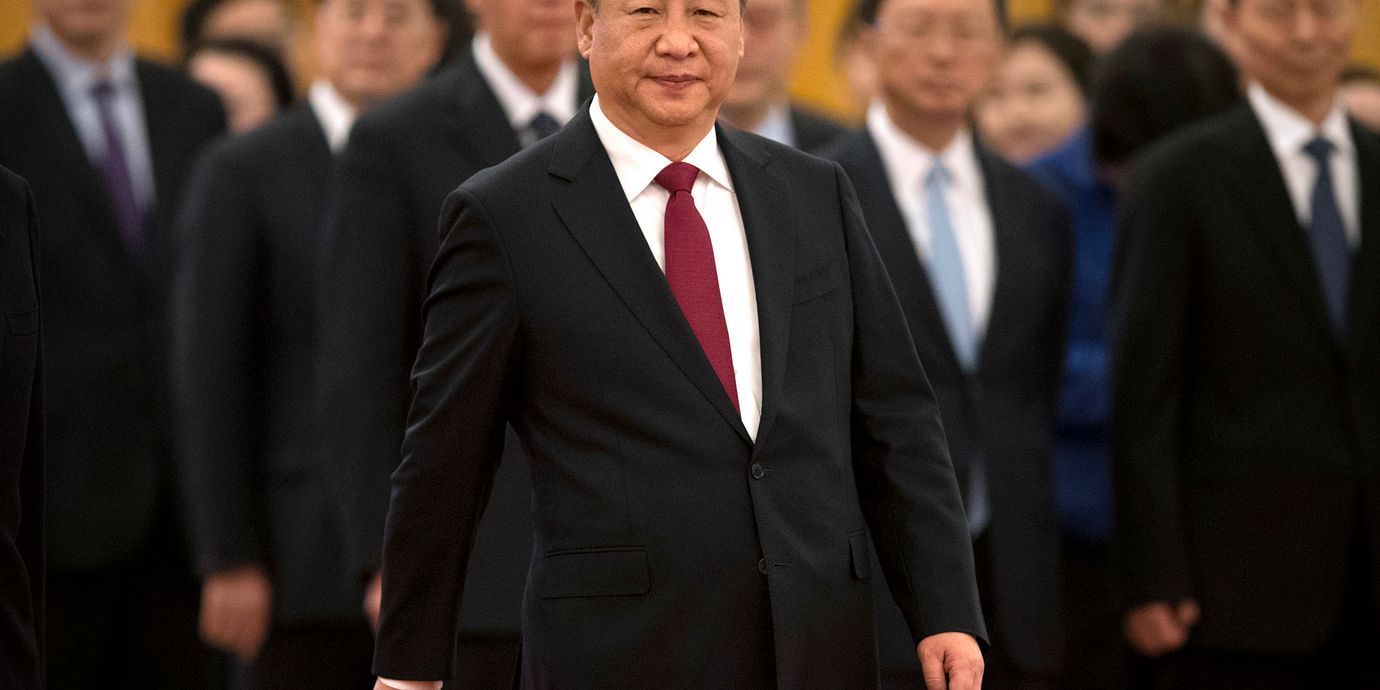
The CPC is, officially, organized on the basis of democratic centralism, a principle conceived by Russian Marxist theoretician Vladimir Lenin which entails democratic and open discussion on policy on the condition of unity in upholding the agreed upon policies. The highest body of the CPC is the National Congress, convened every fifth year. When the National Congress is not in session, the Central Committee is the highest body, but since the body meets normally only once a year, most duties and responsibilities are vested in the Politburo and its Standing Committee. The party's leader holds the offices of General Secretary (responsible for civilian party duties), Chairman of the Central Military Commission (CMC) (responsible for military affairs) and State President (a largely ceremonial position). Through these posts the party leader is the country's paramount leader. The current party leader is Xi Jinping, elected at the 18th National Congress (held in 2012).
The CPC is still committed to communist thought and continues to participate in the International Meeting of Communist and Workers' Parties each year. According to the party constitution the CPC adheres to Marxism–Leninism, Mao Zedong Thought, socialism with Chinese characteristics, Deng Xiaoping Theory, Three Represents and the Scientific Outlook on Development. The official explanation for China's economic reforms is that the country is in the primary stage of socialism, a developmental stage similar to the capitalist mode of production. The planned economy established under Mao Zedong was replaced by the socialist market economy, the current economic system, on the basis that "Practice is the Sole Criterion for the Truth" (i.e. the planned economy was deemed inefficient).
Since the collapse of Eastern European communist regimes in 1989–1990 and the dissolution of the Soviet Union in 1991, the CPC has emphasized its party-to-party relations with the ruling parties of the remaining socialist states. While the CPC still maintains party-to-party relations with non-ruling communist parties around the world, since the 1980s it has established relations with several non-communist parties, most notably with ruling parties of one-party states (whatever their ideology), dominant parties in democratic systems (whatever their ideology), and social democratic parties.
Omni är politiskt obundna och oberoende. Vi strävar efter att ge fler perspektiv på nyheterna. Har du frågor eller synpunkter kring vår rapportering? Kontakta redaktionen