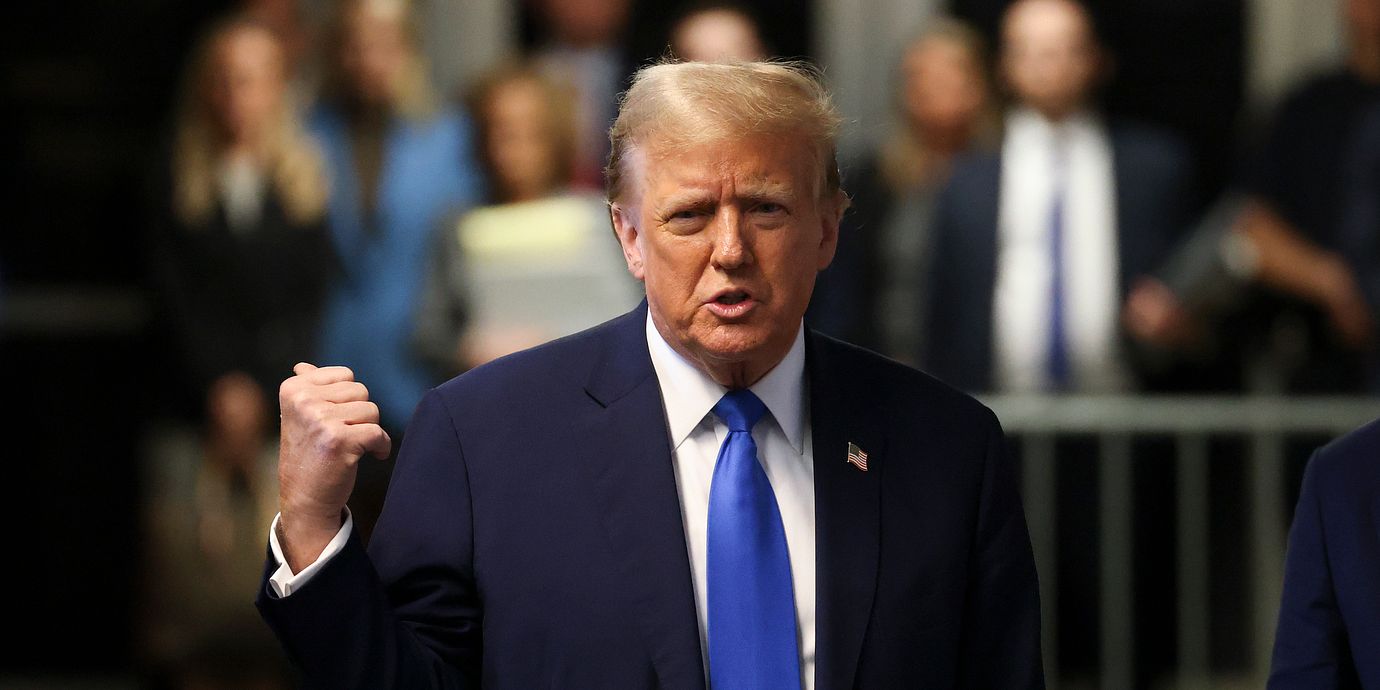
Donald Trump talade i åtta minuter utan att ta frågor efter dagens domstolsförhandling. (Yuki Iwamura / AP)

Expert: Trump kan vända utgången – om han vittnar

Det kan i slutändan bli Donald Trump själv som avgör om han fälls i fallet där han åtalas för att ha försökt dölja att kampanjpengar använts för att köpa porrstjärnan Stormy Daniels tystnad.

Det säger tidigare åklagaren Adam Kaufmann till CNN efter att både åklagarsidan och Trumps försvarsadvokater hållt sina öppningsframställanden i domstolen i Washington under kvällen, svensk tid.

Kaufmann tar fasta på att åklagarna måste övertyga alla jurymedlemmar om att Trump är skyldig. Trump måste å sin sida bara övertyga en av dem för att stoppa en fällande dom.

– Han är en övertygande person. Han behöver få en person att tro honom för att splittra juryn, och det kanske han kan åstadkomma genom att vittna själv.

Varken Donald Trump eller hans advokater har lämnat något besked om huruvida expresidenten tänker ställa sig i vittnesbåset.


bakgrund
 
Jurysystemet i USA
Wikipedia (en)
A citizen's right to a trial by jury is a central feature of the United States Constitution. It is considered a fundamental principle of the American legal system. Laws and regulations governing jury selection and conviction/acquittal requirements vary from state to state (and are not available in courts of American Samoa), but the fundamental right itself is mentioned five times in the Constitution: Once in the original text (Article III, Section 2) and four times in the Bill of Rights (in the Fifth, the Sixth, and the Seventh Amendments). The American system utilizes three types of juries: Investigative grand juries, charged with determining whether enough evidence exists to warrant a criminal indictment; petit juries (also known as a trial jury), which listen to the evidence presented during the course of a criminal trial and are charged with determining the guilt or innocence of the accused party; and civil juries, which are charged with evaluating civil lawsuits. The most outstanding feature of the U.S. system is that convictions (but not necessarily acquittals) in serious criminal cases must be unanimous, which the Supreme Court of the United States affirmed to be a constitutional guarantee in Ramos v. Louisiana (2020).
Omni är politiskt obundna och oberoende. Vi strävar efter att ge fler perspektiv på nyheterna. Har du frågor eller synpunkter kring vår rapportering? Kontakta redaktionen