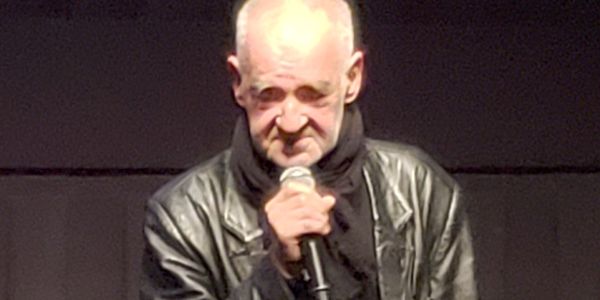
Filmregissören Béla Tarr är död – blev 70 år
Den ungerske filmregissören Béla Tarr är död, rapporterar ungerska medier. Han blev 70 år.
Tarr har gjort filmer som ”Damnation” och ”Turinhästen”, vars manus skrevs av Nobelpristagaren László Krasznahorkai. Tarr filmatiserade även Krasznahorkais roman ”Satantango” 1994 i en sju och en halv timme lång version.
”Turinhästen” tilldelades Silverbjörnen vid Berlins filmfestival 2011 och blev Tarrs sista film.
bakgrund
Béla Tarr
Wikipedia (en)
Béla Tarr (21 July 1955 – 6 January 2026) was an Hungarian filmmaker. Debuting with the film Family Nest (1979), Tarr began his directorial career with a brief period of what he refers to as "social cinema", aimed at telling everyday stories about ordinary people, often in the style of cinema vérité. Over the next decade, he changed the cinematic style and thematic elements of his films. Tarr has been interpreted as having a pessimistic view of humanity; the characters in his works are often cynical, and have tumultuous relationships with one another in ways critics have found to be darkly comic.
Almanac of Fall (1984) follows the inhabitants of a run-down apartment as they struggle to live together while sharing their hostilities. The drama Damnation (1988) was lauded for its languid and controlled camera movement, which Tarr would become known for internationally. Sátántangó (1994) and Werckmeister Harmonies (2000) continued his bleak and desolate representations of reality, while incorporating apocalyptic overtones. The former sometimes appears in scholarly polls of the greatest films ever made, and the latter received wide acclaim from critics. Tarr would later compete at the 2007 Cannes Film Festival with his film The Man from London, which opened to moderately positive reviews.
Director Béla Tarr was Hranitzky’s partner in life and work (film editor and co-director) since they met in 1978 until 2012.
Besides her, Tarr also collaborated with Nobel-prize winner novelist László Krasznahorkai, film composer Mihály Víg, cinematographer Fred Kelemen, and actress Erika Bók.
After the release of his film The Turin Horse (2011), which made many year-end "best-of" critics' lists, Tarr announced his retirement from feature-length film direction. In February 2012 he moved to Sarajevo and in 2013 started an international film school known as film.factory, and has lived between Budapest and Sarajevo ever since. Lauded as one of the most exciting film schools in the world, it has practiced an unconventional and open study format with renowned international film artists as teachers (Apichatpong Weerasethakul, Carlos Reygadas, Pedro Costa, Gus van Sant, Tilda Swinton, Juliette Binoche, Jacques Rancière, and others), and with students coming from all over the world. Bistrik 7 is an international film collective formed by the film.factory students. Besides the educational work, he has continued to develop his artistic projects in media beyond or in an expanded film form. In 2017 at Eye Filmmuseum, Amsterdam, he developed an exhibition, Till the End of the World, a cross between a film, a theatre set and an installation, seen by 40.000 visitors. Commissioned by the Wiener Festwochen, in 2019 he authored Missing People, a site-specific project created at the intersection between performance, installation, and motion picture, involving 250 Viennese homeless people.
Omni är politiskt obundna och oberoende. Vi strävar efter att ge fler perspektiv på nyheterna. Har du frågor eller synpunkter kring vår rapportering? Kontakta redaktionen