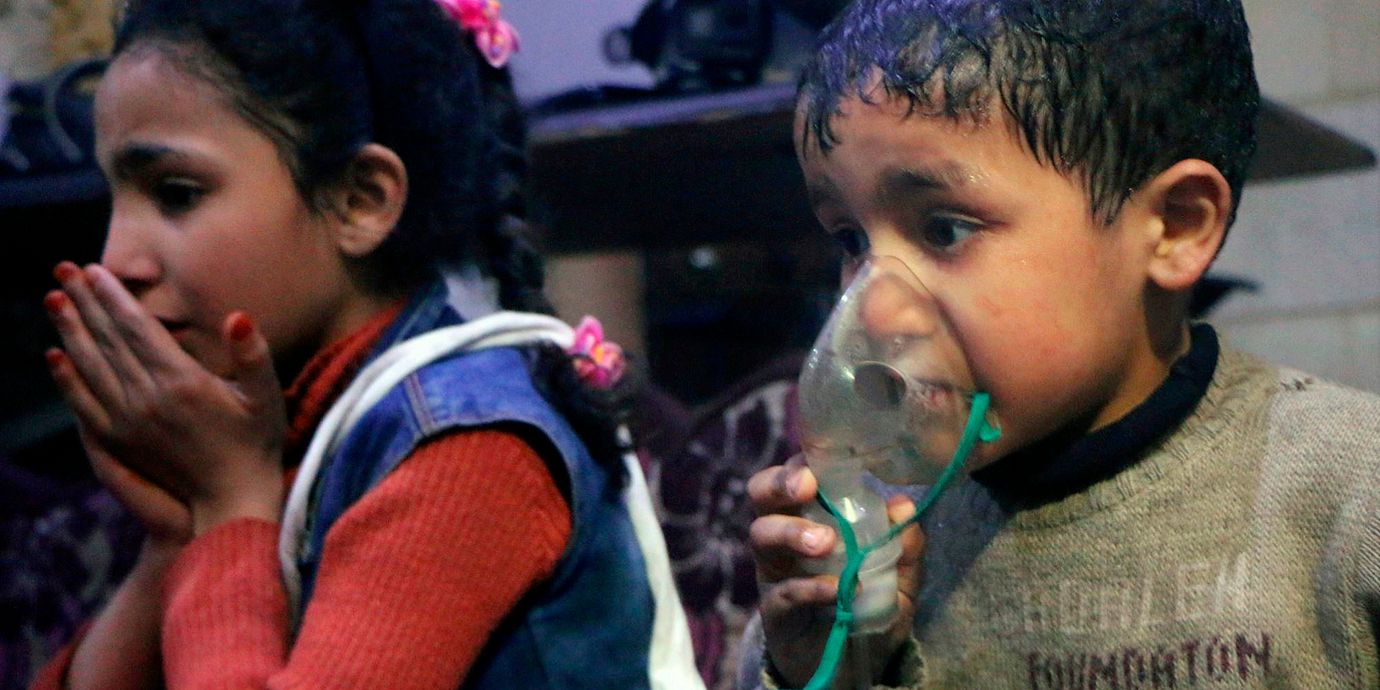
Ny rapport: Regimen låg bakom kemvapenattacker
Bashar al-Assads regim låg bakom kemvapenattacker mot civila i Syrien under inbördeskriget. Det fastslår Organisationen för förbud mot kemiska vapen (OPCW) i en kommande rapport, skriver The Guardian.
Rapporten väntas presenteras på onsdag, nära årsdagarna för två attacker: en klorattack i den då rebellkontrollerade Damaskusförorten Douma 2018 då 85 människor dog , samt en sarinattack i Khan Sheikhun 2017 då 89 personer dog.
OPCW har tidigare inte fått fördela skuld i frågan, men har fått större befogenheter att utreda kemvapenattacker i Syrien tack vare en FN-resolution.
bakgrund
Kemvapenattacken i Douma
Wikipedia (en)
On 7 April 2018, a chemical warfare attack was carried out in the Syrian city of Douma. Medics and witnesses reported that it caused the deaths of between 40 and 50 people and injuries to possibly well over 100. The attack was attributed to the Syrian Army by rebel forces in Douma, and by the United States, British, and French governments. The Syrian and Russian governments asserted that a widely-circulated video allegedly showing the aftermath of the attack was staged.On 14 April 2018, the United States, France and the United Kingdom carried out a series of military strikes against multiple government sites in Syria.
On 6 July 2018, an interim report was issued by the Organisation for the Prohibition of Chemical Weapons (OPCW). Various chlorinated organic chemicals (dichloroacetic acid, trichloroacetic acid, chlorophenol, dichlorophenol, bornyl chloride, chloral hydrate etc.) were found in samples, along with residues of explosive, but the designated laboratory 03 stated that no CWC-scheduled chemicals or nerve agent related chemicals were detected. In September 2018 the UN Commission of Enquiry on Syria reported: "Throughout 7 April, numerous aerial attacks were carried out in Douma, striking various residential areas. A vast body of evidence collected by the Commission suggests that, at approximately 7.30 p.m., a gas cylinder containing a chlorine payload delivered by helicopter struck a multi-storey residential apartment building located approximately 100 metres south-west of Shohada square. The Commission received information on the death of at least 49 individuals, and the wounding of up to 650 others."While it was initially unclear which chemicals had been used, in 2019 the OPCW FFM (Fact-Finding Mission) report concluded: "Regarding the alleged use of toxic chemicals as a weapon on 7 April 2018 in Douma, the Syrian Arab Republic, the evaluation and analysis of all the information gathered by the FFM—witnesses’ testimonies, environmental and biomedical samples analysis results, toxicological and ballistic analyses from experts, additional digital information from witnesses—provide reasonable grounds that the use of a toxic chemical as a weapon took place. This toxic chemical contained reactive chlorine. The toxic chemical was likely molecular chlorine." The OPCW said it found no evidence to support the government's claim that a local facility was being used by rebel fighters to produce chemical weapons.
Omni är politiskt obundna och oberoende. Vi strävar efter att ge fler perspektiv på nyheterna. Har du frågor eller synpunkter kring vår rapportering? Kontakta redaktionen