Sexslavsstaty utlöser kris mellan Japan och Sydkorea
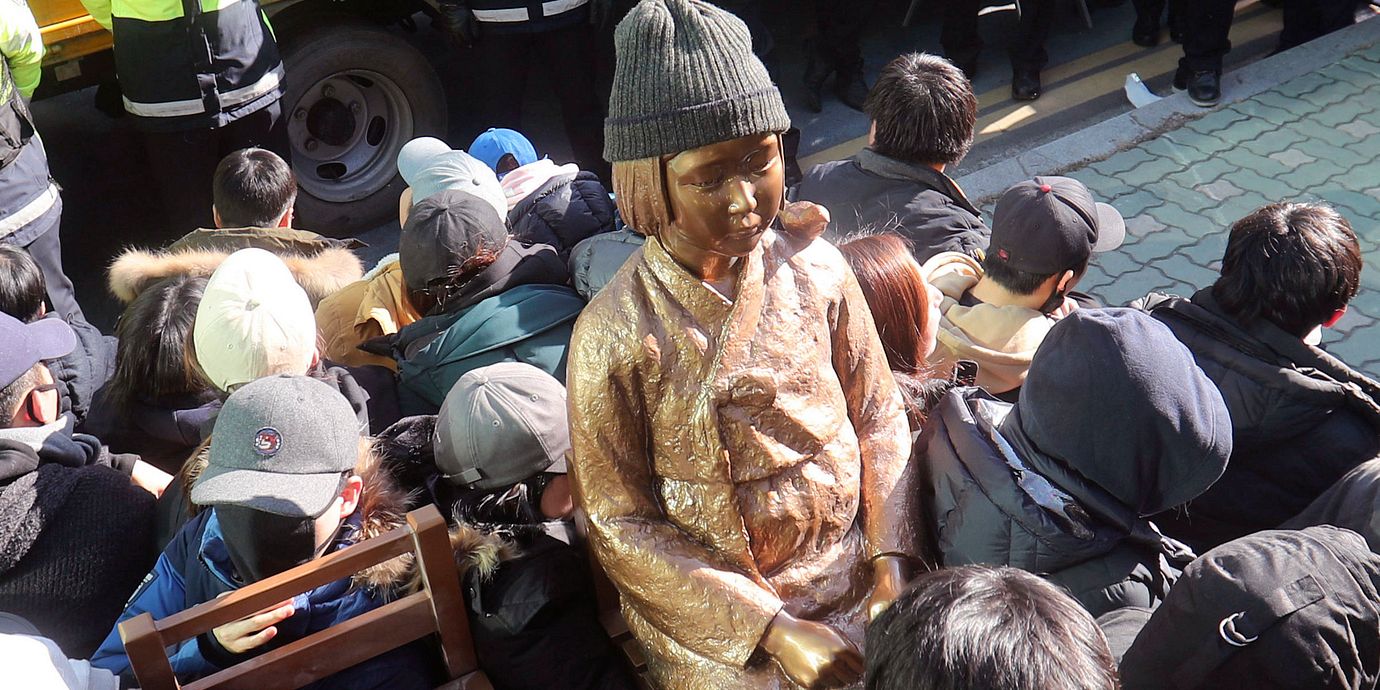
En staty utanför Japans konsulat i den sydkoreanska staden Busan har lett till kraftiga reaktioner i Japan, som nu kallar hem sin ambassadör.
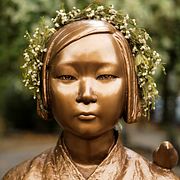
Bronsmonumentet, som är en avbildning av en kvinna i traditionella koreanska kläder som sitter i en stol, är ett minnesmärke över de koreanska kvinnor som utnyttjades som sexslavar på japanska bordeller under andra världskriget.
Frågan om sexslavar har i många år plågat relationerna mellan de båda länderna. För drygt ett år sedan bad Japan om ursäkt för övergreppen och lovade ersätta offren, men kritiker anser inte att det räcker.
bakgrund
Relationerna mellan Japan och Sydkorea
Wikipedia (en)
After the division of Korea, Japan and the Republic of Korea (ROK) had established diplomatic relations in December 1965, under the Treaty on Basic Relations between Japan and the Republic of Korea, with Japan recognizing South Korea as the only legitimate government of the whole Korean peninsula.
Japan and South Korea are close neighbors. The Ministry of Foreign Affairs of Japan explains that ROK is 'Japan’s most important neighbor that shares strategic interests with Japan.' In recent years, however, the relationship has greatly deteriorated due to many disputes, including the territorial claims on Liancourt Rocks (Dokdo or Takeshima), Japanese prime ministers' visits to Yasukuni Shrine, and differing views on Imperial Japan's treatment of colonial Korea, as well as Japan's refusal to negotiate Korea's demands that it apologize or pay reparations for mistreatment of World War II comfort women from Korea. These tensions have complicated American efforts to promote a common front against Chinese threats in the region.
According to a 2014 BBC World Service Poll, 13% of Japanese view South Korea's influence positively, with 37% expressing a negative view, while 15% of South Koreans view Japanese influence positively, with 79% expressing negatively, making South Korea, after China, the country with the second most negative perception of Japan in the world.
bakgrund
Tröstekvinnor
Wikipedia (en)
Comfort women were women and girls who were forced into sexual slavery by the Imperial Japanese Army in occupied territories before and during World War II.
The name "comfort women" is a translation of the Japanese ianfu (慰安婦), a euphemism for "prostitute(s)". Estimates vary as to how many women were involved, with numbers ranging from as low as 20,000 (by Japanese historian Ikuhiko Hata) to as high as 360,000 to 410,000 (by a Chinese scholar); the exact numbers are still being researched and debated. Most of the women were from occupied countries, including Korea, China, and the Philippines, although women were used for military "comfort stations" from Burma, Thailand, Vietnam, Malaysia, Taiwan (then a Japanese dependency), Indonesia (then the Dutch East Indies), East Timor (then Portuguese Timor), and other Japanese-occupied territories. Stations were located in Japan, China, the Philippines, Indonesia, then Malaya, Thailand, Burma, New Guinea, Hong Kong, Macau, and French Indochina. A smaller number of women of European origin were also involved from the Netherlands and Australia.
According to testimonies, young women were abducted from their homes in countries under Imperial Japanese rule. In many cases, women were also lured with promises of work in factories or restaurants; once recruited, they were incarcerated in comfort stations both inside their nations and abroad.
Omni är politiskt obundna och oberoende. Vi strävar efter att ge fler perspektiv på nyheterna. Har du frågor eller synpunkter kring vår rapportering? Kontakta redaktionen