bakgrund
Det kambodjanska folkmordet
Wikipedia (en)
The Cambodian genocide (Khmer: របបប្រល័យពូជសាសន៍នៅកម្ពុជា) was the systematic persecution and killing of Cambodians by the Khmer Rouge under the leadership of Communist Party of Kampuchea general secretary Pol Pot, who radically pushed Cambodia towards an entirely self-sufficient agrarian socialist society. It resulted in the deaths of 1.5 to 2 million people from 1975 to 1979, nearly a quarter of Cambodia's population in 1975 (c. 7.8 million).Pol Pot and Khmer Rouge had long been supported by the Chinese Communist Party (CCP) and its chairman, Mao Zedong; it is estimated that at least 90% of the foreign aid which the Khmer Rouge received came from the People's Republic of China (PRC), and in 1975 alone, at least US$1 billion in interest-free economic and military aid came from China. After it seized power in April 1975, the Khmer Rouge wanted to turn the country into an agrarian socialist republic, founded on the policies of ultra-Maoism and influenced by the Cultural Revolution. Pol Pot and other Khmer Rouge officials met with Mao in Beijing in June 1975, receiving approval and advice, while high-ranking CCP officials such as CCP Politburo Standing Committee member Zhang Chunqiao later visited Cambodia to offer help. To fulfill its goals, the Khmer Rouge emptied the cities and forced Cambodians to relocate to labor camps in the countryside, where mass executions, forced labor, physical abuse, malnutrition, and disease were rampant. In 1976, the Khmer Rouge renamed the country Democratic Kampuchea.
The massacres ended when the Vietnamese military invaded in 1978 and toppled the Khmer Rouge regime. By January 1979, 1.5 to 2 million people had died due to the Khmer Rouge's policies, including 200,000–300,000 Chinese Cambodians, 90,000–500,000 Cambodian Cham (who are mostly Muslim), and 20,000 Vietnamese Cambodians. 20,000 people passed through the Security Prison 21, one of the 196 prisons the Khmer Rouge operated, and only seven adults survived. The prisoners were taken to the Killing Fields, where they were executed (often with pickaxes, to save bullets) and buried in mass graves. Abduction and indoctrination of children was widespread, and many were persuaded or forced to commit atrocities. As of 2009, the Documentation Center of Cambodia has mapped 23,745 mass graves containing approximately 1.3 million suspected victims of execution. Direct execution is believed to account for up to 60% of the genocide's death toll, with other victims succumbing to starvation, exhaustion, or disease.
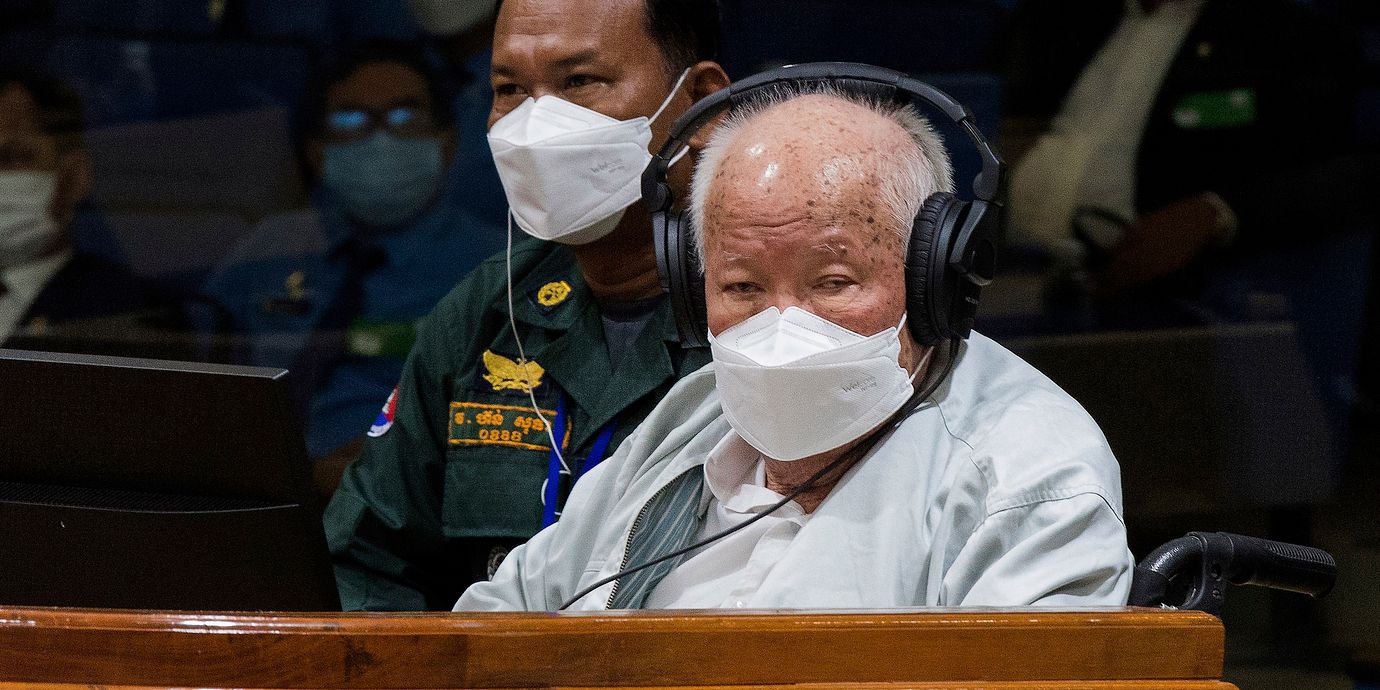
The genocide triggered a second outflow of refugees, many of whom escaped to neighboring Thailand and, to a lesser extent, Vietnam. The Vietnamese invasion of Cambodia ended the genocide by defeating the Khmer Rouge in January 1979. On 2 January 2001, the Cambodian government established the Khmer Rouge Tribunal to try the members of the Khmer Rouge leadership responsible for the Cambodian genocide. Trials began on 17 February 2009. On 7 August 2014, Nuon Chea and Khieu Samphan were convicted and received life sentences for crimes against humanity committed during the genocide.