87-årig senator har testat positivt för coronaviruset
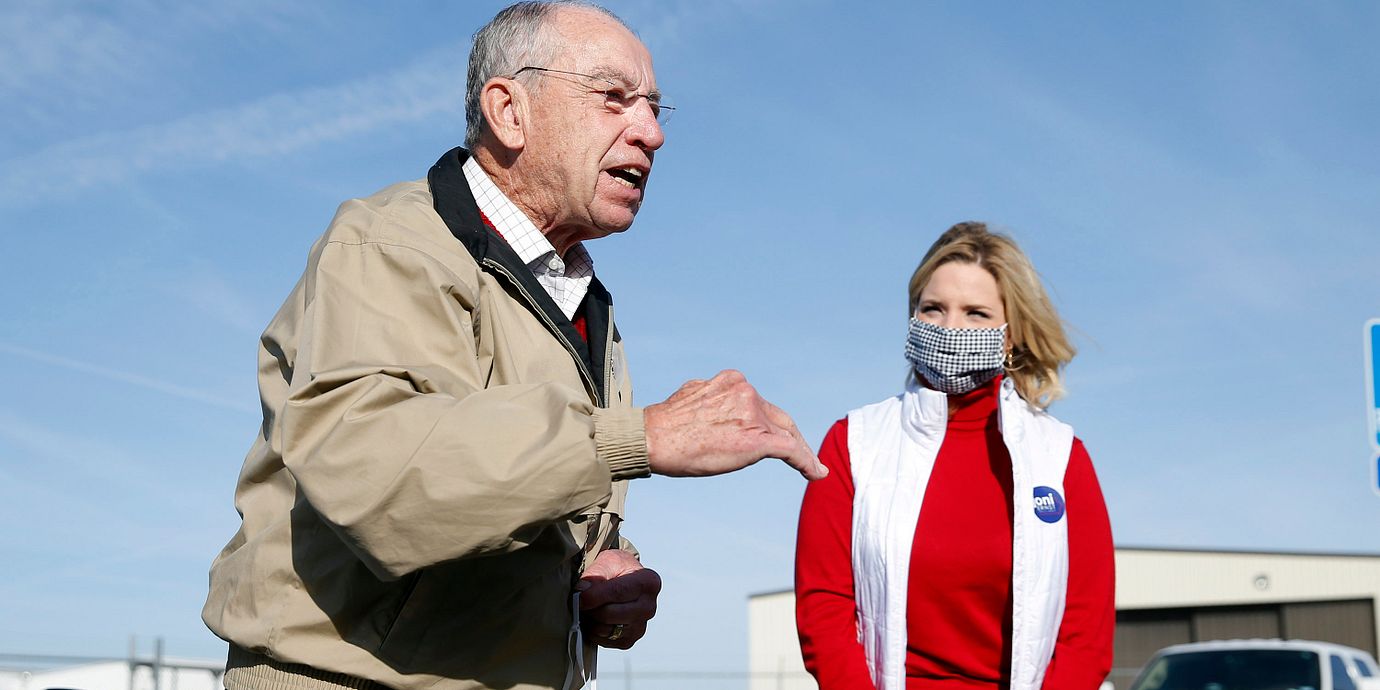
Den amerikanske senatorn Chuck Grassley har testat positivt för coronaviruset. Grassley skriver på Twitter att han mår bra och att han kommer att arbeta hemifrån.
Republikanen Grassley är med sina 87 år den näst äldsta ledamoten i den amerikanska senaten. Han är den högst uppsatta ledamoten näst efter vicepresident Mike Pence och är därmed nummer tre i successionsordningen att efterträda presidenten om något skulle hända, efter Pence och Nancy Pelosi.
Så sent som i måndags höll Grassley ett anförande i senaten, utan att bära munskydd, skriver Bloomberg.
bakgrund
Successionsordningen för USA:s president
Wikipedia (en)
The United States presidential line of succession is the order in which officials of the United States federal government assume the powers and duties of the office of president of the United States if the incumbent president becomes incapacitated, dies, resigns, or is removed from office. The order of succession specifies that the office passes to the vice president; if the vice presidency is simultaneously vacant, or if the vice president is also incapacitated, the powers and duties of the presidency pass to the speaker of the House of Representatives, president pro tempore of the Senate, and then Cabinet secretaries, depending on eligibility.
Presidential succession is referred to multiple times in the U.S. Constitution – Article II, Section 1, Clause 6, as well as the 12th Amendment, 20th Amendment, and 25th Amendment. The vice president is designated as first in the presidential line of succession by the Article II succession clause, which also authorizes Congress to provide for a line of succession beyond the vice president; it has done so on three occasions. The current Presidential Succession Act was adopted in 1947, and last revised in 2006. The 25th Amendment also establishes procedures for filling an intra-term vacancy in the office of the vice president.
The Presidential Succession Act refers specifically to officers beyond the vice president acting as president rather than becoming president when filling a vacancy. The Cabinet currently has 15 members, of which the secretary of state is first in line; the other Cabinet secretaries follow in the order of when their departments (or the department of which their department is the successor) were created. Those heads of department who are constitutionally ineligible to be elected to the presidency are disqualified from assuming the powers and duties of the president through succession, and skipped to the next in line. Since 1789, the vice president has succeeded to the presidency intra-term on nine occasions: eight times due to the incumbent's death, and once due to resignation. No one lower in the line of succession has ever been called upon to act as president.
Widely considered a settled issue during the late 20th century, the terrorist attacks of September 11, 2001 demonstrated the potential for a decapitation strike that would kill or incapacitate multiple individuals in the presidential line of succession in addition to many members of Congress and the federal judiciary. In the years immediately following the attacks, numerous wide-ranging discussions were started, in Congress, among academics and within the public policy community about continuity of government concerns including the existing constitutional and statutory provisions governing presidential succession. These discussions remain ongoing. One effort put forward by the Continuity of Government Commission, a nonpartisan think tank, produced three reports (2003, 2009 and 2011), the second of which focused on the implicit ambiguities and limitations in the current succession act, and contained recommendations for amending the laws for succession to the presidency.
Omni är politiskt obundna och oberoende. Vi strävar efter att ge fler perspektiv på nyheterna. Har du frågor eller synpunkter kring vår rapportering? Kontakta redaktionen