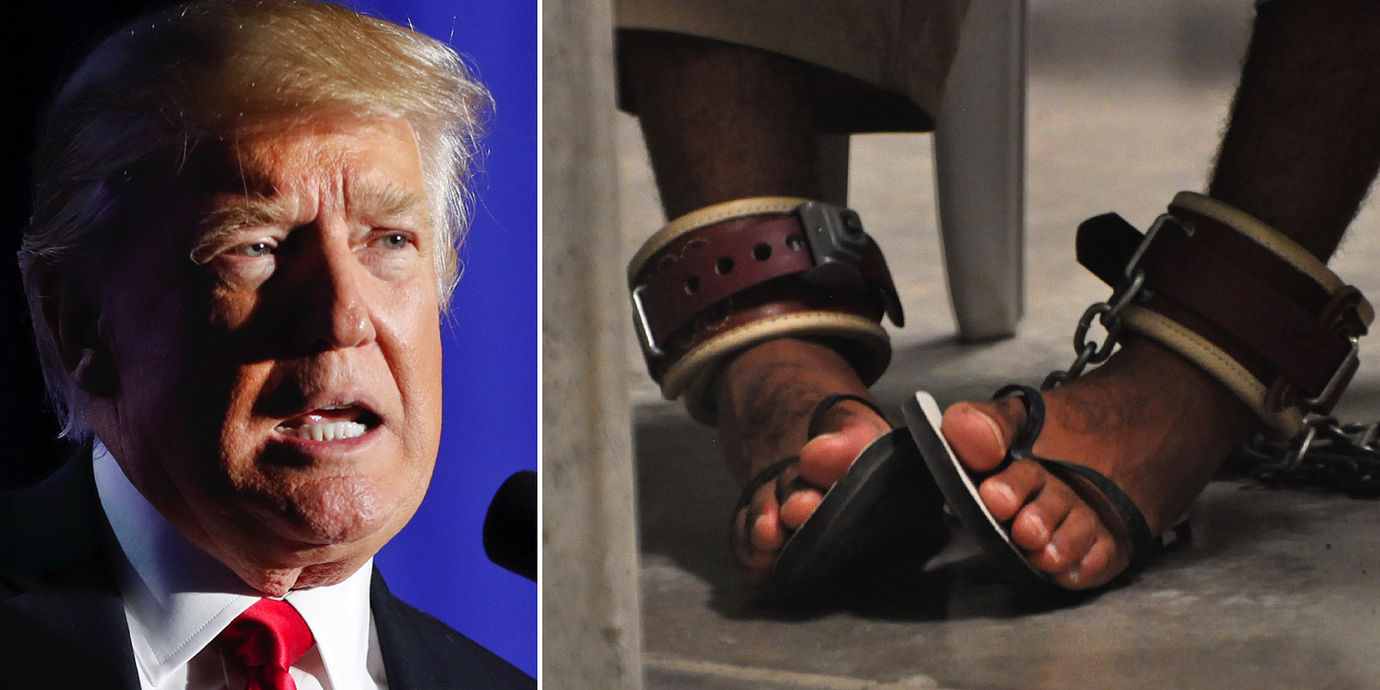
Trump om skendränkning: Tror definitivt det fungerar
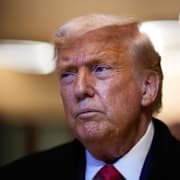
I en intervju med ABC News säger USA:s president Donald Trump att han tror att det är effektivt att använda skendränkning som förhörsmetod.
Han säger att han talat med personer inom underrättelsetjänsten ”så sent som för 24 timmar sedan”.
– Jag frågade dem: Fungerar det, fungerar tortyr? Och svaret var: Ja, absolut, säger han i intervjun.
På frågan om han kommer att införa skendränkning, som normalt klassas som tortyr, säger han att han kommer att lyssna på vad hans försvarsminister James Mattis och CIA-chefen Mike Pompeo säger.
– Jag kommer att lita på dem.
bakgrund
Skendränkning kan leda till hjärnskador, lungskador och till och med döden
Wikipedia (en)
Waterboarding is a form of water torture in which water is poured over a cloth covering the face and breathing passages of an immobilized captive, causing the individual to experience the sensation of drowning. Waterboarding can cause extreme pain, dry drowning, damage to lungs, brain damage from oxygen deprivation, other physical injuries including broken bones due to struggling against restraints, lasting psychological damage, and death. Adverse physical consequences can manifest themselves months after the event, while psychological effects can last for years.
In the most common method of waterboarding, the captive's face is covered with cloth or some other thin material, and the subject is immobilized on their back at an incline of 10 to 20 degrees. Torturers pour water onto the face over the breathing passages, causing an almost immediate gag reflex and creating a drowning sensation for the captive. Vomitus travels up the esophagus, which may then be inhaled. Victims of waterboarding are at extreme risk of sudden death due to the aspiration of vomitus.
The term water board torture appeared in press reports as early as 1976. In late 2007, it was widely reported that the United States Central Intelligence Agency (CIA) was waterboarding extrajudicial prisoners and that the Office of Legal Counsel, Department of Justice, had authorized the procedure among enhanced interrogation techniques. The CIA confirmed having waterboarded three Al-Qaeda suspects: Abu Zubaydah, Khalid Sheikh Mohammed, and Abd al-Rahim al-Nashiri, in 2002 and 2003.
In August 2002 and March 2003, in its war on terror, the George W. Bush administration, through Jay S. Bybee, the Office of Legal Counsel, Department of Justice, issued what became known as the Torture Memos after being leaked in 2004. These legal opinions (including the 2002 Bybee memo) argued for a narrow definition of torture under US law. The first three were addressed to the CIA, which took them as authority to use the described enhanced interrogation techniques (more generally classified as torture) on detainees classified as enemy combatants. Five days before the March 2003 invasion of Iraq, John Yoo, the acting Office of Legal Counsel, issued a fourth memo to the General Counsel of DOD, concluding his legal opinion by saying that federal laws related to torture and other abuse did not apply to interrogations overseas. The legal opinions were withdrawn by Jack Goldsmith of the OLC in June 2004 but reaffirmed by the succeeding head of the OLC in December 2004. US government officials at various times said they did not believe waterboarding to be a form of torture.
In 2006, the Bush administration banned torture including waterboarding on detainees. In January 2009, U.S. President Barack Obama issued a similar ban on the use of waterboarding and other forms of torture in interrogations of detainees. In April 2009, the U.S. Department of Defense refused to say whether waterboarding is still used for training (e.g., SERE) US military personnel in resistance to interrogation.
In December 2014, the Senate Select Committee on Intelligence issued a declassified 500 page summary of its still classified 6,700 page report on the Central Intelligence Agency (CIA) Detention and Interrogation Program. The report concluded that "the CIA's use of enhanced interrogation techniques (EIT) was not effective for acquiring intelligence or gaining cooperation from detainees." According to the report, the CIA had presented no credible proof that information obtained through waterboarding or the other harsh interrogation methods that the CIA employed prevented any attacks or saved any lives. There was no evidence that information obtained from the detainees through EIT was not or could not have been obtained through conventional interrogation methods.
In June 2015, in response to a critical assessment of China in the U.S. State Department's annual human rights report, China noted that the U.S., among other alleged human rights abuses, engaged in torture of terrorism suspects, specifically by waterboarding.
In 2015, various Republican presidential candidates indicated their willingness to bring back waterboarding as an interrogation technique. Donald Trump (the eventual winner of the election) stated he believed in the effectiveness of the technique. Trump also stated that it is a "minimal" form of torture, and that it was necessary. Ben Carson had not ruled out approving its use and nor did Jeb Bush. Carly Fiorina endorsed its use, as did Rick Perry and Rick Santorum.
Omni är politiskt obundna och oberoende. Vi strävar efter att ge fler perspektiv på nyheterna. Har du frågor eller synpunkter kring vår rapportering? Kontakta redaktionen