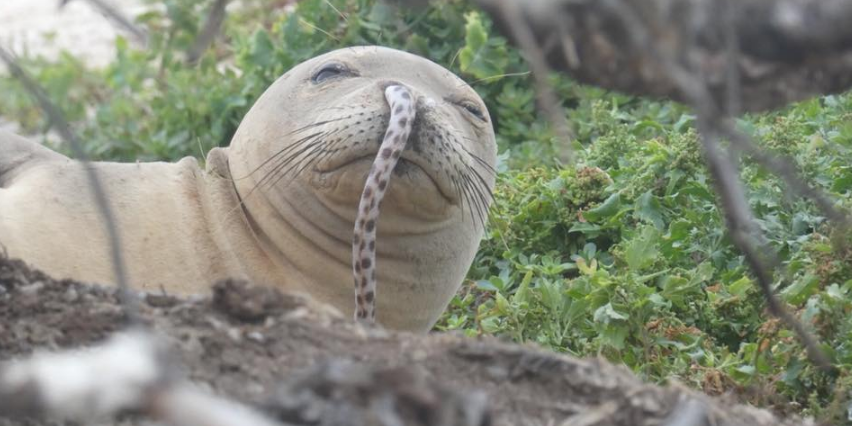
Sälar med ålar i näsan förbryllar forskare
Varför har allt fler munksälar upptäckts med ålar uppstoppade i näsan? Det är ett mysterium som forskare på Hawaii nu grubblar över, rapporterar Washington Post.
Fenomenet uppmärksammandes första gången för två år sedan och sedan dess har ytterligare fyra fall rapporterats, säger munksälsforskaren Charles Littnan till tidningen.
Två teorier om vad som kan ligga bakom nästäppan har lagts fram. Forskarna tror att ålarna kan ha fastnat i sälarnas näsor när de försökt dyka ner emellan korallrev för att leta mat, eller att de kan ha hamnat i näsan när sälarna kräkts upp mat som de tidigare ätit.
bakgrund
Munksälar
Wikipedia (en)
Monk seals are earless seals of the tribe Monachini. They are the only earless seals found in tropical climates. The two genera of monk seals, Monachus and Neomonachus, comprise three species: the Mediterranean monk seal, Monachus monachus; the Hawaiian monk seal, Neomonachus schauinslandi; and the Caribbean monk seal, Neomonachus tropicalis, which became extinct in the 20th century. The two surviving species are now rare and in imminent danger of extinction. All three monk seal species were classified in genus Monachus until 2014, when the Caribbean and Hawaiian species were placed into a new genus, Neomonachus.
Monk seals have a slender body and are agile. They have a broad, flat snout with nostrils on the top. Monk seals are polygynous, and group together in harems. They feed mainly on bony fish and cephalopods, but they are opportunistic. The skin is covered in small hairs, which are generally black in males and brown or dark gray in females. Monk seals are found in the Hawaiian archipelago, certain areas in the Mediterranean Sea (such as Cabo Blanco and Gyaros island), and formerly in the tropical areas of the west Atlantic Ocean.
All species experienced overhunting by sealers. The Hawaiian monk seal experienced population drops in the 19th century and during World War II, and the Caribbean monk seal was exploited since the 1500s until the 1850s, when populations were too low to hunt commercially. The Mediterranean monk seal has experienced commercial hunting since the Middle Ages and eradication by fishermen. Monk seals have developed a fear of humans, and may even abandon beaches due to human presence. Currently, around 1,700 monk seals remain.
Omni är politiskt obundna och oberoende. Vi strävar efter att ge fler perspektiv på nyheterna. Har du frågor eller synpunkter kring vår rapportering? Kontakta redaktionen