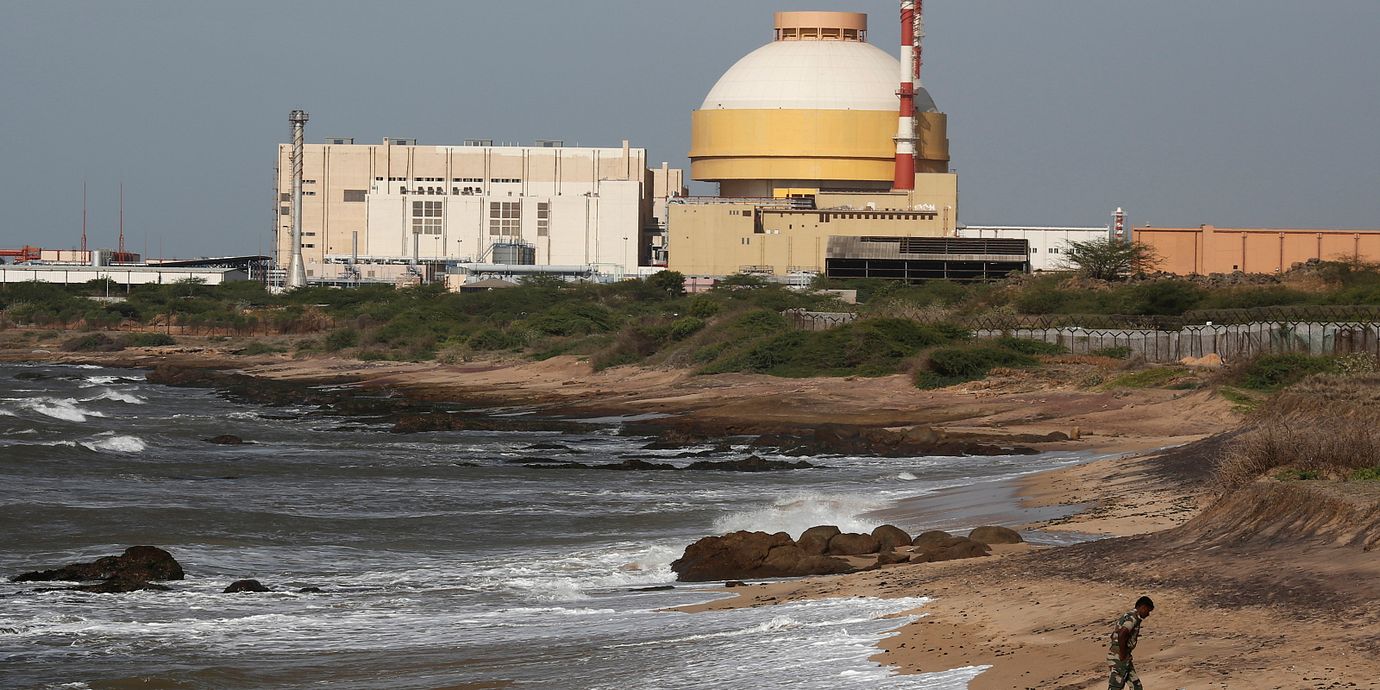
Indien letar ny mark till utbyggnad av kärnkraft
Indien utforskar nya platser som kan anses lämpliga att uppföra kärnkraftverk på, efter att man stött på motstånd från lokalbefolkning på flera av de befintliga platserna på listan. Det uppger en regeringstjänsteman för Bloomberg. Dessutom har leverantörer som General Electric och Toshiba avskräckts av en omdebbaterad lagändring som stärkt skadeståndsansvaret.
bakgrund
Nuclear Liability Act
Wikipedia (en)
The Civil Liability for Nuclear Damage Act, 2010 or Nuclear Liability Act is a highly debated and controversial Act which was passed by both houses of Indian parliament. The Act aims to provide a civil liability for nuclear damage and prompt compensation to the victims of a nuclear incident through a nofault liability to the operator, appointment of Claims Commissioner, establishment of Nuclear Damage Claims Commission and for matters connected therewith or incidental thereto.
This is one of the last steps needed to activate the 2008 Indo-U.S. civilian nuclear agreement as the United state nuclear reactor manufacturing companies will require the liability bill to get insurance in their home state. After this Act was passed, India became a member of the international convention on liability in the civil nuclear arena.
The government has encountered fierce opposition when trying to push this bill through parliament on several occasions. This is because it contains several controversial clauses that the opposition parties claim to be 'unconstitutional'. The opposition believes the bill is being pushed through due to US pressure though this is denied by the government.
The Act effectively caps the maximum amount of liability in case of each nuclear accident at ₹5 billion (US$74 million) to be paid by the operator of the nuclear plant, and if the cost of the damages exceeds this amount, special drawing rights up to 300 million will be paid by the Central Government.
The Act made amendments in the Atomic Energy Act 1962 allowing private investment in the Indian nuclear power program. The issue of an accident is sensitive in India, where a gas leak in a US company's Union Carbide factory in Bhopal city killed about 20,000 people in 1984 in one of the world's worst industrial disasters. The Act came into force from 11 November 2011.
bakgrund
Kärnkraft i Indien
Wikipedia (en)
Nuclear power is the fourth-largest source of electricity in India after thermal, hydroelectric and renewable sources of electricity. As of 2016, India has 21 nuclear reactors in operation in 7 nuclear power plants, having an installed capacity of 6780 MW and producing a total of 30,292.91 GWh of electricity while 6 more reactors are under construction and are expected to generate an additional 4,300 MW.
In October 2010, India drew up "an ambitious plan to reach a nuclear power capacity of 63,000 MW in 2032", but, after the 2011 Fukushima nuclear disaster in Japan, "populations around proposed Indian NPP sites have launched protests, raising questions about atomic energy as a clean and safe alternative to fossil fuels". There have been mass protests against the French-backed 9900 MW Jaitapur Nuclear Power Project in Maharashtra and the Russian-backed 2000 MW Kudankulam Nuclear Power Plant in Tamil Nadu. The state government of West Bengal state has also refused permission to a proposed 6000 MW facility near the town of Haripur that intended to host six Russian reactors. A Public Interest Litigation (PIL) has also been filed against the government’s civil nuclear programme at the Supreme Court.
Despite this opposition, the capacity factor of Indian reactors was at 79% in the year 2011-12 compared to 71% in 2010-11. Nine out of twenty Indian reactors recorded an unprecedented 97% capacity factor during 2011-12. With the imported uranium from France, the 220 MW Kakrapar 2 PHWR reactors recorded 99% capacity factor during 2011-12. The Availability factor for the year 2011-12 was at 89%.
India has been making advances in the field of thorium-based fuels, working to design and develop a prototype for an atomic reactor using thorium and low-enriched uranium, a key part of India's three stage nuclear power programme. The country has also recently re-initiated its involvement in the LENR research activities, in addition to supporting work done in the fusion power area through the ITER initiative.
Omni är politiskt obundna och oberoende. Vi strävar efter att ge fler perspektiv på nyheterna. Har du frågor eller synpunkter kring vår rapportering? Kontakta redaktionen