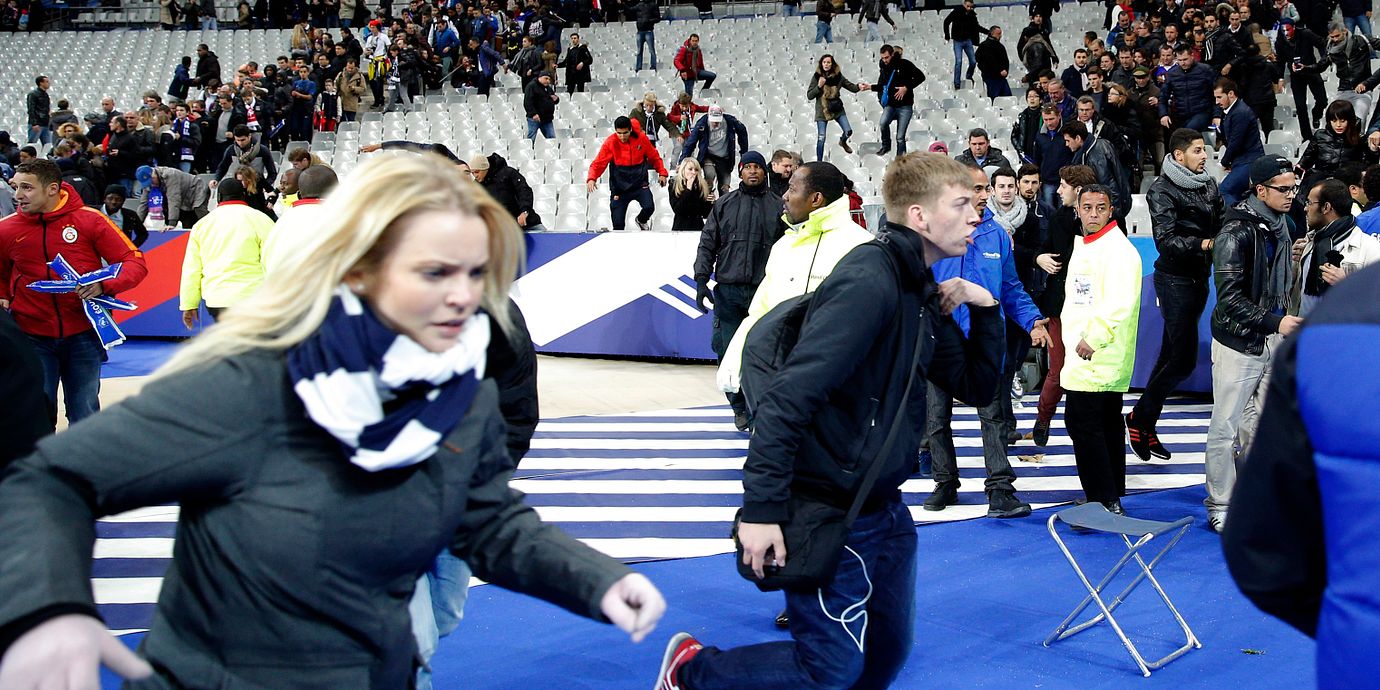
Mohamed träffades av projektiler från bombbältet
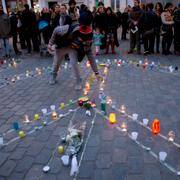
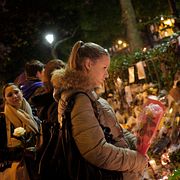
Paris hedrar i dag de döda i fjolårets terrordåd när president François Hollande och stadens borgmästare Anne Hidalgo avtäcker minnesplaketter på brottsplatserna. Expressen Geo har pratat med flera överlevande från attackerna. En av dem var Mohamed, 47, som arbetade som arenavärd på fotbollslandskampen mellan Frankrike och Tyskland på Stade de France. När bombbältet exploderade tio meter från där han stod träffades han av kroppsvätskor från självmordsbombaren och flera projektiler av metall som mörbultade hans kropp.
– Det hade räckt med att en av projektilerna hade haft en liten annan vinkel mot mitt huvud för att jag skulle ha dött. Men Gud ville inte att jag skulle dö just den kvällen, säger Mohamed.
bakgrund
Parisattackerna
Wikipedia (en)
The November 2015 Paris attacks were a series of coordinated terrorist attacks that occurred on Friday 13 November 2015 in Paris, France and the city's northern suburb, Saint-Denis. Beginning at 21:16 CET, three suicide bombers struck outside the Stade de France in Saint-Denis, during a football match. This was followed by several mass shootings, and a suicide bombing, at cafés and restaurants. Gunmen carried out another mass shooting and took hostages at an Eagles of Death Metal concert in the Bataclan theatre, leading to a stand-off with police. The attackers were shot or blew themselves up when police raided the theatre.
The attackers killed 130 people, including 89 at the Bataclan theatre. Another 368 people were injured, 80–99 seriously. Seven of the attackers also died, while the authorities continued to search for accomplices. The attacks were the deadliest on France since World War II, and the deadliest in the European Union since the Madrid train bombings in 2004. France had been on high alert since the January 2015 attacks on Charlie Hebdo offices and a Jewish supermarket in Paris that killed 17 people and wounded 22, including civilians and police officers.
The Islamic State of Iraq and the Levant (ISIL) claimed responsibility for the attacks, saying that it was retaliation for the French airstrikes on ISIL targets in Syria and Iraq. The President of France, François Hollande, said the attacks were an act of war by ISIL planned in Syria, organised in Belgium, and perpetrated with help from citizens of France. All of the known Paris attackers were EU citizens who had fought in Syria. Some of them had returned to Europe among the flow of migrants and refugees.
In response to the attacks, a three-month state of emergency was declared across the country to help fight terrorism, which involved the banning of public demonstrations, and allowing the police to carry out searches without a warrant, put anyone under house arrest without trial and block websites that encouraged acts of terrorism. On 15 November, France launched the biggest airstrike of Opération Chammal, its contribution to the anti-ISIL bombing campaign, striking ISIL targets in Al-Raqqah. On 18 November, the suspected lead operative of the attacks, Abdelhamid Abaaoud, was killed in a police raid in Saint-Denis, along with two others.
Omni är politiskt obundna och oberoende. Vi strävar efter att ge fler perspektiv på nyheterna. Har du frågor eller synpunkter kring vår rapportering? Kontakta redaktionen