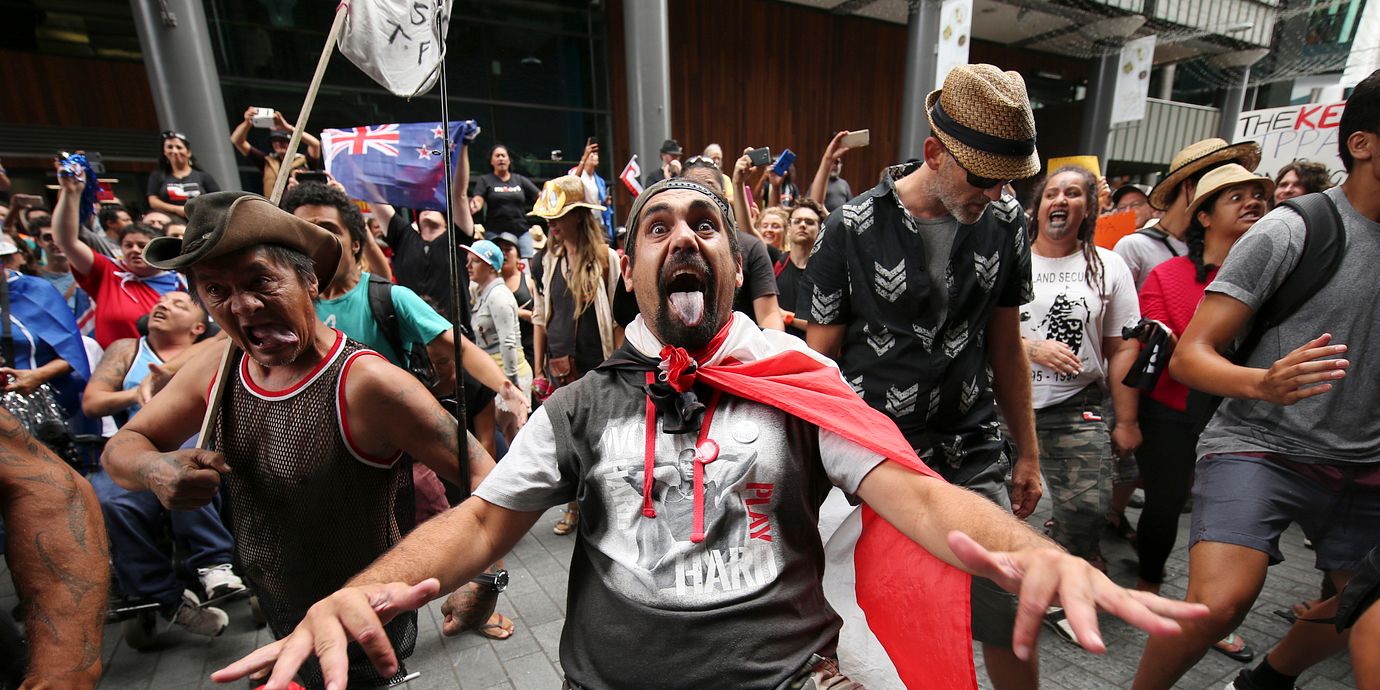
Protester när kontroversiellt handelsavtal undertecknades
Ministrar för tolv länder skrev på torsdagen under handelsavtalet för Stilla havsområdet (TPP) i Auckland, Nya Zeeland. USA president Barack Obama uttryckte i ett uttalande glädje över att man kommit så långt i processen.
– I dagsläget medför reglerna för global handel ofta nackdelar för våra arbetare och företag. TPP kommer att förändra det.
Handelsavtalet är inte okontroversiellt och har varit under förhandling i fem års tid. Bland annat har läckta dokument från Wikileaks avslöjat detaljer ur TPP som i sin tur lett till protester mot miljöpåverkan, industrins ökade makt över mänskliga värden och oro för att handelsavtalet ska leda till ökade ekonomiska klyftor.
På torsdagen hölls också omfattande demonstrationer i Auckland.
bakgrund
Trans-Pacific Partnership
Wikipedia (en)
The Trans-Pacific Partnership (TPP) is a trade agreement among twelve Pacific Rim countries concerning a variety of matters of economic policy, which was reached on 5 October 2015 after 7 years of negotiations. The agreement's stated goal had been to "promote economic growth; support the creation and retention of jobs; enhance innovation, productivity and competitiveness; raise living standards; reduce poverty in our countries; and promote transparency, good governance, and enhanced labor and environmental protections." Among other things, the TPP Agreement contains measures to lower trade barriers such as tariffs, and establish an investor-state dispute settlement mechanism (but states can opt out from tobacco-related measures). The United States government has considered the TPP as the companion agreement to the proposed Transatlantic Trade and Investment Partnership (TTIP), a broadly similar agreement between the United States and the European Union.
Historically, the TPP is an expansion of the Trans-Pacific Strategic Economic Partnership Agreement (TPSEP or P4), which was signed by Brunei, Chile, New Zealand, and Singapore in 2005. Beginning in 2008, additional countries joined the discussion for a broader agreement: Australia, Canada, Japan, Malaysia, Mexico, Peru, the United States, and Vietnam, bringing the total number of participating countries in the negotiations to twelve. Current trade agreements between participating countries, such as the North American Free Trade Agreement, will be reduced to those provisions that do not conflict with the TPP, or that provide greater trade liberalization than the TPP.
Participating nations aimed at completing negotiations in 2012, but contentious issues such as agriculture, intellectual property, and services and investments prolonged negotiations. They finally reached agreement on 5 October 2015. Implementing the TPP has been one of the trade agenda goals of the Obama administration in the US. On 5 October 2015 Canadian prime minister Stephen Harper expected "signatures on the finalized text and deal early in the new year, and ratification over the next two years." A version of the text of the treaty "Subject to Legal Review (...) for Accuracy, Clarity and Consistency" was made public on 5 November 2015, the same day President Obama notified Congress that he intends to sign it.
A number of global health professionals, internet freedom activists, environmentalists, trade unions, advocacy groups, and elected officials have criticized and protested against the treaty, in large part because of the secrecy of negotiations, the agreement's expansive scope, and controversial clauses in drafts leaked to the public.
Omni är politiskt obundna och oberoende. Vi strävar efter att ge fler perspektiv på nyheterna. Har du frågor eller synpunkter kring vår rapportering? Kontakta redaktionen