Människorättsgrupper drar Frankrike inför domstol
Två människorättsorganisationer som driver frågan om att Frankrike bör upphöra med att att sälja vapen till Förenade Arabemiraten kommer ta till rättsliga åtgärder för att stoppa exporten.
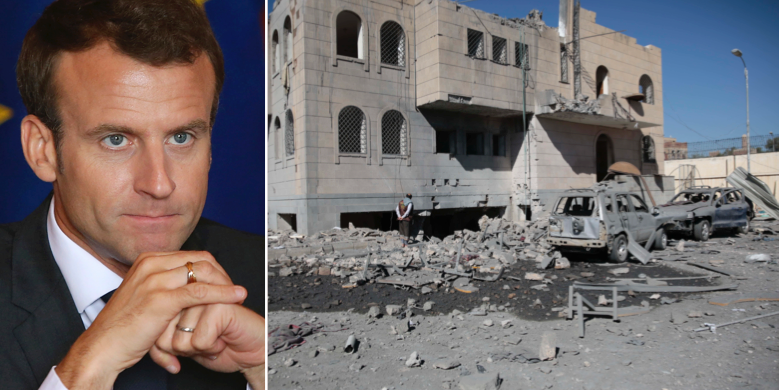
Enligt Reuters tänker organisationerna låta den franska motsvarigheten till Högsta förvaltningsdomstolen, Conseil d’Etat, avgöra om exporten är laglig. Organisationerna anser att Frankrike bryter mot såväl fransk som internationell lag genom att exportera vapen till länder som deltar i kriget i Jemen.
bakgrund
Conseil d'État (France)
Wikipedia (en)
In France, the Council of State (French: Conseil d'État [kɔ̃.sɛj de.ta]) is a body of the French national government that acts both as legal adviser of the executive branch and as the supreme court for administrative justice. Established in 1799 by Napoléon Bonaparte as a successor to the King's Council (Conseil du Roi), it is located in the Palais-Royal in Paris and is primarily made up of top-level legal officers. The Vice President of the Council of State is the highest-ranking civil servant in France.
The Conseil d'État, which is also a Grand Corps of the French State (grand corps de l'État), mainly recruits among the top ranking students graduating from the École nationale d'administration.
bakgrund
Saudi Arabian-led intervention in Yemen
Wikipedia (en)
A military intervention was launched by Saudi Arabia in 2015, leading a coalition of nine African and Middle East countries, to influence the outcome of the Yemeni Civil War in favour of the government of President Abdrabbuh Mansur Hadi. Code-named Operation Decisive Storm (Arabic: عملية عاصفة الحزم 'Amaliyyat 'Āṣifat al-Ḥazm), the intervention initially consisted of a bombing campaign on Houthi Rebels and later saw a naval blockade and the deployment of ground forces into Yemen. The Saudi-led coalition has attacked the positions of the Houthi militia and loyalists of the former President of Yemen, Ali Abdullah Saleh, allegedly supported by Iran (See Iran–Saudi Arabia proxy conflict), in response to a request from the internationally recognized government of President Abdrabbuh Mansur Hadi. The perception that Iran is directly controlling the Houthis is contradicted due to a statement made in April 2015, by National Security Council spokeswoman Bernadette Meehan: "It remains our assessment that Iran does not exert command and control over the Houthis in Yemen"
Fighter jets and ground forces from Egypt, Morocco, Jordan, Sudan, the United Arab Emirates, Kuwait, Qatar, Bahrain and Academi mercenaries also took part in the operation. Djibouti, Eritrea and Somalia made their airspace, territorial waters and military bases available to the coalition. The United States provided intelligence and logistical support, including aerial refueling and search-and-rescue for downed coalition pilots. It also accelerated the sale of weapons to coalition states. US and Britain have deployed their military personnel in the command and control centre responsible for Saudi-led air strikes on Yemen, having access to lists of targets. Pakistan was called on by Saudi Arabia to join the coalition, but its parliament voted to maintain neutrality. On 21 April 2015, the Saudi-led military coalition announced an end to Operation Decisive Storm, saying the intervention's focus would "shift from military operations to the political process". The kingdom and its coalition partners said they would be launching political and peace efforts, which they called Operation Restoring Hope (Arabic: عملية إعادة الأمل 'Amaliyyat 'I'ādat al-'Amal). However, the coalition did not rule out using force, saying it would respond to threats and prevent Houthi militants from operating within Yemen. Qatar was suspended from the coalition due to the 2017 Qatar diplomatic crisis.
The war has received widespread criticism and had a dramatic worsening effect on the humanitarian situation, that reached the level of a "humanitarian disaster" or "humanitarian catastrophe". After the Saudi-led coalition declared the entire Saada Governorate a military target, the UN's Humanitarian Coordinator for Yemen and Human Rights Watch said that air strikes by the Saudi-led coalition on Saada city in Yemen were in breach of international law. On 1 July UN declared for Yemen a "level-three" emergency – the highest UN emergency level – for a period of six months. Human rights groups repeatedly blamed the Saudi-led military coalition for killing civilians and destroying health centers and other infrastructure with airstrikes. The de facto blockade left 78% (20 million) of the Yemeni population in urgent need of food, water and medical aid. Aid ships are allowed, but the bulk of commercial shipping, on which the country relies, is blocked. In one occasion, coalition jets prevented an Iranian Red Crescent plane from landing by bombing Sana'a International Airport's runway, which blocked aid delivery via air. As of 10 December, more than 2,500,000 people had been internally displaced by the fighting. Many countries evacuated more than 23,000 foreign citizens from Yemen. More than 1,000,000 people fled Yemen for Saudi Arabia, Djibouti, Somalia, Ethiopia, Sudan and Oman. The war has caused a humanitarian crisis, including a famine which has threatened over 17 million people, as well as an outbreak of cholera which has infected thousands.
Omni är politiskt obundna och oberoende. Vi strävar efter att ge fler perspektiv på nyheterna. Har du frågor eller synpunkter kring vår rapportering? Kontakta redaktionen