Hem
ToppnyheterSenaste nytt
Bli medlem
ANNONS
ANNONS
Atlanten.
Atlanten. (Wikimedia Commons)
Klimathotet • Globala utmaningarna

Studie: Atlantströmmar kan kollapsa inom några år

Av Joel Malmén
Publicerad: 3 aug. 2024
ANNONS

Ett viktigt system av vattenströmmar i Atlanten, kallat Atlantic meridional overturning circulation (Amoc), kan kollapsa redan under 2030-talet på grund av mänsklig klimatpåverkan. Det visar en ny studie som använt sig av nyskapande beräkningsmodeller, skriver CNN.

– Det är väldigt oroväckande, säger medförfattaren René van Westen, havs- och atmosfärforskare vid universitetet i nederländska Utrecht.

Enligt studien tros Amoc kollapsa mellan 2037 och 2064. Det skulle göra delar av världen oigenkännliga – temperaturen skulle sjunka drastiskt i Europa och Nordamerika, och inom 100 år skulle de arktiska isarna ha krupit ner till södra England. I Amazonas skulle regn- och torrperioden byta plats.

Amoc är ett kretslopp som för varmt ytvatten från södra Atlanten norrut, där kallare vatten med högre salthalt i sin tur sjunker och flödar söderut.


Omni förklarar • Kan regnskogen skyddas genom att sälja sin koldioxid?

Omni Mer
ANNONS
van Westen: Klimatet kommer att bli helt förvrängt
CNN
Kan göra Europa tre grader kallare per årtionde (2 augusti)
thehill.com
bakgrund
 
Atlantic meridional overturning circulation
Wikipedia (en)
The Atlantic meridional overturning circulation (AMOC) is the main ocean current system in the Atlantic Ocean.: 2238  It is a component of Earth's ocean circulation system and plays an important role in the climate system. The AMOC includes Atlantic currents at the surface and at great depths that are driven by changes in weather, temperature and salinity. Those currents comprise half of the global thermohaline circulation that includes the flow of major ocean currents, the other half being the Southern Ocean overturning circulation. The AMOC is composed of a northward flow of warm, more saline water in the Atlantic's upper layers and a southward, return flow of cold, salty, deep water. Warm water from the south is more saline ('halocline') because of the higher evaporation rate in the tropical zone. The warm saline water forms the upper layer of the ocean ('thermocline'), but when this layer cools down, the density of the salty water increases, making it sink into the deep. This is an important part of the motor of the AMOC-system. The limbs are linked by regions of overturning in the Nordic Seas and the Southern Ocean. Overturning sites are associated with intense exchanges of heat, dissolved oxygen, carbon and other nutrients, and very important for the ocean's ecosystems and its function as a carbon sink. Changes in the strength of the AMOC can affect multiple elements of the climate system.: 2238  Climate change may weaken the AMOC through increases in ocean heat content and elevated flows of freshwater from melting ice sheets. Studies using oceanographic reconstructions suggest as of 2015, the AMOC is weaker than it was before the Industrial Revolution. There is debate over the relative contributions of different factors and it is unclear how much of this weakening is due to climate change or the circulation's natural variability over millennia. Climate models predict the AMOC will further weaken during the 21st century;: 19  this weakening would affect average air temperatures over Scandinavia and Great Britain because these regions are warmed by the North Atlantic drift. Weakening of the AMOC would also accelerate sea level rise around North America and reduce primary production in the North Atlantic. Severe weakening of the AMOC may lead to a collapse of the circulation, which would not be easily reversible and thus constitutes one of the tipping points in the climate system. A collapse would substantially lower the average temperature and amount of rain and snowfall in Europe. It may also raise the frequency of extreme weather events and have other severe effects. High-quality Earth system models indicate a collapse is unlikely and would only become probable if high levels of warming (≥4 °C (7.2 °F)) are sustained long after 2100. Some paleoceanographic research seems to support this idea. Some researchers fear the complex models are too stable and that lower-complexity projections pointing to an earlier collapse are more accurate. One of those projections suggests AMOC collapse could happen around 2057 but many scientists are skeptical of the projection. Some research also suggests the Southern Ocean overturning circulation may be more prone to collapse than the AMOC.
Annons
Förläng helgen på hotell — bo från torsdag eller fredag hos Elite Hotels och få 30% rabatt vid minst två nätter
Elite Hotels
ANNONS
Omni är politiskt obundna och oberoende. Vi strävar efter att ge fler perspektiv på nyheterna. Har du frågor eller synpunkter kring vår rapportering? Kontakta redaktionen
KlimathotetGlobala utmaningarnaKlimat & miljöForskning & vetenskap

Omni förklarar •Kan regnskogen skyddas genom att sälja sin koldioxid?

EU har öppnat för att köpa internationella koldioxidkrediter för att nå sitt klimatmål till 2040. Tanken är enkel: den som skyddar skog ska kunna få betalt för utsläppen som aldrig sker.

Omni Mer
En granskning av The Guardian visade hur företag och stiftelser erbjuder urfolk i den bolivianska Amazonas pengar för det som lokalbefolkningen beskriver som ”osynlig luft”.

FN: USA ligger ensamt bakom halva ökningen

Arbetet mot katastrofala klimatförändringar går bakåt, slår FN:s miljöprogram Unep fast i en ny rapport i dag. Experter menar att det till stor del är USA:s fel.

I dag 08.11
Republikanen Lauren Boebert bär en sjal med texten ”drill baby drill” i USA:s representanthus. Frasen har blivit ett signum för Donald Trumps energipolitik, och syftar på ökad utvinning av olja.

FN varnar: Uppvärmningen mer omfattande än väntat

Den globala uppvärmningen är mer omfattande än vad man tidigare trott, visar en ny FN-rapport under onsdagen. Även i det mest optimistiska scenariot väntas jordens medeltemperatur stiga till mellan 1,7 och 1,8 grader mer än under förindustriell tid innan 2050.

I dag 07.14
En bild från värmeböljan i London i somras.

Norge: ”Säker tillgång till vatten är en del av beredskapen”

I tider när både Ryssland och USA vill utöka sin närvaro i Arktis är det ett uttalat mål för Norges regering att Svalbard fortsätter ha en civil befolkning. Det skriver NRK, och konstaterar att vattenförsörjningen är central för att det ska vara möjligt.

19 oktober, 22.37
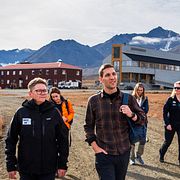
Norges klimat- och miljöminister Andreas Bjelland Eriksen vid ett besök på Svalbard tillsammans med Hege Walør Fagertun, chef för företaget Kings Bay och Geir Gotaas från norska polarinstitutet.