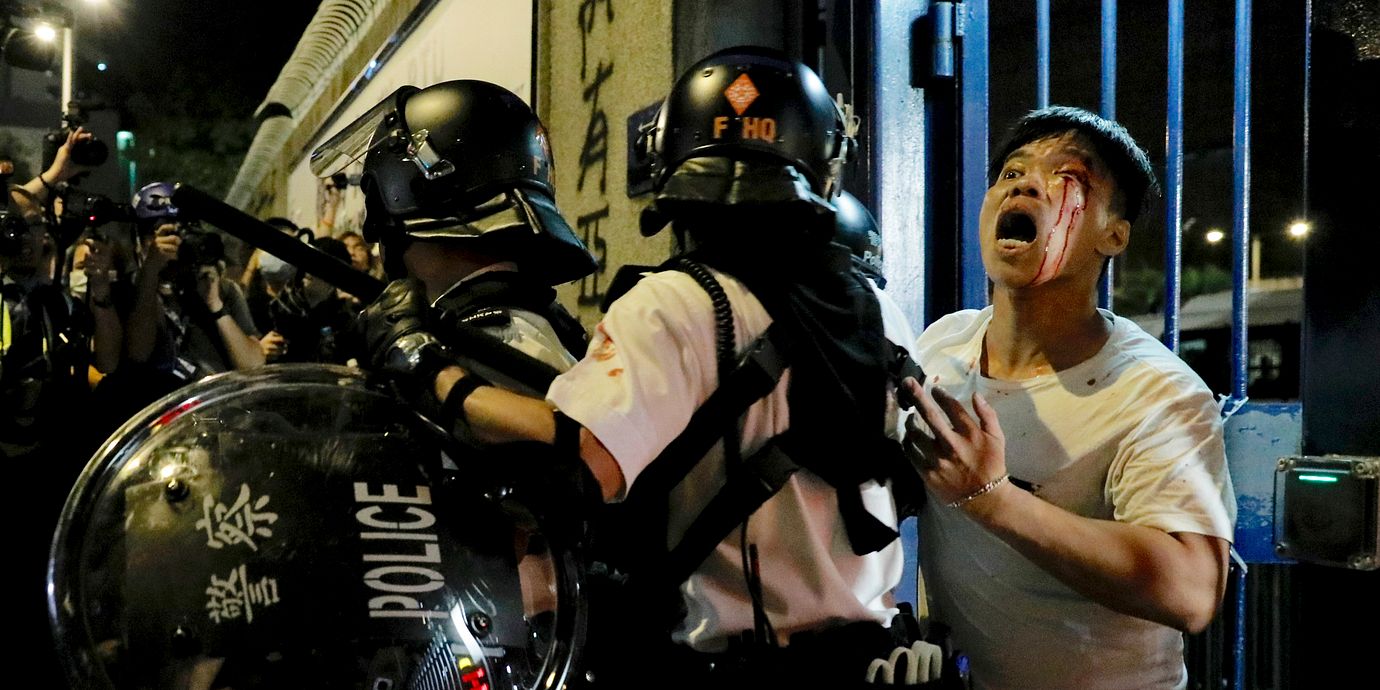
Demonstranternas skrik till polisen: Befria martyrerna
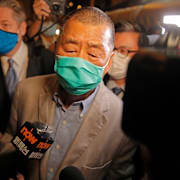
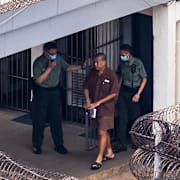
Hundratals demonstranter omringade på tisdagskvällen en polisstation i Hongkong och skrek ”befria martyrerna” efter att 44 aktivister gripits i samband med protesterna, skriver flera medier.
Återigen har poliser använt batonger och pepparspray mot demonstranter som samlats, enligt AFP:s reporter på plats. Samtidigt visar ett av BBC:s filmklipp från platsen hur en polisman riktar ett stort vapen mot flera av demonstranterna.
De gripna demonstranterna riskerar upp till tio års fängelse om de döms för upplopp, enligt AFP.
bakgrund
Protesterna i Hongkong
Wikipedia (en)
The 2019 Hong Kong anti-extradition bill protests are a series of ongoing demonstrations in Hong Kong against the Fugitive Offenders and Mutual Legal Assistance in Criminal Matters Legislation (Amendment) Bill proposed by the government of Hong Kong.
As a special administrative region of China, Hong Kong is jurisdictionally distinct from mainland China and maintains a separate governing and legal system under the "one country, two systems" principle. There is currently no formal process for Hong Kong to render fugitives wanted for crimes committed in the mainland over to Chinese authorities. The proposed bill was first introduced by the Security Bureau in February 2019 in response to a murder that occurred in Taiwan in the previous year. Taiwanese authorities requested for the transfer of the murder suspect, who had fled to Hong Kong, but the regional government declared that it was unable to do so due to the lack of formal extradition arrangements between the two jurisdictions.If enacted, the bill would allow local authorities to detain and extradite people who are wanted in countries or territories that Hong Kong does not have extradition agreements with, including mainland China and Taiwan. Opponents of the legislation fear that it would place Hong Kong residents and visitors under the jurisdiction of mainland courts (which are controlled by the Communist Party of China) and apply not only to criminals, but political dissidents as well.The first protest happened on 31 March with an attendance of 12,000 pro-democracy protesters according to organisers; police put the peak figure at 5,200. The movement gained stronger momentum after a second demonstration on 28 April, attracting an estimated 22,800 people according to police, while organisers claimed 130,000.Starting from June, many demonstrations followed, some of which attracted hundreds of thousands of people. A protest held on 9 June was attended by 240,000 people according to police sources, or over 1 million people according to organisers. On 12 June, the day the government had attempted to table the bill for its second reading, protests outside government headquarters escalated into violent clashes. Allegations of excessive force used by the police severely strained the relationship between the police and the protesters, the press and the medical profession; accountability for police brutality became one of the protestors' demands at subsequent protests. A protest march held on 16 June was attended by nearly 2 million people, according to organisers; police sources estimated 338,000 protesters on the original route at the height of the march.As the city marked the 22nd anniversary of its 1997 handover, the annual pro-democracy protest march organised by civil rights groups claimed a record turnout of 550,000 while police placed the estimate at around 190,000. Separately, hundreds of young protesters stormed the Legislative Council and desecrated symbols associated with the People's Republic of China (PRC) and pro-Beijing elements inside the building. International protests in solidarity also took place in 29 cities including New York City, San Francisco, Los Angeles, Toronto, Vancouver, London, Paris, Berlin, Frankfurt, Tokyo, Sydney and Taipei.On 9 July, Chief Executive Carrie Lam pronounced the extradition bill "dead", using an ambiguous Cantonese phrase (壽終正寢 Jyutping: sau6 zung1 zing3 cam2) that may be translated as "dying a peaceful death". She called amendment efforts a "total failure". Lam gave no assurances, however, that the bill would be completely withdrawn, or that any of the other demands of the protesters would be addressed. Since July, the wave of localised protests has continued, and some have escalated into clashes between police, democracy activists, and pro-Beijing gangsters and local residents.During interviews on Friday 19 July, top advisers to Carrie Lam stated no further concessions will be made, and that Lam will not step down. The political strategy will instead involve a mid-October public policy address. Insiders believe the government will attempt to wait out the protests in hopes that calm will prevail before the upcoming November district council elections.
Omni är politiskt obundna och oberoende. Vi strävar efter att ge fler perspektiv på nyheterna. Har du frågor eller synpunkter kring vår rapportering? Kontakta redaktionen