Joe Biden fördömer Trump: ”Han är del av problemet”
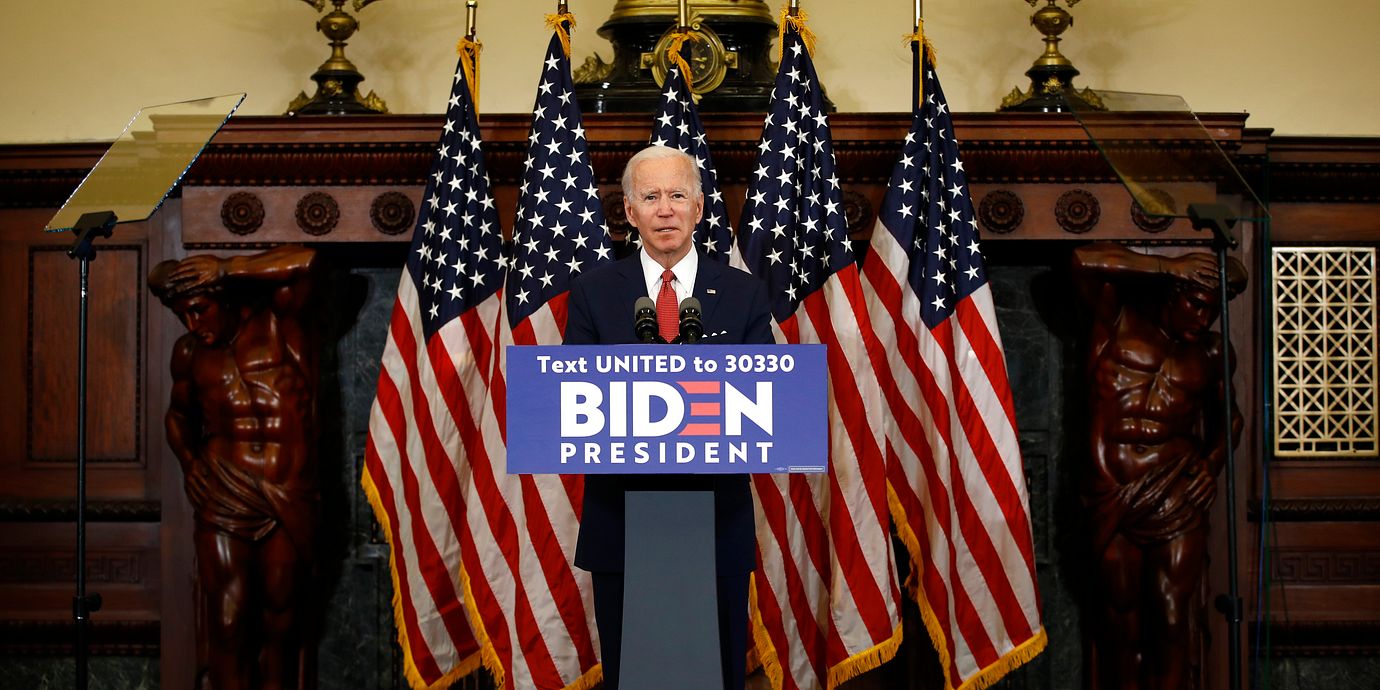
Demokraternas presidentkandidat Joe Biden fördömer Donald Trumps agerande under protesterna mot polisvåld i landet i ett tv-sänt uttalande. Biden menar att presidenten ”borde läsa den amerikanska grundlagen ibland”, och i synnerhet det första tillägget, där bland annat yttrandefriheten listas.
Han säger att det är dags för USA att ta itu med den systematiska rasismen.
– Presidenten i USA måste vara en del av lösningen, inte av problemet. Men den här presidenten är en del av problemet, säger Biden i talet.
– Jag ska försöka läka de rasistiska sår som länge har plågat det här landet – inte använda det för politisk vinning, fortsätter han.
bakgrund
First Amendment to the United States Constitution
Wikipedia (en)
The First Amendment (Amendment I) to the United States Constitution prevents the government from making laws which regulate an establishment of religion, prohibit the free exercise of religion, or abridge the freedom of speech, the freedom of the press, the right to peaceably assemble, or the right to petition the government for redress of grievances. It was adopted on December 15, 1791, as one of the ten amendments that constitute the Bill of Rights.
The Bill of Rights was originally proposed to assuage Anti-Federalist opposition to Constitutional ratification. Initially, the First Amendment applied only to laws enacted by the Congress, and many of its provisions were interpreted more narrowly than they are today. Beginning with Gitlow v. New York (1925), the Supreme Court applied the First Amendment to states—a process known as incorporation—through the Due Process Clause of the Fourteenth Amendment.
In Everson v. Board of Education (1947), the Court drew on Thomas Jefferson's correspondence to call for "a wall of separation between church and State", though the precise boundary of this separation remains in dispute. Speech rights were expanded significantly in a series of 20th and 21st century court decisions which protected various forms of political speech, anonymous speech, campaign financing, pornography, and school speech; these rulings also defined a series of exceptions to First Amendment protections. The Supreme Court overturned English common law precedent to increase the burden of proof for defamation and libel suits, most notably in New York Times Co. v. Sullivan (1964). Commercial speech, however, is less protected by the First Amendment than political speech, and is therefore subject to greater regulation.
The Free Press Clause protects publication of information and opinions, and applies to a wide variety of media. In Near v. Minnesota (1931) and New York Times v. United States (1971), the Supreme Court ruled that the First Amendment protected against prior restraint—pre-publication censorship—in almost all cases. The Petition Clause protects the right to petition all branches and agencies of government for action. In addition to the right of assembly guaranteed by this clause, the Court has also ruled that the amendment implicitly protects freedom of association.
It is a common misconception that the First Amendment prohibits anyone from limiting free speech, including private, non-governmental entities. It is applicable only to state actors.
Direktrapporter om protesterna i USA
Fördjupande lyssning och läsning om situationen
bakgrund
Death of George Floyd
Wikipedia (en)
On May 25, 2020, George Floyd, an African-American man, died in Powderhorn, a neighborhood south of downtown Minneapolis, Minnesota. While Floyd was handcuffed and lying face down on a city street during an arrest, Derek Chauvin, a white Minneapolis police officer, kept his knee on the right side of Floyd's neck for 8 minutes and 46 seconds; according to the criminal complaint against Chauvin, 2 minutes and 53 seconds of that time occurred after Floyd became unresponsive. Officers Tou Thao, J. Alexander Kueng, and Thomas K. Lane participated in Floyd's arrest, with Kueng holding Floyd's back, Lane holding his legs, and Thao looking on as he stood nearby. Preliminary results from the official autopsy found no indication that Floyd died of strangulation or traumatic asphyxia, but that the combined effects of being restrained, underlying health conditions, including coronary artery disease and hypertensive heart disease, and potential intoxicants in his system likely contributed to his death. Attorneys for Floyd's family announced that they have requested an independent autopsy.The arrest was made after Floyd was accused of using a counterfeit $20 bill at a deli. Police said Floyd physically resisted arrest. A security camera from a nearby business did not show Floyd resisting. However, the criminal complaint filed later stated Floyd "did not voluntarily get in the car and struggled with the officers, intentionally falling down, saying he was not going in the car, and refusing to stand still" based on body cameras worn by Kueng and Lane. Several bystanders recorded the event on their smartphones, with one video showing Floyd repeating "Please", "I can't breathe", "Mama", and "Don't kill me" being widely circulated on social media platforms and broadcast by the media. All four officers were fired the next day.The Federal Bureau of Investigation (FBI) is conducting a federal civil rights investigation into the incident at the request of the Minneapolis Police Department. The Minnesota Bureau of Criminal Apprehension (BCA) is also investigating possible violations of Minnesota statutes. On May 29, Chauvin was charged with third-degree murder and second-degree manslaughter for Floyd's death, with Hennepin County attorney Michael O. Freeman saying he anticipated charges to be brought against the other three officers at the scene of Floyd's death.After Floyd's death, demonstrations and protests in the Minneapolis–Saint Paul area were initially peaceful on May 26, but later that day became violent as windows were smashed at a police precinct, two stores were set on fire, and many stores were looted and damaged. Some demonstrators skirmished with police, who fired tear gas and rubber bullets. Additional protests developed in over 100 cities throughout all 50 states in the United States, as well as internationally. Floyd's death has been compared to the 2014 death of Eric Garner. Garner, also an unarmed black man, repeated "I can't breathe" eleven times after being placed in a chokehold by a New York police officer during an arrest in Staten Island.
Omni är politiskt obundna och oberoende. Vi strävar efter att ge fler perspektiv på nyheterna. Har du frågor eller synpunkter kring vår rapportering? Kontakta redaktionen