Kina sätter tillväxtmål på ”runt 6,5 procent” i år
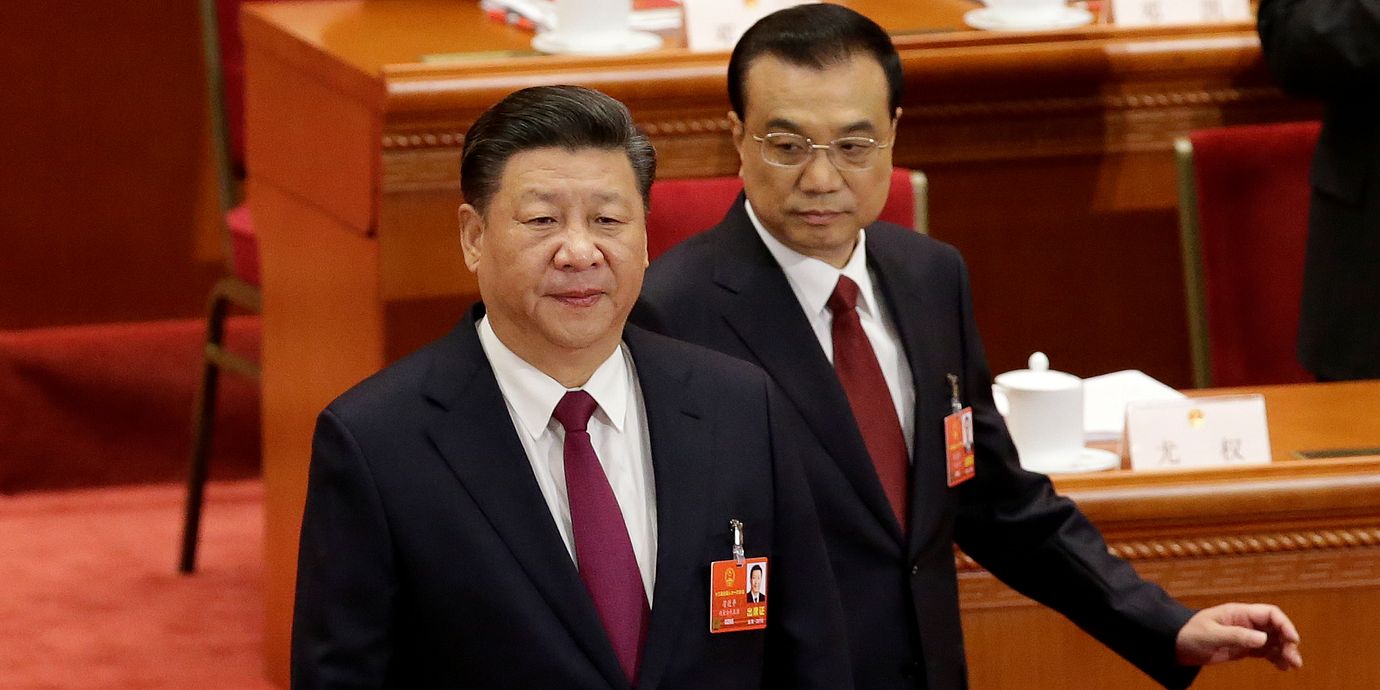
Kinas tillväxtmål sätts till ”omkring 6,5 procent” i år, meddelade premiärminister Li Keqiang i en rapport inför den årliga nationalkongressen. Det rapporterar Bloomberg.
Därmed tar man bort en textrad från förra årets målformulering om att sikta på en högre tillväxt ”om möjligt”. Samtidigt minskas målet för budgetunderskottet till 2,5 procent av BNP, från 3 procent som varit standard de två senaste åren.
Ambitionerna att minska de finansiella riskerna i systemet så mycket som möjligt är fortsatt högt prioriterade, enligt premiärministern. Samtidigt har regeringen för avsikt att uppmuntra att privata medel lånas ut till småföretag, jordbruksverksamhet och landsbygden, säger Li enligt nyhetsbyrån.
bakgrund
Kinas ekonomi
Wikipedia (en)
The socialist market economy of the People's Republic of China is the world's second largest economy by nominal GDP and the world's largest economy by purchasing power parity according to the IMF, although China's National Bureau of Statistic denies this claim. Until 2015, China was the world's fastest-growing major economy, with growth rates averaging 10% over 30 years. Due to historical and political facts of China's developing economy, China's public sector accounts for a bigger share of the national economy than the burgeoning private sector. On a per capita income basis, China ranked 71st by GDP (nominal) and 78th by GDP (PPP) in 2016, according to the International Monetary Fund (IMF). The country has an estimated $23 trillion worth of natural resources, 90% of which are coal and rare earth metals.
Often called the "World's Factory," China is the world's largest manufacturing economy and exporter of goods. China is also the world's fastest-growing consumer market and second-largest importer of goods. China is a net importer of services products. As of 2016, China is the second largest trading nation in the world and plays a prominent role in international trade and has increasingly engaged in trade organizations and treaties in recent years. China became a member of the World Trade Organization in 2001. China also has free trade agreements with several nations, including ASEAN, Australia, New Zealand, Pakistan, South Korea and Switzerland. The provinces in the coastal regions of China tend to be more industrialized, while regions in the hinterland are less developed. As China's economic importance has grown, so has attention to the structure and health of the economy.
To avoid the long-term socioeconomic cost of environmental pollution in China, it has been suggested by Nicholas Stern and Fergus Green of the Grantham Research Institute on Climate Change and the Environment that the economy of China be shifted to more advanced industrial development with high-tech, low carbon emissions with better allocation of national resources to innovation and R&D for sustainable economic growth in order to reduce the impact of China's heavy industry. This is in accord with the planning goals of the central government. Xi Jinping’s Chinese Dream is described as achieving the "Two 100s": the material goal of China becoming a "moderately well-off society" by 2021, the 100th anniversary of the founding of the Communist Party and the modernization goal of China becoming a fully developed nation by 2049, the 100th anniversary of the founding of the People's Republic.
The internationalization of the Chinese economy continues to affect the standardized economic forecast officially launched in China by the Purchasing Managers Index in 2005. By 2009, China became the sole Asian nation to have a GDP (PPP) above the $10-trillion mark (along with the United States and the European Union). In 2015, China became the first nation to have a GDP (PPP) above the $20-trillion mark, doubling its overall output in the fastest time possible (six years). As China's economy grows, so does China's Renminbi, which undergoes the process needed for its internationalization. China initiated the founding of the Asian Infrastructure Investment Bank in 2015. The economic development of Shenzhen is dubbed as the next Silicon Valley in the world.
Omni är politiskt obundna och oberoende. Vi strävar efter att ge fler perspektiv på nyheterna. Har du frågor eller synpunkter kring vår rapportering? Kontakta redaktionen