Människan nådde norra Europa tidigare än känt
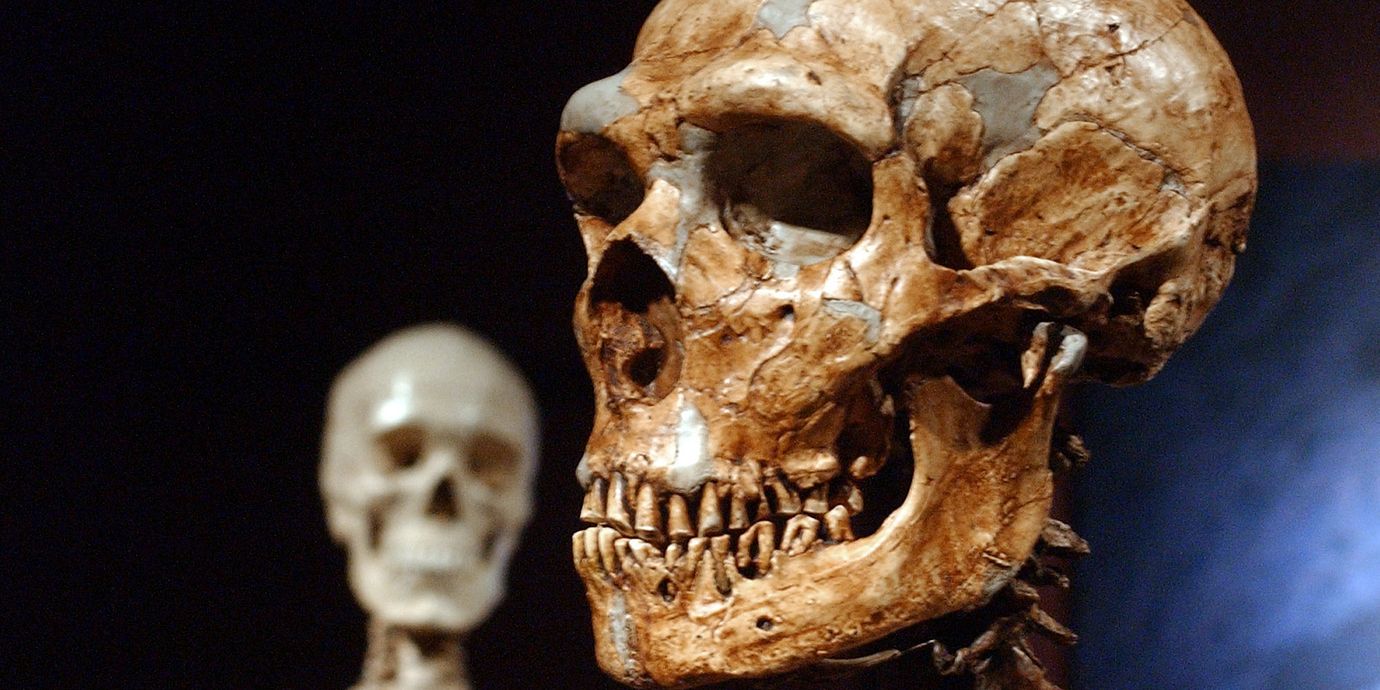
Människor och neandertalare levde sannolikt sida vid sida i norra Europa redan för 45 000 år sedan, visar ny forskning från Max Planck-institutet. Det är tidigare än vad som förut har varit känt, skriver CNN.
Slutsatserna bygger på analyser av ben- och verktygsrester som hittats i en grotta i Tyskland. Detta är de äldsta spår av människan, homo sapiens, som hittats så långt norrut.
Fynden kan skriva om historien för hur det gick till när neandertalarna så småningom ersattes av människor, rapporterar AFP.
bakgrund
Människan
Wikipedia (en)
Humans (Homo sapiens) or modern humans are the most common and widespread species of primate, and the last surviving species of the genus Homo. A great ape characterized by their hairlessness, bipedalism, and high intelligence, humans have large brains, enabling more advanced cognitive skills that enable them to thrive and adapt in varied environments, develop highly complex tools, and form complex social structures and civilizations. Humans are highly social, with individual humans tending to belong to a multi-layered network of cooperating, distinct, or even competing social groups – from families and peer groups to corporations and political states. As such, social interactions between humans have established a wide variety of values, social norms, languages, and traditions (collectively termed institutions), each of which bolsters human society. Humans are also highly curious: the desire to understand and influence phenomena has motivated humanity's development of science, technology, philosophy, mythology, religion, and other frameworks of knowledge; humans also study themselves through such domains as anthropology, social science, history, psychology, and medicine. As of January 2024, there are more than 8 billion humans alive.
Although some scientists equate the term "humans" with all members of the genus Homo, in common usage it generally refers to Homo sapiens, the only extant member. Extinct members of the genus Homo are known as archaic humans, and the term "modern human" is used to distinguish Homo sapiens from archaic humans. Anatomically modern humans emerged around 300,000 years ago in Africa, evolving from Homo heidelbergensis or a similar species. Migrating out of Africa, they gradually replaced and interbred with local populations of archaic humans. Multiple hypotheses for the extinction of archaic human species such as Neanderthals include competition, violence, or interbreeding with Homo sapiens, or inability to adapt to climate change.
For most of their history, humans were nomadic hunter-gatherers. Humans began exhibiting behavioral modernity about 160,000–60,000 years ago. The Neolithic Revolution, which began in Southwest Asia around 13,000 years ago (and separately in a few other places), saw the emergence of agriculture and permanent human settlement; in turn, this led to the development of civilization and kickstarted a period of continuous (and ongoing) population growth and rapid technological change. Since then, a number of civilizations have risen and fallen, while a number of sociocultural and technological developments have resulted in significant changes to the human lifestyle.
Genes and the environment influence human biological variation in visible characteristics, physiology, disease susceptibility, mental abilities, body size, and life span. Though humans vary in many traits (such as genetic predispositions and physical features), humans are among the least genetically diverse primates. Any two humans are at least 99% genetically similar. Humans are sexually dimorphic: generally, males have greater body strength and females have a higher body fat percentage. At puberty, humans develop secondary sex characteristics. Females are capable of pregnancy, usually between puberty, at around 12 years old, and menopause, around the age of 50.
Humans are omnivorous, capable of consuming a wide variety of plant and animal material, and have used fire and other forms of heat to prepare and cook food since the time of Homo erectus. Humans can survive for up to eight weeks without food and several days without water. Humans are generally diurnal, sleeping on average seven to nine hours per day. Childbirth is dangerous, with a high risk of complications and death. Often, both the mother and the father provide care for their children, who are helpless at birth.
Humans have a large, highly developed, and complex prefrontal cortex, the region of the brain associated with higher cognition. Humans are highly intelligent and capable of episodic memory; they have flexible facial expressions, self-awareness, and a theory of mind. The human mind is capable of introspection, private thought, imagination, volition, and forming views on existence. This has allowed great technological advancements and complex tool development through complex reasoning and the transmission of knowledge to subsequent generations through language.
Humans' advanced technology has enabled them to spread to all the continents of the globe as well as to outer space, and to command profound influence on the biosphere and environment. The latter has prompted some geologists to demarcate the time from the emergence of human civilization till present as a separate geological epoch: the Anthropocene (with anthropo- deriving from the Ancient Greek word for "human", ἄνθρωπος).
Omni är politiskt obundna och oberoende. Vi strävar efter att ge fler perspektiv på nyheterna. Har du frågor eller synpunkter kring vår rapportering? Kontakta redaktionen