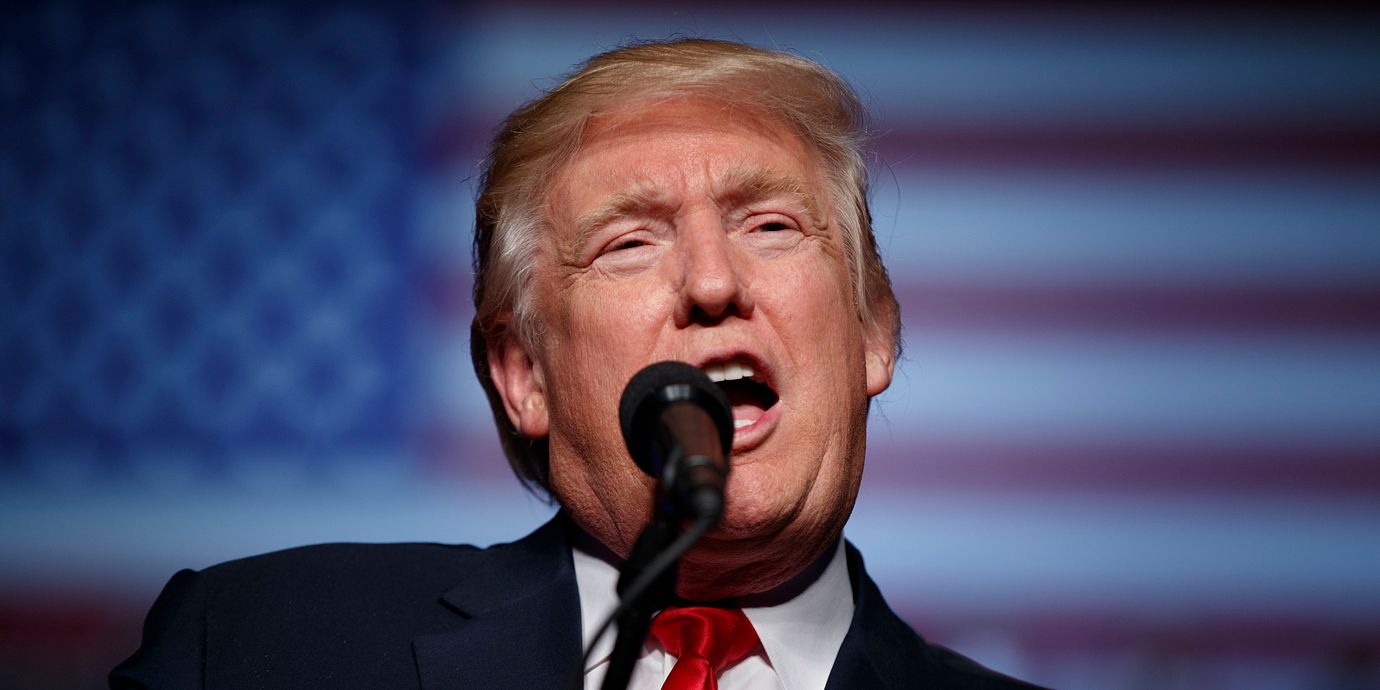
Nu väljs Trump till USA:s president – formellt
I dag samlas USA:s elektorer för att formellt utse Donald Trump till landets näste president.
Praxis är att elektorerna röstar på sin kandidat – vissa delstater har till och med tvingande lagar – men det går att rösta annorlunda, och vid några få tillfällen har elektorer faktiskt röstat på en annan kandidat än den han eller hon har lovat att rösta på.
Möjligheten att någon annan än Trump skulle väljas till president anses dock vara minimal. För att ändra utgången skulle det krävas att minst 38 ”otrogna” elektorer röstar på Hillary Clinton, enligt CNN.
När elektorerna har genomfört sin omröstning skickas resultatet till kongressen. Den 6 januari räknas rösterna inför kongressens båda kamrar och segraren meddelas officiellt.
bakgrund
USA:s elektorer
Wikipedia (en)
The United States Electoral College is a mechanism established by Article Two of the United States Constitution in the indirect United States presidential election system to select the President of the United States and Vice President of the United States. Citizens of the United States vote in each state at a general election to choose a slate of "electors" pledged to vote for a party's candidate.
The Twelfth Amendment requires each elector to cast one vote for president and another vote for vice president. In each state and the District of Columbia, electors are chosen every four years on the Tuesday after the first Monday in November, and then meet to cast ballots on the first Monday after the second Wednesday in December. The candidates who receive an absolute majority of electoral votes among the states are elected President and Vice President of the United States when the Electoral College vote is certified by Congress in January.
There are currently a total of 538 electors, corresponding to the 435 Representatives, the 100 Senators, plus three electors for the District of Columbia as provided for in the Twenty-third Amendment. Each state chooses electors amounting to the combined total of its Senators and Representatives. The Constitution bars any federal official, elected or appointed, from being an elector. The Office of the Federal Register is charged with administering the Electoral College. In most elections, the Electoral College has elected the candidate who received the most popular votes nationwide, except in four elections, 1824, 1876, 1888, and 2000.
All states except Maine and Nebraska have chosen electors on a "winner-take-all" basis since the 1880s. Under the winner-take-all system, the state's electors are awarded to the candidate with the most votes in that state. Maine and Nebraska use the "congressional district method", selecting one elector within each congressional district by popular vote and awarding two electors by a statewide popular vote. Although no elector is required by federal law to honor their pledge, there have been very few occasions when an elector voted contrary to a pledge.
If no person receives an absolute majority of electoral votes for president, the Twelfth Amendment provides that the House of Representatives will select the president, with each of the fifty state delegations casting one vote. If no person receives a majority of electoral votes for vice president, then the Senate will select the vice president, with each of the 100 senators having one vote.
Omni är politiskt obundna och oberoende. Vi strävar efter att ge fler perspektiv på nyheterna. Har du frågor eller synpunkter kring vår rapportering? Kontakta redaktionen