Analys: Trumps hotell ett grundlagsproblem
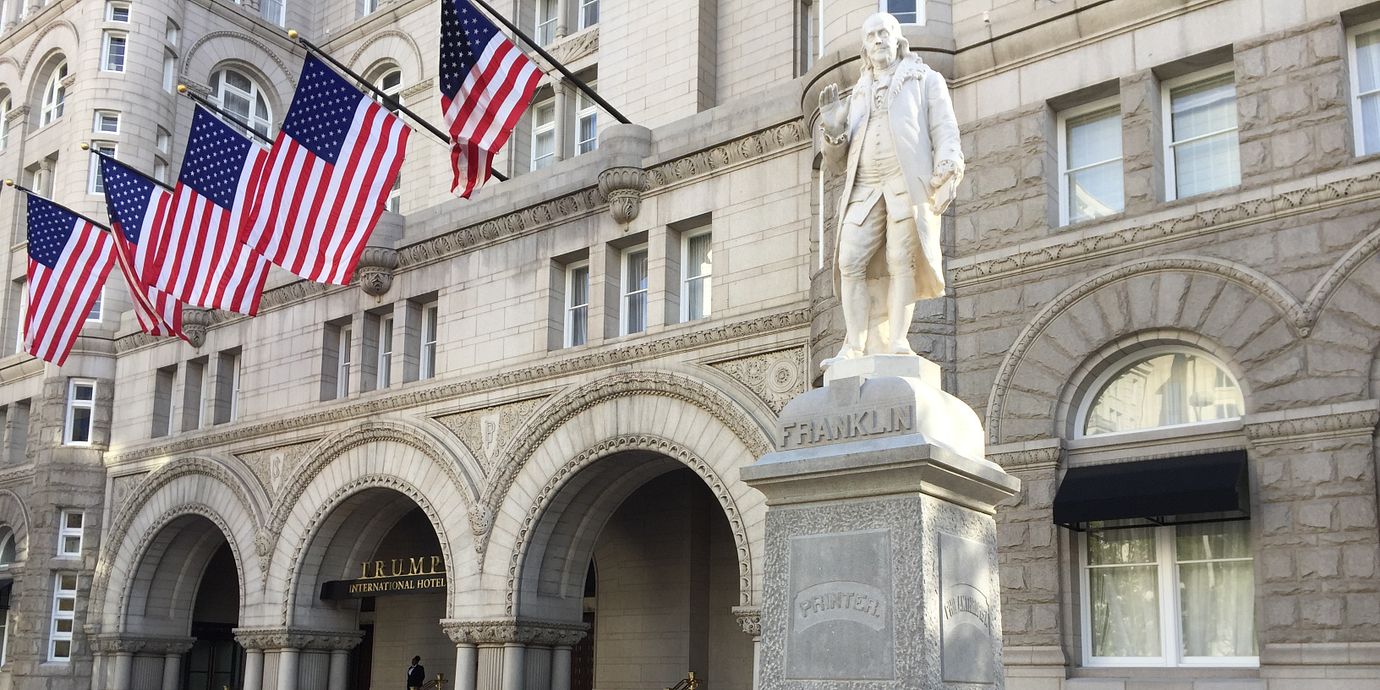
Donald Trumps hotell i Washington raggar aktivt utländska diplomater som vill träffa honom i egenskap av USA:s näste president. Det kan utgöra ett grundlagsproblem, skriver Bloombergs Noah Feldman. Den amerikanska konstitutionen innehåller ett förbud mot att presidenten mottar någon form av betalning från andra länders officiella representanter. Att diplomaterna bor på Trumps kan möjligen ses som en sådan betalning och hypotetiskt användas som grund om den amerikanska kongressen vill ställa honom inför riksrätt, enligt Feldman.
bakgrund
Reglerna analysen handlar om
Wikipedia (en)
The Title of Nobility Clause is a provision in Article I, Section 9, Clause 8 of the United States Constitution, that does the following:
Forbids the United States from granting titles of nobility,
Restricts members of the government from receiving gifts from foreign states without the consent of the United States Congress.
This clause is also sometimes called the "federal" Nobility Clause, because a similar clause in Article I, Section 10, Clause 1 bars the states (rather than the federal government) from granting titles of nobility. The Title of Nobility Clause is also one of the clauses that is sometimes called the "Emolument Clause".
bakgrund
Riksrätt i USA
Wikipedia (en)
Impeachment in the United States is an enumerated power of the legislature that allows formal charges to be brought against a civil officer of government for crimes alleged to have been committed. Most impeachments have concerned alleged crimes committed while in office, though there have been a few cases in which Congress has impeached and convicted officials partly for prior crimes. The actual trial on such charges, and subsequent removal of an official upon conviction, is separate from the act of impeachment itself. Impeachment proceedings have been initiated against several presidents of the United States. Andrew Johnson and Bill Clinton are the only two presidents to have been successfully impeached by the House of Representatives, and both were later acquitted by the Senate. The impeachment process of Richard Nixon was technically unsuccessful, as Nixon resigned his office before the vote of the full House for impeachment, but successful in the broader sense of leading to Nixon's departure. To date, no U.S. President has been removed from office by impeachment and conviction.
Impeachment is analogous to indictment in regular court proceedings; trial by the other house is analogous to the trial before judge and jury in regular courts. Typically, the lower house of the legislature impeaches the official and the upper house conducts the trial.
At the federal level, Article II of the United States Constitution states in Section 4 that "The President, Vice President, and all civil Officers of the United States shall be removed from Office on Impeachment for, and conviction of, Treason, Bribery, or other High Crimes and Misdemeanors." The House of Representatives has the sole power of impeaching, while the United States Senate has the sole power to try all impeachments. The removal of impeached officials is automatic upon conviction in the Senate. In Nixon v. United States (1993), the Supreme Court determined that the federal judiciary cannot review such proceedings.
Impeachment can also occur at the state level: state legislatures can impeach state officials, including governors, in accordance with their respective state constitutions.
At the Philadelphia Convention, Benjamin Franklin noted that, historically, the removal of "obnoxious" chief executives had been accomplished by assassination. Franklin suggested that a proceduralized mechanism for removal—impeachment—would be preferable.
Omni är politiskt obundna och oberoende. Vi strävar efter att ge fler perspektiv på nyheterna. Har du frågor eller synpunkter kring vår rapportering? Kontakta redaktionen