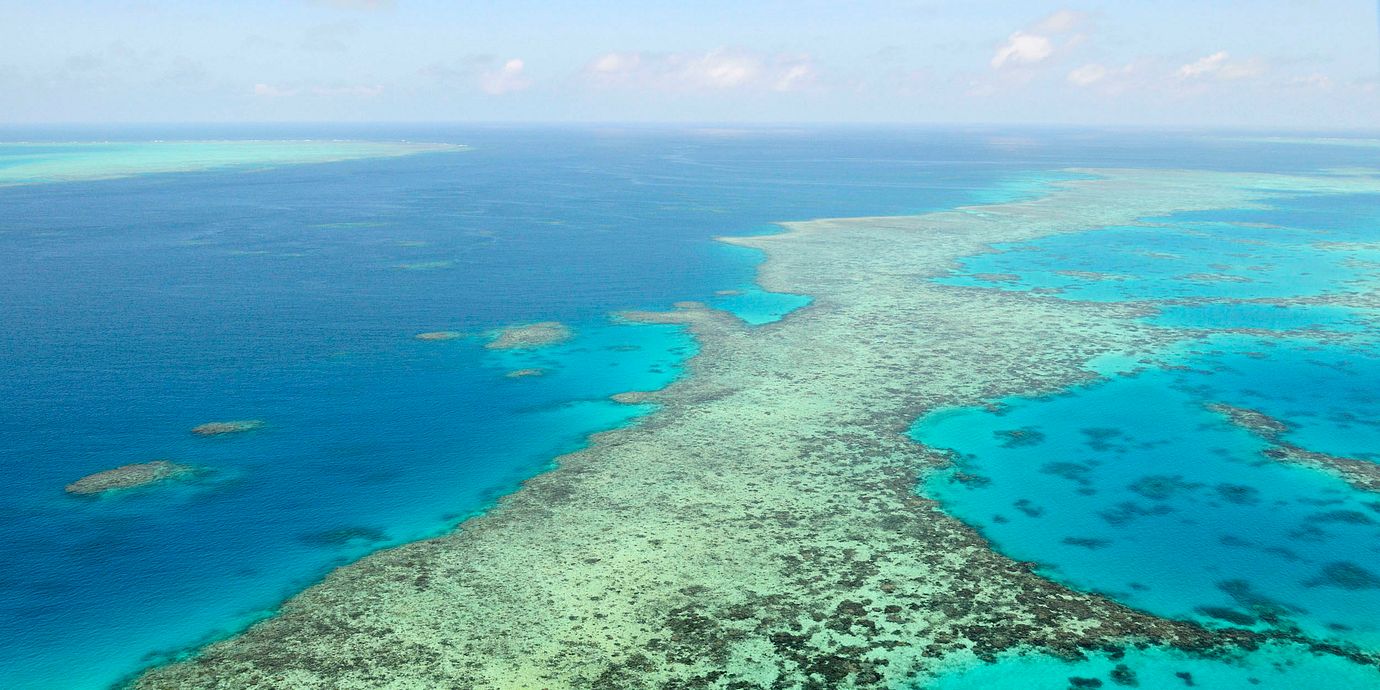
Stora barriärrevet drabbat av massblekning – trots La Niña
Australien meddelar att Stora barriärrevet för fjärde gången sedan 2016 har drabbats av ”massblekning” till följd av allt varmare havsvatten, skriver AFP. Enligt landets särskilda revmyndighet stiger temperaturerna trots att väderfenomenet La Niña just nu har en avkylande effekt på vattnet.
Myndigheten uppger dock att revets koraller kan återhämta sig om förhållandena blir mer gynnsamma.
”De kommande veckornas väder är kritiskt för att avgöra omfattningen och allvaret av korallblekningen”‚ skriver revmyndigheten i en ny rapport.
bakgrund
Stora barriärrevet
Wikipedia (en)
The Great Barrier Reef is the world's largest coral reef system composed of over 2,900 individual reefs and 900 islands stretching for over 2,300 kilometres (1,400 mi) over an area of approximately 344,400 square kilometres (133,000 sq mi). The reef is located in the Coral Sea, off the coast of Queensland, Australia, separated from the coast by a channel 100 miles wide in places and over 200 feet deep. The Great Barrier Reef can be seen from outer space and is the world's biggest single structure made by living organisms. This reef structure is composed of and built by billions of tiny organisms, known as coral polyps. It supports a wide diversity of life and was selected as a World Heritage Site in 1981. CNN labelled it one of the seven natural wonders of the world in 1997. Australian World Heritage places included it in its list in 2007. The Queensland National Trust named it a state icon of Queensland in 2006.A large part of the reef is protected by the Great Barrier Reef Marine Park, which helps to limit the impact of human use, such as fishing and tourism. Other environmental pressures on the reef and its ecosystem include runoff, climate change accompanied by mass coral bleaching, dumping of dredging sludge and cyclic population outbreaks of the crown-of-thorns starfish. According to a study published in October 2012 by the Proceedings of the National Academy of Sciences, the reef has lost more than half its coral cover since 1985, a finding reaffirmed by a 2020 study which found over half of the reef's coral cover to have been lost between 1995 and 2017, with the effects of a widespread 2020 bleaching event not yet quantified.The Great Barrier Reef has long been known to and used by the Aboriginal Australian and Torres Strait Islander peoples, and is an important part of local groups' cultures and spirituality. The reef is a very popular destination for tourists, especially in the Whitsunday Islands and Cairns regions. Tourism is an important economic activity for the region, generating over AUD$3 billion per year. In November 2014, Google launched Google Underwater Street View in 3D of the Great Barrier Reef.A March 2016 report stated that coral bleaching was more widespread than previously thought, seriously affecting the northern parts of the reef as a result of warming ocean temperatures. In October 2016, Outside published an obituary for the reef; the article was criticized for being premature and hindering efforts to bolster the resilience of the reef. In March 2017, the journal Nature published a paper showing that huge sections of an 800-kilometre (500 mi) stretch in the northern part of the reef had died in the course of 2016 due to high water temperatures, an event that the authors put down to the effects of global climate change. The percentage of baby corals being born on the Great Barrier Reef dropped drastically in 2018 and scientists are describing it as the early stage of a "huge natural selection event unfolding". Many of the mature breeding adults died in the bleaching events of 2016–17 leading to low coral birth rates. The types of corals that reproduced also changed, leading to a "long-term reorganisation of the reef ecosystem if the trend continues."The Great Barrier Reef Marine Park Act 1975 (section 54) demands every five years an Outlook Report on the Reef's health, pressures, and future. The last report was published in 2019.In March 2022, another mass bleaching event has been confirmed, which raised further concerns about the future of this reef system, especially when considering the possible effects of El Niño weather phenomenon.
bakgrund
Korallblekning
Wikipedia (en)
Coral bleaching is the process when corals become white due to various stressors, such as changes in temperature, light, or nutrients. Bleaching occurs when coral polyps expel the algae (zooxanthellae) that live inside their tissue, causing the coral to turn white. The zooxanthellae are photosynthetic, and as the water temperature rises, they begin to produce reactive oxygen species. This is toxic to the coral, so the coral expels the zooxanthellae. Since the zooxanthellae produce the majority of coral pigmentation, the coral tissue becomes transparent, revealing the coral skeleton made of calcium carbonate. Most bleached corals appear bright white, but some are pastel blue, yellow, or pink due to proteins in the coral.Bleached corals continue to live, but they are more vulnerable to disease and starvation. Zooxanthellae provide up to 90 percent of the coral's energy, so corals are deprived of nutrients when zooxanthellae are expelled. Some corals recover if conditions return to normal, and some corals can feed themselves. However, the majority of coral without zooxanthellae starve.Normally, coral polyps live in an endosymbiotic relationship with zooxanthellae. This relationship is crucial for the health of the coral and the reef, which provide shelter for approximately 25% of all marine life. In this relationship, the coral provides the zooxanthellae with shelter. In return, the zooxanthellae provide compounds that give energy to the coral through photosynthesis. This relationship has allowed coral to survive for at least 210 million years in nutrient-poor environments. Coral bleaching is caused by the breakdown of this relationship.The leading cause of coral bleaching is rising water temperature. A temperature about 1 °C (or 2 °F) above average can cause bleaching. According to the United Nations Environment Programme, between 2014 and 2016, the longest recorded global bleaching events killed coral on an unprecedented scale. In 2016, bleaching of coral on the Great Barrier Reef killed between 29 and 50 percent of the reef's coral. In 2017, the bleaching extended into the central region of the reef. The average interval between bleaching events has halved between 1980 and 2016. The world's most bleaching tolerant corals can be found in the southern Persian/Arabian Gulf. Some of these corals bleach only when water temperatures exceed ~35 °C.
Stora barriärrevet

Omni är politiskt obundna och oberoende. Vi strävar efter att ge fler perspektiv på nyheterna. Har du frågor eller synpunkter kring vår rapportering? Kontakta redaktionen