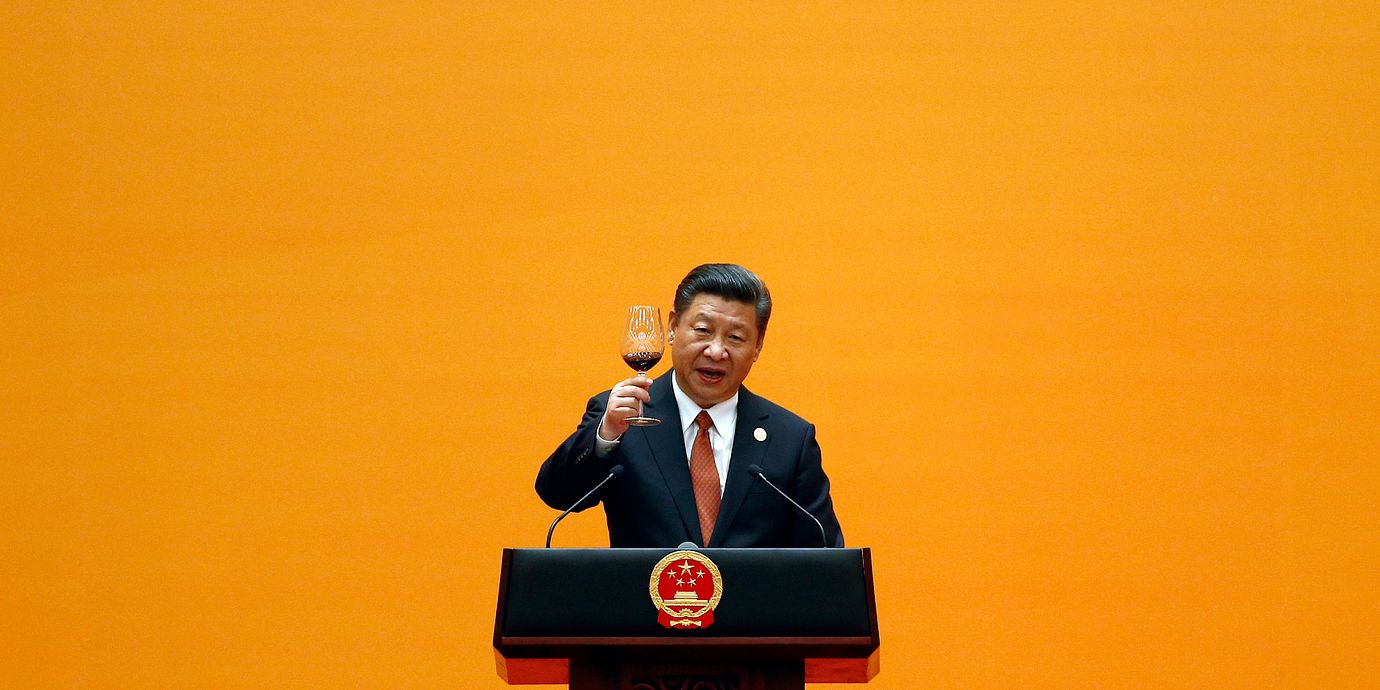
Xis arv hänger på tidernas största byggprojekt
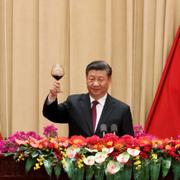
Med ”One Belt One Road” vill Xi Jinping genomföra den största infrastruktursatsningen genom alla tider. Planen kan bli avgörande för om den sittande kinesiske presidenten ska få ett bestående eftermäle eller inte, skriver Bloomberg inför Kommunistpartiets kongress där Xi Jinpings ledarskap hamnat i fokus.
Projektet handlar om att, i ett nötskal, skapa förbättrade förbindelser mellan Kina och Europa, Afrika och övriga Asien genom att lägga räls samt bygga vägar och hamnar.
”Förhoppningen är att detta ska cementera landets plats som världens nav. Ett tydligt eko av den här typen av ambitioner blir ett allt vanligare inslag i uttalanden från Kinas politiker”, skriver Bloomberg.
bakgrund
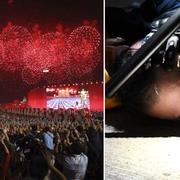
Kongressen, den 19:e i ordningen, öppnar den 18 oktober
Wikipedia (en)
The National Congress of the Communist Party of China (NCCPC) (Chinese: 中国共产党全国代表大会; pinyin: Zhōngguó Gòngchǎndǎng Quánguó Dàibiǎo Dàhuì; literally: Chinese Communist Party National Representatives Congress) is a party congress that is held every five years. The National Congress is theoretically the highest body within the Communist Party of China, but in practice important decisions are made before the meeting. Since 1987 the National Congress has been held in the months of October or November. The venue for the event, beginning in 1956, is the Great Hall of the People in Beijing. In the past two decades the National Congress of the CPC has been pivotal at least as a symbolic part of leadership changes, and therefore has gained international media attention.
Since the mid-1980s, the Communist Party has attempted to maintain a smooth and orderly succession and avoiding a cult of personality, by having a major shift in personnel every ten years in even number party congresses, and by promoting people in preparation for this shift in odd number party congresses.
In addition, as people at the top level of the party retire, there is room for younger members of the party to move up one level. Hence the party congress is a time of a general personnel reshuffle, and the climax of negotiations that involve not only the top leadership but practically all significant political positions in China. Because of the pyramid structure of the party and the existence of mandatory retirement ages, cadres who are not promoted at a party congress are likely to face the end of their political careers.
In addition to making leadership changes, the Congress also reviews and changes, if necessary, the Party's Constitution, and selects the Central Committee, a powerful decision making body. Each five-year cycle of the National People's Congress also has a series of plenums of the Central Committee which since the mid-1990s have been held more or less regularly once every year.
Similar to the practice of the NPC, the delegates to the Congress are formally selected from grassroot party organizations, and like the NPC, the system of staggered elections in which one level of the party votes for the delegates to the next higher level allows the party center to control the election of delegates.
bakgrund
One Belt One Road Initiative
Wikipedia (en)
The Silk Road Economic Belt and the 21st-century Maritime Silk Road, better known as the One Belt and One Road Initiative (OBOR), The Belt and Road (B&R) and The Belt and Road Initiative (BRI) is a development strategy proposed by China's paramount leader Xi Jinping that focuses on connectivity and cooperation between Eurasian countries, primarily the People's Republic of China (PRC), the land-based Silk Road Economic Belt (SREB) and the oceangoing Maritime Silk Road (MSR). The strategy underlines China's push to take a larger role in global affairs with a China-centered trading network. It was unveiled in September and October 2013 for SREB and MSR respectively. It was also promoted by Premier Li Keqiang during the state visit to Asia and Europe and the most frequently mentioned concept in the People's Daily in 2016. It was initially called One Belt and One Road, but in mid-2016 the official English name was changed to the Belt and Road Initiative due to misinterpretations of the term one. In the past three years, the focuses were mainly on infrastructure investment, construction materials, railway and highway, automobile, real estate, power grid, and iron and steel.
Läs även
Omni är politiskt obundna och oberoende. Vi strävar efter att ge fler perspektiv på nyheterna. Har du frågor eller synpunkter kring vår rapportering? Kontakta redaktionen