Syriens nya sedlar de första med Assads avbild
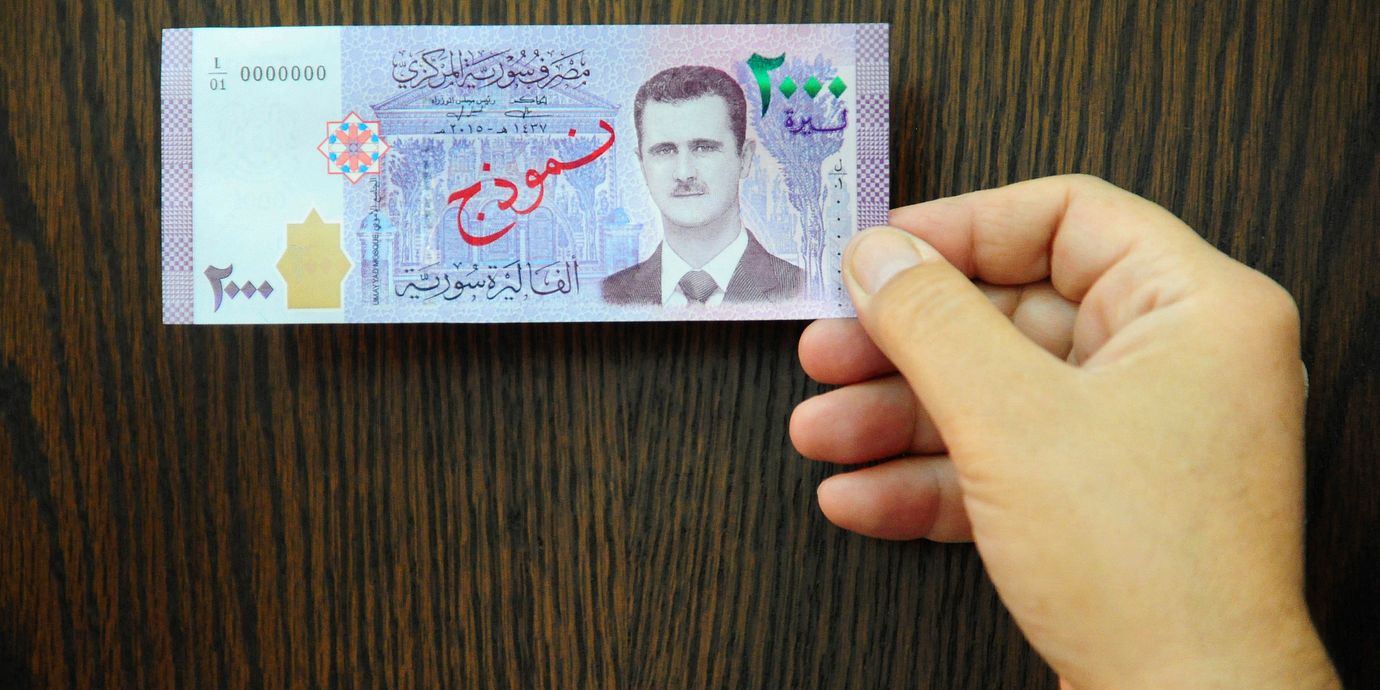
Syriens centralbank kommer att ge ut en ny sedel – med valören 2 000 syriska lira – som kommer att prydas av det krigshärjade landets president Bashar al-Assad, rapporterar AP. Det är första gången som Assad får synas på syriska kontanter sedan han kom till makten för 17 år sedan.
Landets valuta har rasat mot dollarn sedan inbördeskriget började. 2011 kostade en dollar 47 lira – jämfört med 517 i dag. Samtidigt har landets inflation rusat och uppskattas i fjol ha varit omkring 50 procent.
bakgrund
Syriens ekonomi
Wikipedia (en)
The economy of Syria is based on agriculture, oil, industry and services. Its GDP per capita expanded 80% in the 1960s reaching a peak of 336% of total growth during the 1970s. This proved unsustainable for Syria and the economy shrank by 33% during the 1980s. However the GDP per capita registered a very modest total growth of 12% (1.1% per year on average) during the 1990s due to successful diversification. More recently, the International Monetary Fund (IMF) projected real GDP growth at 3.9% in 2009 from close to 6% in 2008. The two main pillars of the Syrian economy used to be agriculture and oil, which together accounted for about one-half of GDP. Agriculture, for instance, accounted for about 25% of GDP and employed 25% of the total labor force. However, poor climatic conditions and severe drought badly affected the agricultural sector, thus reducing its share in the economy to about 17% of 2008 GDP, down from 20.4% in 2007, according to preliminary data from the Central Bureau of Statistics. On the other hand, higher crude oil prices countered declining oil production and led to higher budgetary and export receipts.
Since the outbreak of the Syrian civil war, the Syrian economy has been hit by massive economic sanctions restricting trade with the Arab League, Australia, Canada, the European Union, (as well as the European countries of Albania, Iceland, Liechtenstein, Macedonia, Moldova, Montenegro, Norway, Serbia, and Switzerland) Georgia, Japan, Turkey, and the United States. These sanctions and the instability associated with the civil war have reversed previous growth in the Syrian economy to a state of decline for the years 2011 and 2012. According to the UN, total economic damages of the Syrian civil war are estimated at $143 billion as of late 2013.
By July 2013, the Syrian economy had shrunk 45 percent since the start of the Civil War. Unemployment increased fivefold, the value of the Syrian currency decreased to one-sixth its pre-war value, and the public sector lost USD $15 billion. By the end of 2013, the UN estimated total economic damage of the Syrian civil war at $143 billion. The total economic loss from the Syrian Civil War will reach $237 billion by the end of 2015, according to the United Nations Economic and Social Commission for Western Asia, with the Syrian opposition's capture of Nasib border crossing costing the government a further $500–$700 million a year on top of this.
As a result of the war, the six economies of the greater Levant (Turkey, Syria, Lebanon, Jordan, Iraq, and Egypt) taken together have lost close to US$35 billion in output, measured in 2007 prices.
Omni är politiskt obundna och oberoende. Vi strävar efter att ge fler perspektiv på nyheterna. Har du frågor eller synpunkter kring vår rapportering? Kontakta redaktionen