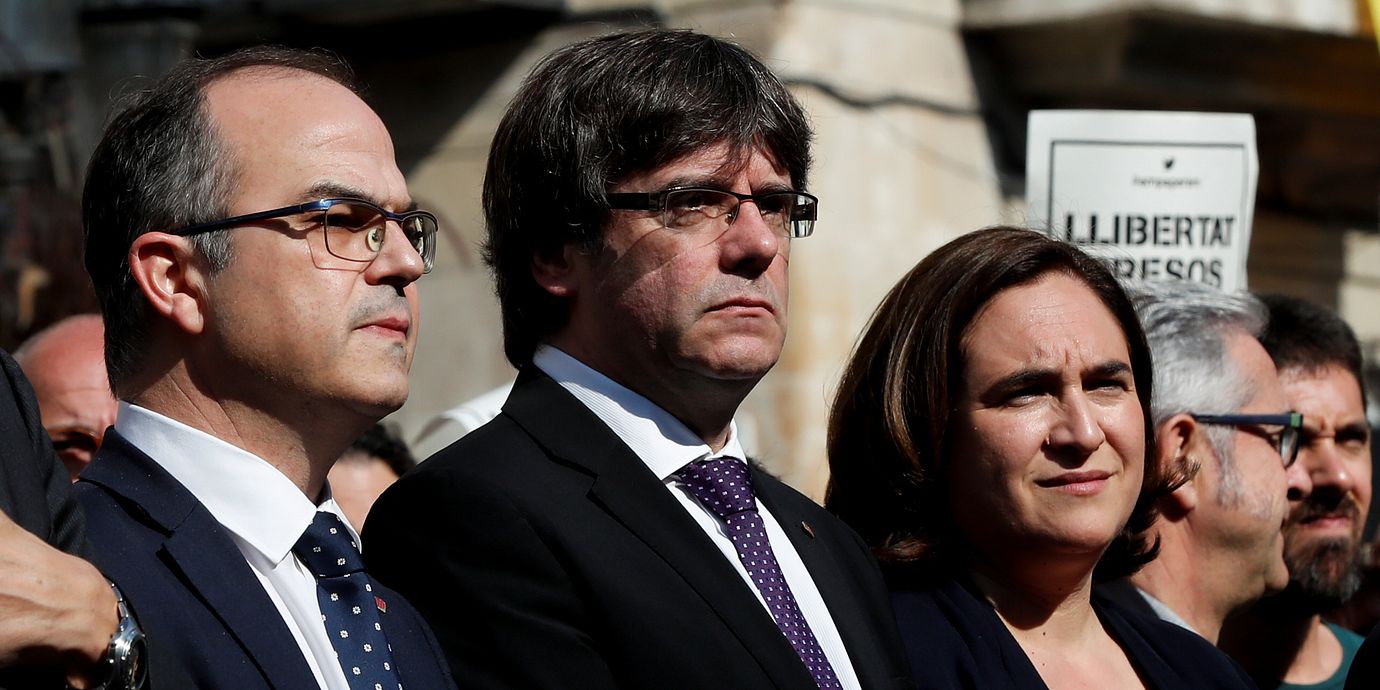
Spanien kräver att Katalonien backar före deadline
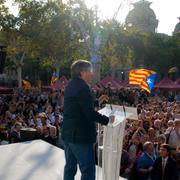
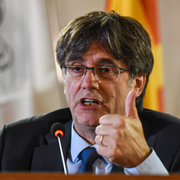
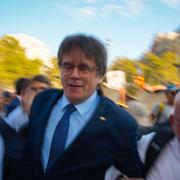
Spaniens regering kräver att Kataloniens regionpresident Carles Puigdemont backar från kravet om självständighet före klockan 10 i dag. Annars hotar Spaniens premiärminister Mariano Rajoy med att upplösa regionens autonoma styre.
Regionpresidenten ignorerade den första deadline som Madrid satte till i måndags. Då bjöd han i stället in till samtal, och har signalerat att han inte kommer att backa denna gång heller.
Puigdemont hävdar att bollen ligger hos regeringen och att han kommer tvingas till en formell självständighetsförklaring om regeringen tillämpar den omtalade artikel 155 i konstitutionen – som upphäver regionens autonomi.
bakgrund
Katalanska självständighetsrörelsen
Wikipedia (en)
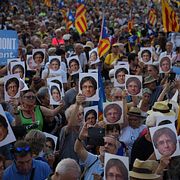
The Catalan independence movement Catalan: independentisme català; Spanish: independentismo catalán or secesionismo catalán) is a political movement historically derived from Catalan nationalism, which seeks the independence of Catalonia from the Kingdom of Spain. The Estelada flag, in its blue and red versions, has become its main symbol.
The political movement began in 1922 when Francesc Macià founded Estat Català (Catalan State). In 1931, Estat Català and other parties formed Esquerra Republicana de Catalunya (Republican Left of Catalonia; ERC), which won a dramatic victory in the municipal elections of that year. Macià proclaimed a Catalan Republic, but after negotiations with the leaders of the new Spanish Republic, he instead accepted autonomy within the Spanish state. In the Spanish Civil War, General Francisco Franco abolished Catalan autonomy in 1938. Following Franco's death in 1975, Catalan political parties concentrated on autonomy rather than independence.
The modern independence movement began when the 2006 Statute of Autonomy, which had been agreed with the Spanish government and passed by a referendum in Catalonia, was challenged in the Spanish High Court of Justice, which ruled that some of the articles were unconstitutional, or were to be interpreted restrictively. Popular protest against the decision quickly turned into demands for independence. Starting with the town of Arenys de Munt, over 550 municipalities in Catalonia held symbolic referendums on independence between 2009 and 2011, all of them returning a high "yes" vote, with a turnout of around 30% of those eligible to vote. A 2010 protest demonstration against the court's decision, organised by the cultural organisation Òmnium Cultural, was attended by over a million people. The popular movement fed upwards to the politicians; a second mass protest on 11 September 2012 (the National Day of Catalonia) explicitly called on the Catalan government to begin the process towards independence. Catalan president Artur Mas called a snap general election, which resulted in a pro-independence majority for the first time in the region's history. The new parliament adopted the Catalan Sovereignty Declaration in early 2013, asserting that the Catalan people had the right to decide their own political future.
The Catalan government announced a referendum, to be held in November 2014, on the question of statehood. The referendum was to ask two questions: "Do you want Catalonia to become a State?" and (if yes) "Do you want this State to be independent?" The Spanish government referred the proposed referendum to the Spanish Constitutional Court, which ruled it unconstitutional. The Catalan government then changed it from a binding referendum to a non-binding "consultation". Despite the Spanish court also banning the non-binding vote, the Catalan self-determination referendum went ahead on 9 November 2014. The result was an 81% vote for "yes-yes", but the turnout was only 42%. Mas called another election for September 2015, which he said would be a plebiscite on independence. Pro-independence parties fell just short of a majority of votes in the September election, although they won a majority of seats. The new parliament passed a resolution declaring the start of the independence process in November 2015, and the following year, new president Carles Puigdemont announced a binding referendum on independence. Although deemed illegal by the Spanish government and Constitutional Court, the referendum was held on 1 October 2017. Results showed a 90% vote in favour of independence, with a turnout of only 43%.
In the Parliament of Catalonia, parties explicitly supporting independence are Partit Demòcrata Europeu Català (Catalan European Democratic Party; PDeCAT), formerly named Convergència Democràtica de Catalunya (Democratic Convergence of Catalonia; CDC); Esquerra Republicana de Catalunya (Republican Left of Catalonia; ERC), and Candidatura d'Unitat Popular (Popular Unity Candidacy; CUP). The PDeCAT and ERC currently form the coalition Junts pel Sí (Together for "Yes"). Parties opposed to any change in Catalonia's position are Ciutadans (Citizens) and the Catalan branch of the Partido Popular (People's Party). The Partit dels Socialistes de Catalunya (Socialists' Party of Catalonia; PSC), the Catalan referent of the Partido Socialista Obrero Español (Spanish Socialist Workers' Party; PSOE), officially favours a federalist option, although some of its members support self-determination. Podemos, the second largest party in Spain by membership, supports a referendum. Other parties favour an intermediate form of self-determination, or at least support a referendum on the question.
Omni är politiskt obundna och oberoende. Vi strävar efter att ge fler perspektiv på nyheterna. Har du frågor eller synpunkter kring vår rapportering? Kontakta redaktionen