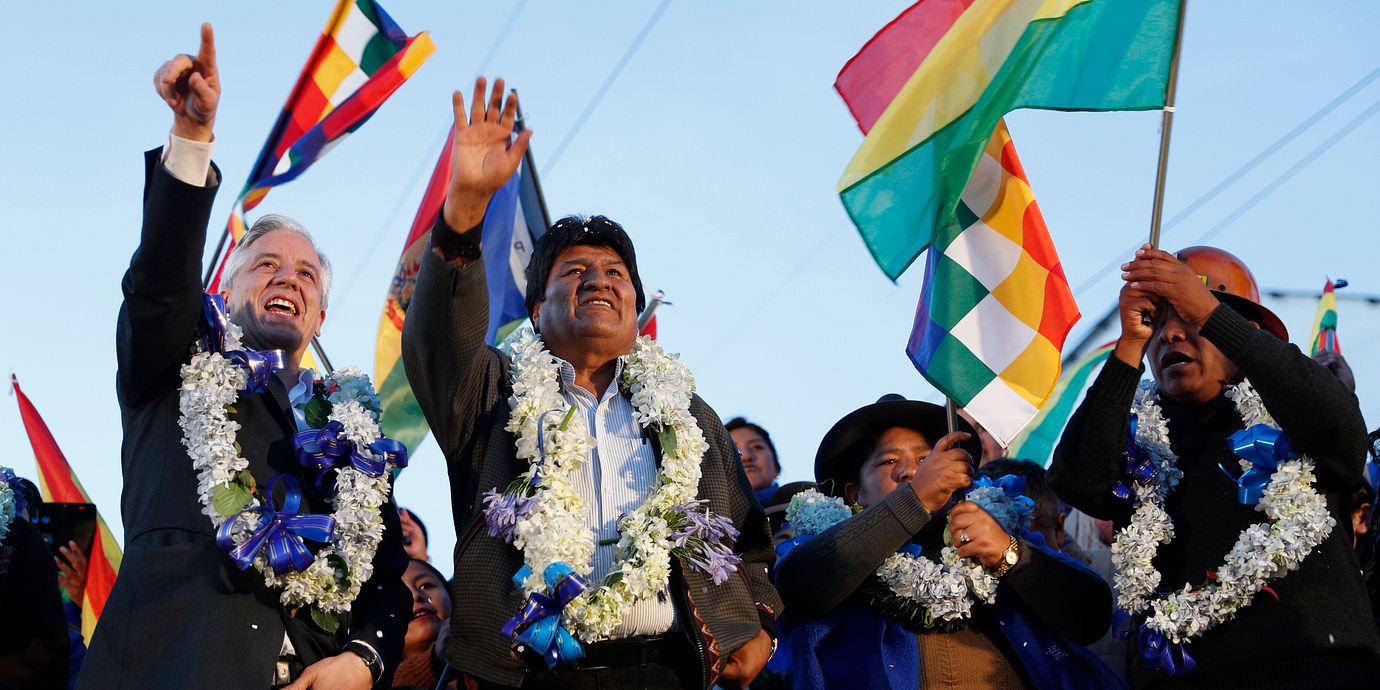
Morales: Kommer tillbaka – krävs väpnade milisgrupper
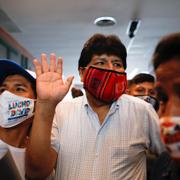
Bolivias tidigare president Evo Morales har planer på att återvända till landet för att kampanja för nyvalet den 3 maj, trots att han riskerar att gripas. Det säger han i läckta ljudfiler som har publicerats i boliviansk radio, enligt internationella nyhetsbyråer.
– Om jag återvänder till Bolivia kommer vi behöva organisera beväpnade milisgrupper som i Venezuela, säger Morales.
För Reuters har han bekräftat ljudupptagningens äkthet. Han säger att människor har rätt att skydda sig, men tonar ner sitt uttalande om beväpnade grupper.
– Vi pratar inte om vapen, snarare om slangbellor, säger han till nyhetsbyrån.
Morales flydde landet efter kritik om misstänkt valfusk i valet i oktober. Innan flykten var han president i landet i 14 år.
bakgrund
Bolivias politiska kris
Wikipedia (en)
On 10 November 2019, after 19 days of civil protests following the disputed election results of October 2019 and the release of a report from the OAS, which alleged irregularities in the electoral process, trade unions, the military and the police of Bolivia suggested that president Evo Morales resign. After General Williams Kaliman Romero made the military's request for Morales's resignation public, Morales complied, accompanied by other resignations by high-level politicians throughout the day, some citing fears for the safety of their families. The government of Mexico offered political asylum to Morales the following day, which Morales accepted a day afterwards.The second vice president of the Senate, opposition senator Jeanine Áñez, assumed the role of president on 12 November, being the next in line for the presidency after a vacuum had been left following a string of resignations. This was not without controversy as her initial appointment was made during a brief legislative session that lacked quorum, due to a boycott by Morales's party, Movement for Socialism (MAS). Bolivia's Plurinational Constitutional Tribunal then confirmed Áñez's assumption of the presidency as legitimate and the ruling party returned most members to both chambers, with some assuming key positions such as Leader of the Senate. They have also committed to working with the interim government towards new elections.Despite the return of his party to the role of government, Morales has called for the Bolivian people to reject the leadership of Áñez. He and his supporters argue that the event was a coup d'état. International politicians, scholars and journalists are divided between describing the event as a coup or a popular uprising.The Bolivian Congress, with the majority being members of Morales' MAS party, unanimously approved a bill on 23 November 2019 that annulled the results of the October 20 election, allowed for new elections and prevented Evo Morales from participating in the new elections. The bill was signed into law the next day by president Áñez.On 4 December 2019, the Organization of American States released its final report related to the October 20 election, detailing what they called "deliberate" and "malicious" tactics to rig that election in favor of President Evo Morales.
Tidigare
Omni är politiskt obundna och oberoende. Vi strävar efter att ge fler perspektiv på nyheterna. Har du frågor eller synpunkter kring vår rapportering? Kontakta redaktionen