Nya inreseförbudet ska inte stoppa den som börjat resa
Vita huset planerar en ny version av det stoppade inreseförbudet, skriver Reuters. Den nya varianten ska inte stoppa personer med ”green card” eller inresevisum, som redan befinner sig ombord på flyg till USA, från att komma in i landet. Det uppger John Kelly, inrikessäkerhetsminister, vid säkerhetskonferensen i München.
Det tidigare förbudet satte stopp för personer från Iran, Irak, Jemen, Libyen, Somalia, Sudan och Syrien från inresa under 90 dagar och alla flyktingar under 120 dagar. Flyktingar från Syrien skulle stoppas på obestämd tid. Det plötsliga förbudet skapade kaos i januari och orsakade en våg av kritik från omvärlden. Ett utkast av den nya ordern visar att folk från samma sju länder omfattas, enligt Wall Street Journal.
bakgrund
Det tidigare inreseförbudet
Wikipedia (en)
Executive Order 13769, titled Protecting the Nation from Foreign Terrorist Entry into the United States, is an executive order signed by President Donald Trump on January 27, 2017, that places limits on travel to the U.S. from certain countries, and by all refugees, out of concern for terrorists infiltrating the U.S. The order was challenged by widespread protests and numerous lawsuits, including State of Washington v. Trump, which resulted in a temporary restraining order (TRO) on February 3 that blocked much of the executive order pending further litigation. The dispute centers on the constitutionality and legality of the order including a fundamental question of whether this area of Presidential authority should be subject to review by the courts.
The order placed a limit on the number of refugees to be admitted into the United States in 2017 to 50,000 and suspended the U.S. Refugee Admissions Program (USRAP) for 120 days, after which the program would be conditionally resumed for individual countries while prioritizing refugee claims from persecuted minority religions. The order also indefinitely suspended the entry of Syrian refugees. The order directs some Cabinet secretaries to suspend entry of nationals from countries who do not meet adjudication standards under the Immigration and Nationality Act. Homeland Security lists these countries as Iran, Iraq, Libya, Somalia, Sudan, Syria, and Yemen. The order was widely seen as fulfilling Trump's campaign pledge for a "complete shutdown of Muslims entering the United States," known as his "Muslim ban," but the administration said the order was crafted to block likely terrorists, not Muslims.
The order allows exceptions to the entry ban on a case-by-case basis. The Department of Homeland Security later exempted U.S. lawful permanent residents (green-card holders) and dual nationals of other countries who also held a passport or nationality of one of the listed countries provided they used a passport of a non-listed country on entry into the U.S.
More than 100 travelers were detained, being held for hours without access to family or legal assistance, and up to 60,000 visas were "provisionally revoked". Within hours nearly 50 lawsuits were filed arguing that the order, or actions taken pursuant to the order, violated the U.S. Constitution, federal statutes, and treaty obligations. Federal courts issued emergency orders halting detention, expulsion, or blocking of lawful travelers pending final rulings. Following the February 3 temporary restraining order from State of Washington v. Trump the Department of Homeland Security (DHS) stopped enforcing portions of the executive order affected by the restraining order and the State Department revalidated visas that had been previously revoked. The restraining order was upheld by the United States Court of Appeals for the Ninth Circuit on February 9.
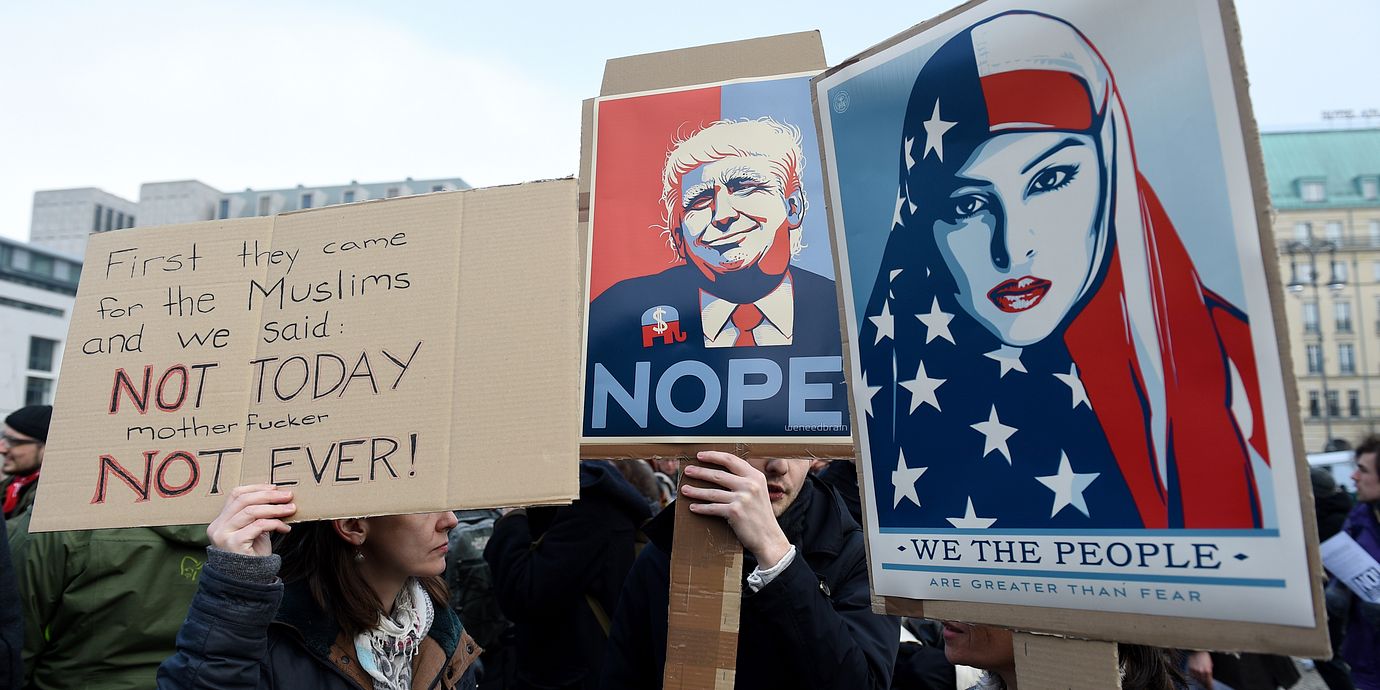
Domestically the order was criticized by Democratic and Republican members of Congress, universities, business leaders, Catholic bishops, and Jewish organizations. 1,000 U.S. diplomats signed a dissent cable opposing the order. Public opinion was divided with initial national polls yielding inconsistent results. Protests against the order erupted in airports and cities. Internationally the order prompted broad condemnation including from longstanding U.S. allies. The travel ban and suspension of refugee admissions was criticized by top United Nations officials and by a group of 40 Nobel laureates and thousands of other academics.
Omni är politiskt obundna och oberoende. Vi strävar efter att ge fler perspektiv på nyheterna. Har du frågor eller synpunkter kring vår rapportering? Kontakta redaktionen