Wikipedia (en)
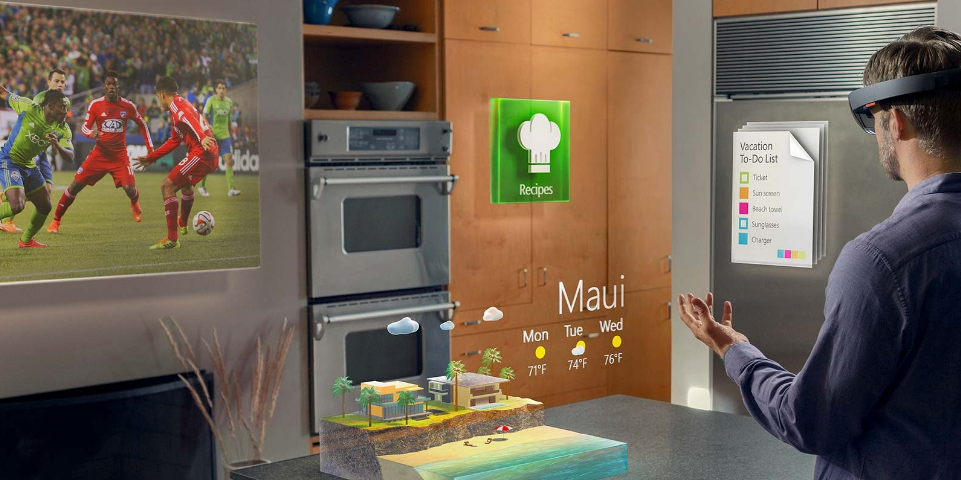
Augmented Reality (AR) is an interactive experience of a real-world environment whereby the objects that reside in the real-world are "augmented" by computer-generated perceptual information, sometimes across multiple sensory modalities, including visual, auditory, haptic, somatosensory, and olfactory. The overlaid sensory information can be constructive (i.e. additive to the natural environment) or destructive (i.e. masking of the natural environment) and is seamlessly interwoven with the physical world such that it is perceived as an immersive aspect of the real environment. In this way, augmented reality alters one’s ongoing perception of a real world environment, whereas virtual reality completely replaces the user's real world environment with a simulated one. Augmented reality is related to two largely synonymous terms: mixed reality and computer-mediated reality.
The primary value of augmented reality is that it brings components of the digital world into a person's perception of the real world, and does so not as a simple display of data, but through the integration of immersive sensations that are perceived as natural parts of an environment. The first functional AR systems that provided immersive mixed reality experiences for users were invented in the early 1990s, starting with the Virtual Fixtures system developed at the U.S. Air Force's Armstrong Laboratory in 1992. The first commercial augmented reality experiences were used largely in the entertainment and gaming businesses, but now other industries are also getting interested about AR's possibilities for example in knowledge sharing, educating, managing the information flood and organizing distant meetings. Augmented reality is also transforming the world of education, where content may be accessed by scanning or viewing an image with a mobile device. Another example is an AR helmet for construction workers which display information about the construction sites.
Augmented reality is used to enhance natural environments or situations and offer perceptually enriched experiences. With the help of advanced AR technologies (e.g. adding computer vision and object recognition) the information about the surrounding real world of the user becomes interactive and digitally manipulable. Information about the environment and its objects is overlaid on the real world. This information can be virtual or real, e.g. seeing other real sensed or measured information such as electromagnetic radio waves overlaid in exact alignment with where they actually are in space. Augmented reality also has a lot of potential in the gathering and sharing of tacit knowledge. Augmentation techniques are typically performed in real time and in semantic context with environmental elements. Immersive perceptual information is sometimes combined with supplemental information like scores over a live video feed of a sporting event. This combines the benefits of both augmented reality technology and heads up display technology (HUD).