Hem
Gainsborough Old Hal (English Heritage)

”Förbluffande många” häxmärken i engelskt hus

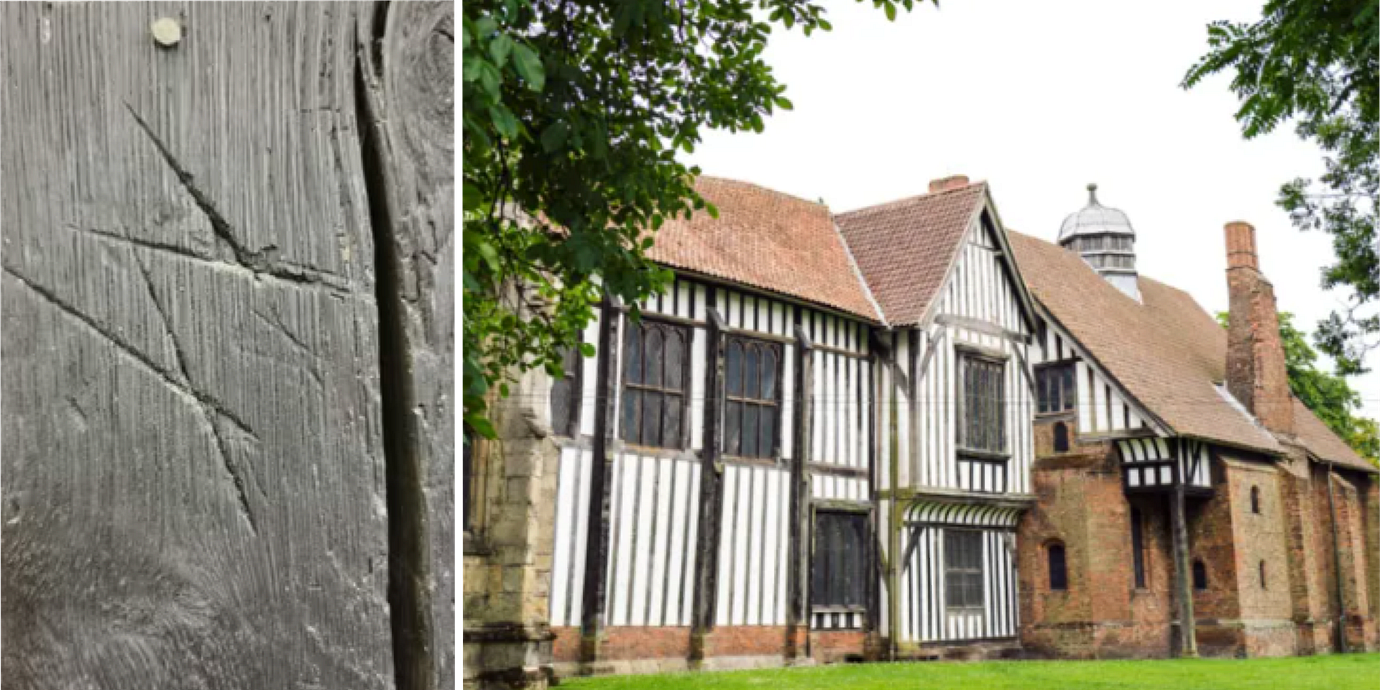
”Förbluffande många” häxmärken och andra inskriptioner har hittats i 600 år gamla Gainsborough Old Hall. Det rapporterar brittiska medier.

Rick Berry, volontär för välgörenhetsorganisationen English heritage, har upptäckt kring 20 inristningar vid en inventering av den historiska byggnaden, som bland annat besöktes av kung Henrik VIII och hans femte hustru Catherine Howard.

Inskriptionerna är så kallade apotropeiska inristningar och tänkta att skydda mot exempelvis ondska och demoner. Somliga är i formen av överlappande V:n och åkallar jungfru Maria. Det finns även brännmärken som ska skydda mot bränder.

– Det är ett mysterium varför just den här byggnaden har så många beskyddande inristningar, säger Kevin Booth vid English Heritage.

I ett fall har den tidigare ägaren William Hickmans namn skrivits in uppochned, något som kan syfta till att förbanna Hickman som inte var särskilt omtyckt.

bakgrund
 
Gainsborough Old Hall
Wikipedia (en)
Gainsborough Old Hall in Gainsborough, Lincolnshire is over five hundred years old and one of the best preserved medieval manor houses in England. The hall was built by Sir Thomas Burgh in 1460. The Burghs were rich, flamboyant and powerful. Gainsborough Old Hall was not only their home, but also a demonstration of their wealth and importance. Burgh was a benefactor to Newark Church and also the founder of the Chantry and Alms House at Gainsborough. In 1470, the manor was attacked by Sir Robert Welles over a clash about lands, status, and honour, but it was not severely damaged. In 1484 Thomas entertained King Richard III in his hall. Henry VII intended to raise Thomas to the pre-eminence of a Barony, but no second writ was issued, nor was a patent. In 1510, Thomas Burgh's son, Edward Burgh, 2nd Baron Burgh, was incarcerated at the Old Hall after being declared a lunatic, never having attended the House of Lords. He died in 1528, leaving his eldest son Sir Thomas as head of the family. He was regarded as 1st Baron Burgh, de jure 3rd. In 1529, Thomas' son and heir, Edward, married Catherine Parr, later Queen consort to King Henry VIII. The couple stayed at Gainsborough Old Hall until 1530, when they were granted their own manor in Kirton-in-Lindsey. Henry VIII visited Gainsborough twice: once in 1509, and again in 1541 with his fifth wife, Queen Catherine Howard. The Queen was accused of indiscretions both at Gainsborough and Lincoln, and she was later executed. Catherine Parr, by this time widowed twice (Edward Burgh having died in 1533), became Henry's sixth wife. When Thomas, the fifth Lord Burgh, died without an heir, the Hall was sold in 1596 to William Hickman, a merchant from London, who made many improvements, especially to the east wing. William and his mother Rose supported John Smyth and the Separatist movement, and allowed them to meet and worship in the hall from 1603 until they sailed to the low countries to find religious freedom and establish the Baptist movement. The Hickman family continued to play a prominent role in the development of Gainsborough, and many became local members of Parliament. Sir Neville Hickman invited John Wesley to preach in the Great Hall several times in 1759, and in 1761 and 1764. In 1720 a new house was built at Thonock on the edge of the town and the Old Hall became unoccupied. It remained in the family and was used for a variety of purposes. Architecturally, the Old Hall has changed very little over the years. It is principally a timber framed building, giving a characteristic 'striped' or 'black and white' appearance. On the north-east corner is a brick tower. A splendid view of the town is available after a fifty-nine-step climb to the top. Today, the Hall with its elaborate timber roof survives, with a kitchen which is possibly the most complete medieval kitchen in England. The kitchen still contains many original features, including two open fireplaces, each large enough to roast an ox, and two bread ovens served by a third chimney. The Hall contains a great number of "witches' marks", thought to prevent against evil, and curses carved into its walls. There are also many burn marks, to protect against fire. The tower of the Old Hall is supposedly haunted by the Grey Lady, thought to be the daughter of the Lord of the Manor, who fell in love with a poor soldier and planned to elope with him. Her father discovered the plan and locked her away in the tower, where she died from a broken heart. According to local legend, the girl's spirit still wanders the tower, endlessly waiting for her lover to arrive. The house was looked after from 1949 by a volunteer group, The Friends of the Old Hall (FOHA), who saved the building and first opened it to the public. Sir Edmund Bacon gave it to the nation in 1970. The house is now owned by English Heritage and is open to the public as a museum. It is listed as Grade I for Heritage Protection. The Friends organisation still exists, and provides volunteer guides and other expertise.
bakgrund
 
English Heritage
Wikipedia (en)
English Heritage (officially the English Heritage Trust) is a charity that manages over 400 historic monuments, buildings and places. These include prehistoric sites, medieval castles, Roman forts, and country houses. The charity states that it uses these properties to "bring the story of England to life for over 10 million people each year". Within its portfolio are Stonehenge, Dover Castle, Tintagel Castle, and the best-preserved parts of Hadrian's Wall. English Heritage also manages the London blue plaque scheme, which links influential historical figures to particular buildings. When originally formed in 1983, English Heritage was the operating name of an executive non-departmental public body of the British Government, officially titled the Historic Buildings and Monuments Commission for England, that ran the national system of heritage protection and managed a range of historic properties. It was created to combine the roles of existing bodies that had emerged from a long period of state involvement in heritage protection. In 1999, the organisation merged with the Royal Commission on the Historical Monuments of England and the National Monuments Record, bringing together resources for the identification and survey of England's historic environment. On 1 April 2015, English Heritage was divided into two parts: Historic England, which inherited the statutory and protection functions of the old organisation, and the new English Heritage Trust, a charity that would operate the historic properties, and which took on the English Heritage operating name and logo. The British government gave the new charity an £80 million grant to help establish it as an independent trust, although the historic properties remain in the ownership of the state.
bakgrund
 
Apotropeism
Wikipedia (sv)
Apotropeism, från grekiska ἀποτρόπαιος, apotropaios, "avvärjande", är rituella handlingar som har ett avvärjande, avskräckande eller skyddande syfte. En gest eller ett föremål (då kallat apotropeiskt föremål) används för att hålla onda väsen eller fiender borta. Det kan också innebära ett skydd mot onda ögat eller då det onda redan inträffat förrätta reningsritualer i form av till exempel exorcism eller syndabekännelse. Vanliga apotropeiska handlingar kan vara att göra korstecken, knacka i bordet, spotta, tända eldar eller rökelse, spela på musikinstrument (som trummor eller klockor) eller bära amuletter. I medelhavsländer används gesterna fica och corna som skydd mot onda ögat. Inom folkmedicin och folktro används apotropeiska föremål som ellakors, vådastål och dyvelsträck. Material som silver och stål har i folktro ansetts som effektivt mot onda makter och föremål av dessa material har använts som amuletter. Föremål av stål lades i den nyföddas säng och den dödas kista som skydd.
bakgrund
 
Sir William Hickman, 2nd Baronet
Wikipedia (en)
Sir William Hickman. 2nd Baronet (8 January 1629 – 10 February 1682) was an English politician who sat in the House of Commons from 1660 to 1682. Hickman was the son of Sir Willoughby Hickman, 1st Baronet and his wife Bridget Thornhaugh, daughter of Sir John Thornhaugh of Fenton, Nottinghamshire. He inherited the baronetcy on the death of his father in 1649. In 1660, Hickman was elected Member of Parliament for East Retford in the Convention Parliament. He was re-elected MP for East Retford for the Cavalier Parliament in 1661 and held his seat through successive parliaments until his death in 1682. He was a Commissioner of the Ordnance from 1679 to his death. Hickman died in 1682 at the age of 53. He had married Elizabeth Neville, daughter of John Nevile of Mattersey Priory, Nottinghamshire. He was succeeded in the baronetcy by their son Willoughby.
Omni är politiskt obundna och oberoende. Vi strävar efter att ge fler perspektiv på nyheterna. Har du frågor eller synpunkter kring vår rapportering? Kontakta redaktionen