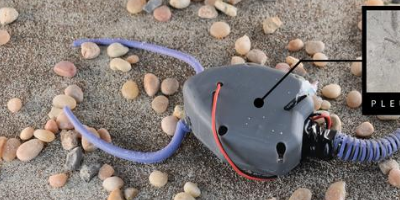
Forskare bygger kopia – djuret dog ut för 450 miljoner år sedan
Forskare på maskintekniska institutionen vid Carnegie Mellon University har skapat en robotversion av en pleurocystitid, en havslevande tagghuding som dog ut för 450 miljoner år sedan. Det skriver Science Daily.
Den nya versionen av djuret är en så kallad ”mjuk” robot, som använder mjuka material för att skapa ”flexibla robotlemmar och bihang”, som Carmel Majidi, en av forskarna bakom projektet, uttrycker saken i en vetenskaplig artikel.
Pleurocystitiden var en enkel livsform som tros ha varit en av de första att använda sig av en muskelstam för att ta sig fram i vattnet. Forskarna hoppas att den nya roboten ska ge kunskap som kan användas för att utveckla framtidens robotteknik.
bakgrund
Tagghudingar
Wikipedia (en)
An echinoderm () is any member of the phylum Echinodermata (). The adults are recognisable by their (usually five-point) radial symmetry, and include starfish, brittle stars, sea urchins, sand dollars, and sea cucumbers, as well as the sea lilies or "stone lilies". Adult echinoderms are found on the sea bed at every ocean depth, from the intertidal zone to the abyssal zone. The phylum contains about 7,000 living species, making it the second-largest grouping of deuterostomes, after the chordates. Echinoderms are the largest entirely marine phylum. The first definitive echinoderms appeared near the start of the Cambrian.
The echinoderms are important both ecologically and geologically. Ecologically, there are few other groupings so abundant in the biotic desert of the deep sea, as well as shallower oceans. Most echinoderms are able to reproduce asexually and regenerate tissue, organs, and limbs; in some cases, they can undergo complete regeneration from a single limb. Geologically, the value of echinoderms is in their ossified skeletons, which are major contributors to many limestone formations, and can provide valuable clues as to the geological environment. They were the most used species in regenerative research in the 19th and 20th centuries. Further, some scientists hold that the radiation of echinoderms was responsible for the Mesozoic Marine Revolution.
Omni är politiskt obundna och oberoende. Vi strävar efter att ge fler perspektiv på nyheterna. Har du frågor eller synpunkter kring vår rapportering? Kontakta redaktionen