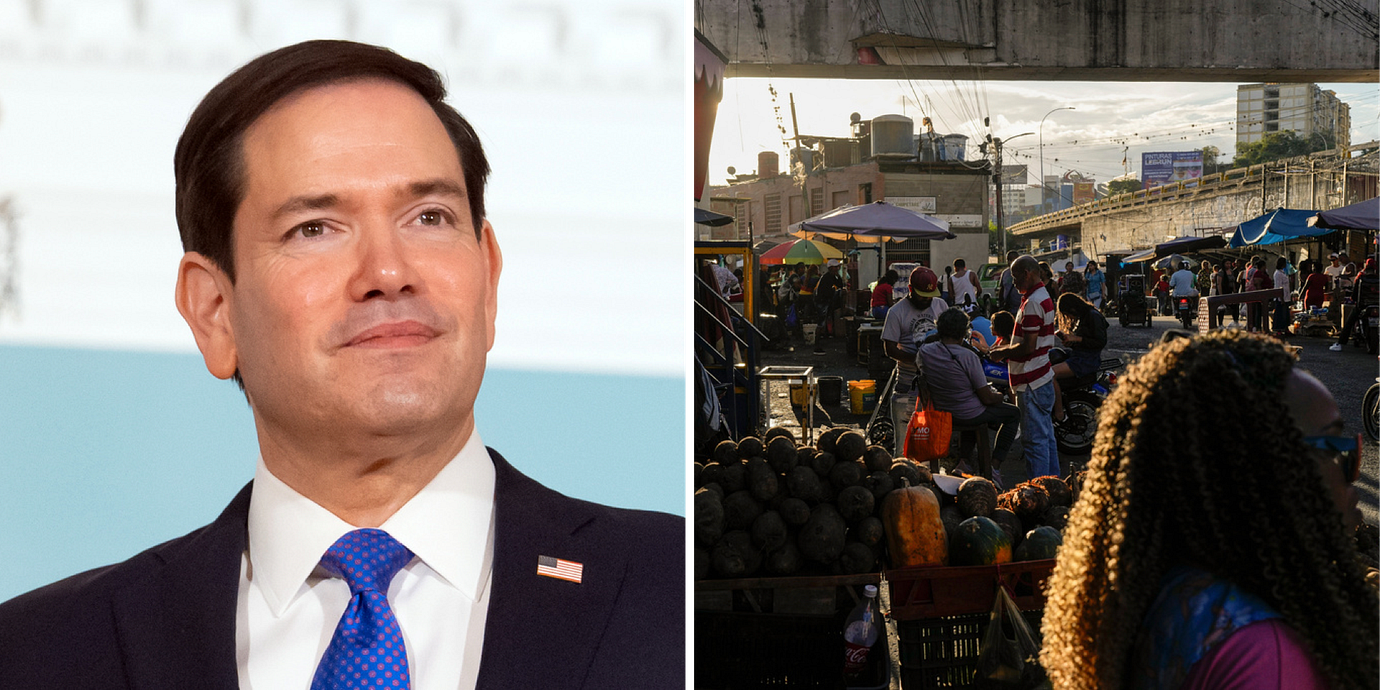
Källor: Marco Rubio styr Venezuela från USA
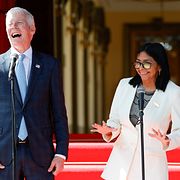
Efter tillfångatagandet av Nicolás Maduro lekte Donald Trump med tanken på att placera Marco Rubio i Venezuela för att styra landet. I dag har det till hälften blivit verklighet – den amerikanske utrikesministern styr i praktiken Venezuela från Washington, uppger flera källor i båda länder för New York Times.
Trots att han aldrig besökt landet kontrollerar Rubio dess finanser, naturresurser och regering, enligt källorna. Han håller regelbundet kontakt med den USA-godkända interimspresidenten Delcy Rodríguez – de har en Whatsapp-chatt där de skriver på spanska och utbyter skvaller, selfies och födelsedagshälsningar.
Utåt sett tonar Rubio ner sin roll i Venezuela. De båda ländernas regeringar vill inte kommentera uppgifterna.
bakgrund
USA:s attack mot Venezuela
Wikipedia (en)
On 3 January 2026, the United States launched a military strike in Venezuela and captured incumbent Venezuelan president Nicolás Maduro and his wife, Cilia Flores. The US operation, codenamed Operation Absolute Resolve, began around 2 a.m. local time, when explosions were observed. The US Armed Forces bombed infrastructure across northern Venezuela to suppress air defenses as an apprehension force attacked Maduro's compound in Caracas. Maduro and Flores were transported to New York City by US forces to face their trial for drug trafficking there. The operation is sometimes considered a military conflict because seven US soldiers were injured. At 2 hours and 28 minutes, it qualifies as one of the shortest wars in history.
The US federal government announced that Maduro and Flores had been indicted on several charges related to narcoterrorism. Maduro and Flores pleaded not guilty to the charges in Manhattan federal court on 5 January 2026. US president Donald Trump and his administration justified the operation as a law-enforcement action, with military support, that the president has "inherent constitutional authority" to undertake.
Venezuelan vice president Delcy Rodríguez denounced Maduro's "kidnapping". Venezuelan officials said at least 23 Venezuelan security officers were killed during the attack. The Cuban government said that 32 members of the Cuban military and intelligence agencies were killed. Officials in the United Nations (UN), the US, and other countries, as well as international law experts said the raid violated the UN Charter and Venezuela's sovereignty.. Other reactions around the world included celebrations by the Venezuelan diaspora and protests against the attack.
The Venezuelan government remained in place, with Rodríguez sworn in as acting president on 5 January 2026. Multiple political prisoners (including foreigners) detained in Venezuela were released, a gesture which, according to Trump, contributed to avoiding a second wave of attacks. On 30 January, Rodríguez announced an amnesty bill for political prisoners covering the period of 1999 to present, which was approved on 19 February. As of 8 March, the number of political prisoners released confirmed since 8 January was 621 out of an estimate of over 800 held before January, according to human rights organizations. By February, the US and Venezuela had already restarted diplomatic relations, with the Embassy of the United States, Caracas, being reopened for the first time since its closure in 2019.
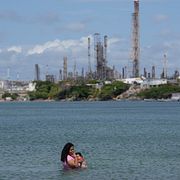
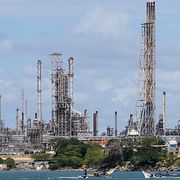
Trump and his administration made clear that access to Venezuelan oil was a core reason for the action. The US announced a 50-million-barrel oil supply deal with the remaining government in Venezuela, with the first $300 million already received on 20 January. On 29 January, a new law was passed by Rodríguez to give private companies control over the production and sale of oil. In parallel, the US lifted sanctions imposed on Venezuelan oil trade and issued licenses for companies to trade Venezuelan oil. According to US secretary of energy Chris Wright, who visited Venezuela in February, sales of Venezuelan oil have already reached over $1 billion since Maduro's capture and about $5 billion are expected in the upcoming months.
In May 2026, the interim Venezuelan authorities also collaborated in the capture and deportation to the United States of Alex Saab, a close ally of Maduro who was previously pardoned by previous US president Joe Biden during a prisoner exchange and in request for democratic presidential elections in Venezuela in 2024. In June 2026, Niño Guerrero, leader of the Venezuelan criminal organization Tren de Aragua, was killed in a joint operation between Venezuela and the United States.
Omni är politiskt obundna och oberoende. Vi strävar efter att ge fler perspektiv på nyheterna. Har du frågor eller synpunkter kring vår rapportering? Kontakta redaktionen