bakgrund
Kinas kärnvapenprogram
Wikipedia (en)
China's stockpile of nuclear weapons is estimated at 600 nuclear warheads as of 2025, making it the world's third-largest nuclear arsenal. China was the fifth country to develop nuclear weapons, conducting its first test in 1964 and its first full-scale thermonuclear test in 1967. China is one of the five nuclear-weapon states recognized by the Nuclear Non-Proliferation Treaty (NPT), to which it acceded in 1992. China conducted 45 nuclear tests before signing the Comprehensive Nuclear-Test-Ban Treaty in 1996. China is the only NPT nuclear-weapon state significantly expanding its arsenal, projected to reach 1,000 warheads by 2030 and up to 1,500 by 2035. Compared to the arsenals of the United States and Russia, a much smaller proportion of China's warheads are believed to be deployed on their delivery systems, with the remainder stored separately.
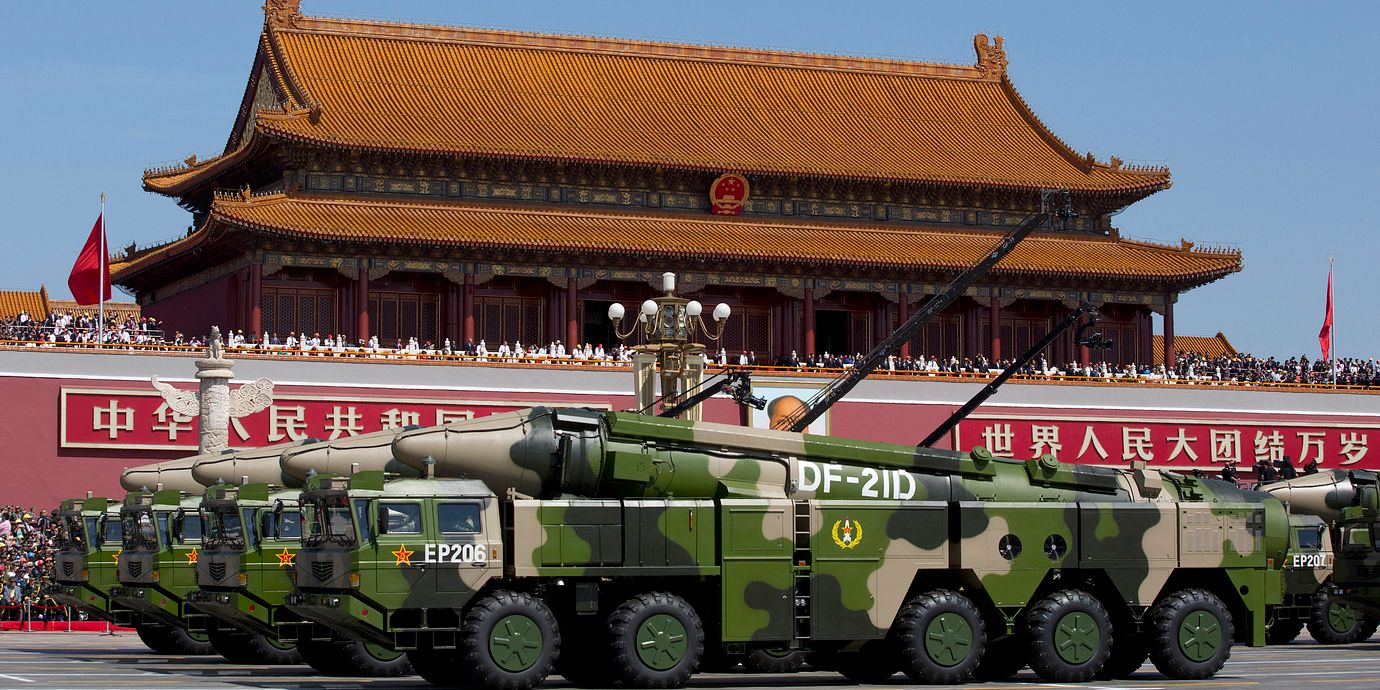
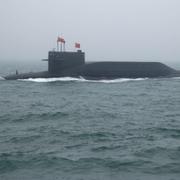
Since 2020, the People's Liberation Army has operated a nuclear triad. Of its 600 warheads, it is estimated 376 are assigned to its Rocket Force's Dongfeng intermediate and intercontinental ballistic missiles, 72 to its Navy's Julang-3 submarine-launched ballistic missiles on six Type 094 submarines, and 20 to its Air Force's Jinglei-1 air-launched ballistic missiles for 20 Xi'an H-6N strategic bombers. Approximately 132 warheads await assignment; China operates 804 strategic ballistic missiles, the world's largest such force. China is upgrading its triad with the in-development Xi'an H-20 stealth bomber, Type 096 submarine, and large missile silo fields. China fields multiple independently targetable reentry vehicles, and has tested hypersonic glide vehicles and a fractional orbital bombardment system. China operates early warning systems including at least three satellites, and four large phased array radars. It operates HQ-29, HQ-19 and S-400 air defense systems with anti-ballistic missile capability.
Since 1964, China has maintained a declaratory policy of no-first-use, called for an international no-first-use treaty. It has not fielded tactical nuclear weapons. Prior to the 21st century, China held to a minimal deterrence policy focused on countervalue targets. Officially, China's nuclear command and control requires the Politburo and Central Military Commission to jointly authorize the alerting and use of nuclear weapons. With a build-up in its arsenal in the 2020s, some nuclear forces are reported to have moved toward a launch on warning posture.
China has consistently rejected arms control talks with the US and Russia on the grounds of its smaller stockpile. In the early Cold War, China considered the US its strategic adversary. China received aid, technology transfer and a nuclear umbrella from the Soviet Union between 1955 and 1960. However, the Sino-Soviet split ended Soviet assistance. Following the Sino-Soviet border conflict, the US extended an informal nuclear umbrella to China, and China viewed the Soviet Union as its primary threat until a rapprochement at the end of the Cold War. China resumed nuclear weapons planning focused on the US from the early 2000s after their relations were strained by the Third Taiwan Strait Crisis and US bombing of the Chinese embassy in Belgrade.
All of China's civilian and military nuclear programs are operated by China National Nuclear Corporation, formerly the Second Ministry of Machine Building. China's level of nuclear warhead technology is similar to that of United States and Russia, despite conducting far fewer nuclear tests. All documented nuclear tests, 23 atmospheric and 22 underground, were conducted at Lop Nur Nuclear Test Base in Xinjiang. China is believed to have halted weapons-grade nuclear material production in 1990. Chinese aid was instrumental to Pakistan's nuclear weapons program, and its nuclear capability influenced the nuclear weapons programs of India and Taiwan. Like other CTBT adherents, China is believed to use supercomputers and inertial confinement fusion in a warhead verification program analogous to stockpile stewardship. Since 2020, the US has accused China of covertly resuming underground nuclear testing. China is also reported to have operated chemical and biological weapons programs during the Cold War and possibly beyond.