Kinesiska kärnvapenbaser byggs ut: ”Aldrig sett något liknande”
Kina bygger i tysthet ut flera av sina kärnvapenanläggningar i stor skala, rapporterar Reuters. Nyhetsbyrån har granskat nya satellitbilder som visar tusentals kvadratkilometer fyllda med avfyrningsplatser, bunkrar och andra byggnader.
– Jag har aldrig sett något liknande. Det är en extraordinär insats, säger Hans Kristensen på tankesmedjan Federation of American Scientists avdelning för kärnteknik.
Syftet med utbyggnaden kan vara att skydda den kinesiska kärnvapenarsenalen från angrepp och säkerställa att Kina kan slå tillbaka efter ett inledande kärnvapenangrepp från USA.
bakgrund
Kina har jordens tredje största kärnvapenarsenal – Rysslands och USA:s är långt större
Wikipedia (en)
China's stockpile of nuclear weapons is the world's third-largest, estimated at 620 nuclear warheads as of 2026. China was the fifth country to develop nuclear weapons, conducting its first test in 1964 and its first full-scale thermonuclear test in 1967. One of the five nuclear-weapon states recognized by the Nuclear Non-Proliferation Treaty (NPT), China conducted 45 nuclear tests before signing the Comprehensive Nuclear-Test-Ban Treaty in 1996. China is significantly expanding its arsenal, projected to reach 1,000 warheads by 2030 and up to 1,500 by 2035. Compared to the arsenals of the United States and Russia, a much smaller proportion of China's warheads are believed to be deployed on their delivery systems, with the remainder stored separately.
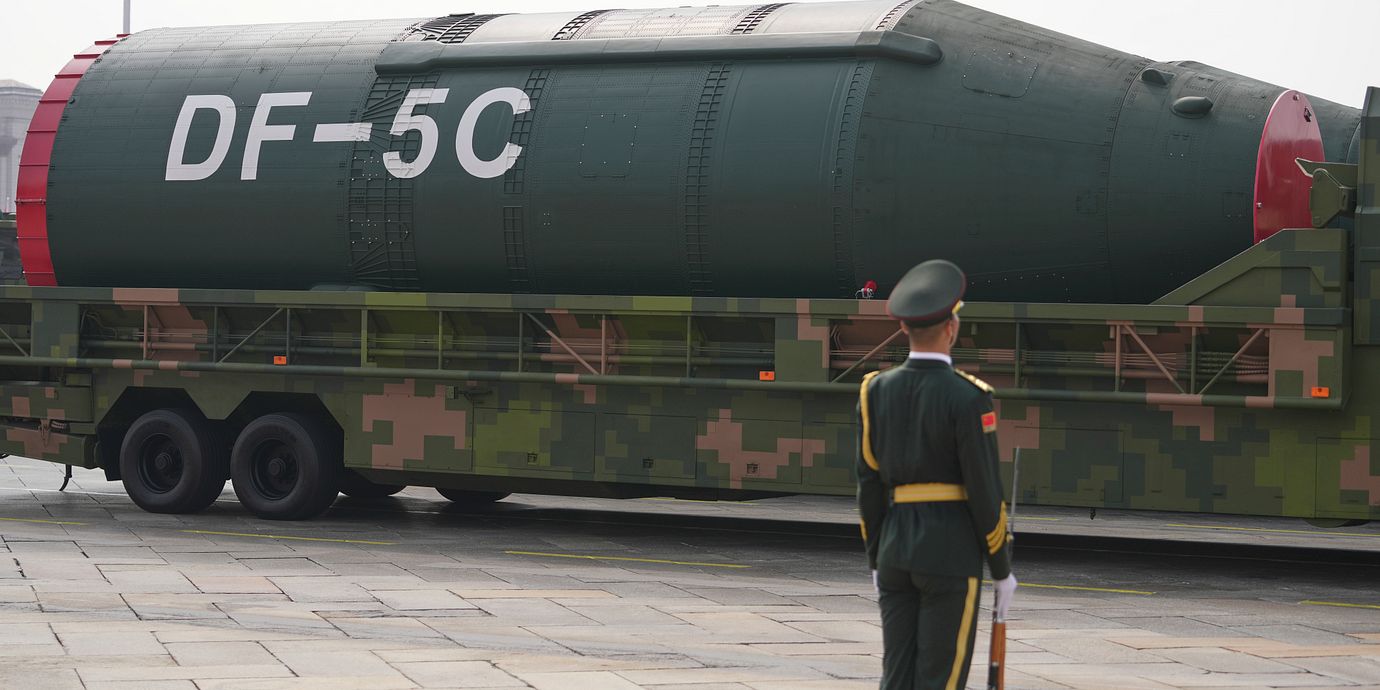
Since 2020, the People's Liberation Army has operated a nuclear triad. Of its 620 warheads, it is estimated 376 are assigned to its Rocket Force's Dongfeng intermediate and intercontinental ballistic missiles (ICBMs), 72 to its Navy's Julang-3 submarine-launched ballistic missiles on six Type 094 submarines, and 20 to its Air Force's Jinglei-1 air-launched ballistic missiles for 20 Xi'an H-6N strategic bombers. China is upgrading its triad with large ICBM silo fields, and in-development Xi'an H-20 stealth bomber and Type 096 submarine. China has tested hypersonic glide vehicles and a fractional orbital bombardment system. The Aerospace Force's early warning systems include at least three satellites, and four large phased array radars. China's anti-ballistic missiles include HQ-29, HQ-19, and S-400 systems.
Since 1964, China has declared a no-first-use policy, called for an international no-first-use treaty, and has not fielded tactical nuclear weapons. Prior to the 21st century, China held to a minimal deterrence policy focused on countervalue targets. Officially, China's nuclear command and control requires the Politburo and Central Military Commission to jointly authorize the alerting and use of nuclear weapons. In the 2020s, some nuclear forces adopted a launch on warning posture.
China consistently rejects official bilateral arms control talks with the US, on the grounds of its much smaller stockpile. In the early Cold War's Korean War and Taiwan Strait Crises, China confronted US nuclear threats, which were partially deterred by the Soviet nuclear arsenal. The Soviet Union transferred nuclear and missile technology from 1955 until the early Sino-Soviet split in 1960. The land-based Rocket Force has continuously operated the bulk of the country's nuclear forces from its founding in 1966 as the Second Artillery Corps. Following the Sino-Soviet border conflict, China received an informal nuclear umbrella from the US, and viewed the Soviet Armed Forces as its greatest threat, until a détente in 1989. China's nuclear weapons planning refocused on the US in the early 2000s, with relations strained by the Third Taiwan Strait Crisis and US bombing of the Chinese embassy in Belgrade. Since 2020, the US has accused China of covertly resuming underground nuclear testing.
China's civilian and military nuclear industries are operated by China National Nuclear Corporation, formerly the Second Ministry of Machine Building. China's level of warhead technology is similar to that of the US and Russia, despite conducting far fewer nuclear tests. All documented nuclear tests, 23 atmospheric and 22 underground, were conducted at Lop Nur Nuclear Test Base in Xinjiang. China is believed to have halted weapons-grade nuclear material production in 1990. China substantially aided Pakistan's nuclear weapons program, and influenced the programs of India and Taiwan. Like other CTBT adherents, China is believed to use supercomputers and inertial confinement fusion in a warhead verification program analogous to stockpile stewardship. China is also reported to have operated chemical and biological weapons programs during the Cold War and possibly beyond.
Omni är politiskt obundna och oberoende. Vi strävar efter att ge fler perspektiv på nyheterna. Har du frågor eller synpunkter kring vår rapportering? Kontakta redaktionen