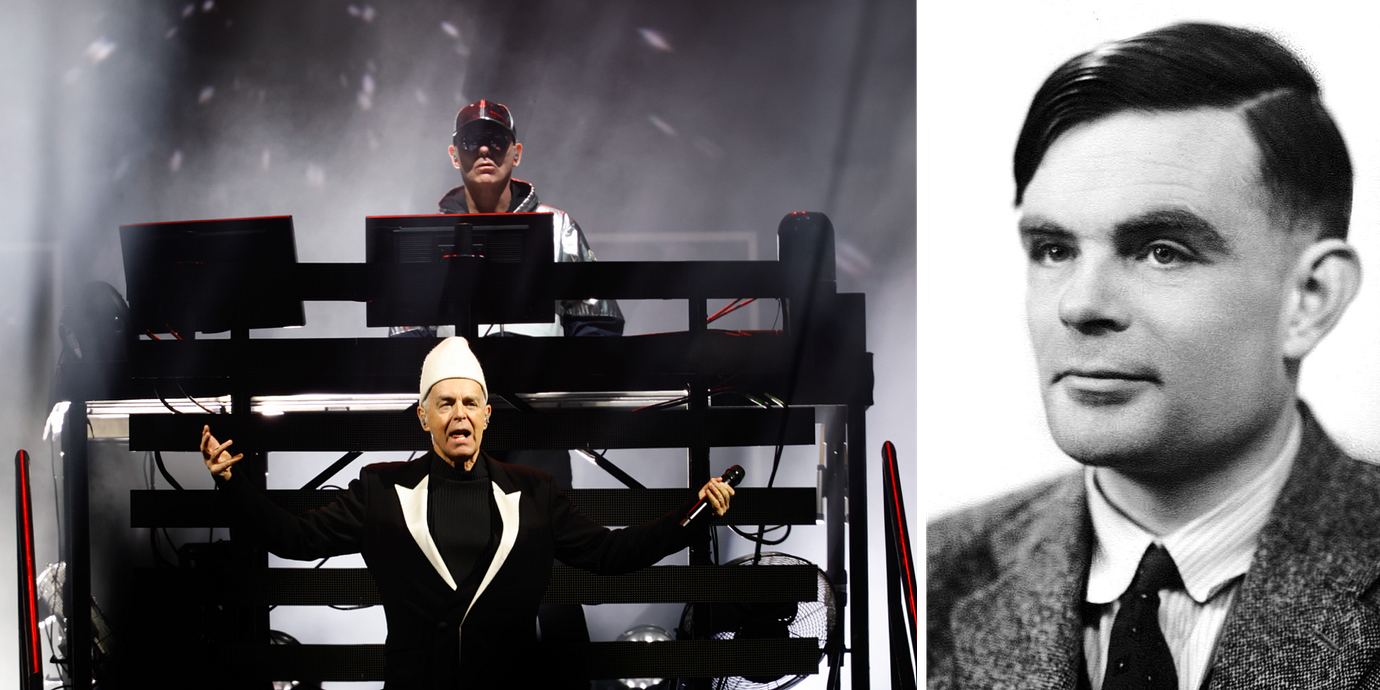
Pet Shop Boys hyllar Alan Turing på nya albumet
Synthpopbandet Pet Shop Boys nästa album kommer att handla om den brittiske matematikern Alan Turing, rapporterar NME.
Turing var en centralgestalt i arbetet med att knäcka de tyska nazisternas koder under andra världskriget. Han var också en tidig och inflytelserik tänkare inom AI-fältet, men förföljdes av den brittiska staten på grund av sin homosexualitet. Han tog sitt eget liv 1954.
”Vi ville skapa ett musikaliskt minnesmärke för Alan Turing, som gav så mycket till sitt land och till världen och belönades med att åtalas för sin sexualitet”, skriver bandmedlemmarna i ett uttalande.
bakgrund
Alan Turing
Wikipedia (en)
Alan Mathison Turing (; 23 June 1912 – 7 June 1954) was an English mathematician, computer scientist, logician, cryptanalyst, philosopher and theoretical biologist. He was highly influential in the development of theoretical computer science, providing a formalisation of the concepts of algorithm and computation with the Turing machine, which can be considered a model of a general-purpose computer. Turing is widely considered to be the father of theoretical computer science.
Born in London, Turing was raised in southern England. He graduated from King's College, Cambridge, and in 1938, earned a doctorate degree from Princeton University. During World War II, Turing worked for the Government Code and Cypher School at Bletchley Park, Britain's codebreaking centre that produced Ultra intelligence. He led Hut 8, the section responsible for German naval cryptanalysis. Turing devised techniques for speeding the breaking of German ciphers, including improvements to the pre-war Polish bomba method, an electromechanical machine that could find settings for the Enigma machine. He played a crucial role in cracking intercepted messages that enabled the Allies to defeat the Axis powers in the Battle of the Atlantic and other engagements.
After the war, Turing worked at the National Physical Laboratory, where he designed the Automatic Computing Engine, one of the first designs for a stored-program computer. In 1948, Turing joined Max Newman's Computing Machine Laboratory at the University of Manchester, where he contributed to the development of early Manchester computers and became interested in mathematical biology. Turing wrote on the chemical basis of morphogenesis and predicted oscillating chemical reactions such as the Belousov–Zhabotinsky reaction, first observed in the 1960s. Despite these accomplishments, he was never fully recognised during his lifetime because much of his work was covered by the Official Secrets Act.
In 1952, Turing was prosecuted for homosexual acts. He accepted hormone treatment, a procedure commonly referred to as chemical castration, as an alternative to prison. Turing died on 7 June 1954, aged 41, from cyanide poisoning. An inquest determined his death as suicide, but the evidence is also consistent with accidental poisoning. Following a campaign in 2009, British prime minister Gordon Brown made an official public apology for "the appalling way [Turing] was treated". Queen Elizabeth II granted a pardon in 2013. The term "Alan Turing law" is used informally to refer to a 2017 law in the UK that retroactively pardoned men cautioned or convicted under historical legislation that outlawed homosexual acts.
Turing left an extensive legacy in mathematics and computing which has become widely recognised with statues and many things named after him, including an annual award for computing innovation. His portrait appears on the Bank of England £50 note, first released on 23 June 2021 to coincide with his birthday. The audience vote in a 2019 BBC series named Turing the greatest scientist of the 20th century.
The cognitive scientist Douglas Hofstadter writes:
Atheist, homosexual, eccentric, marathon-running mathematician, A. M. Turing was in large part responsible not only for the concept of computers, incisive theorems about their powers, and a clear vision of the possibility of computer minds, but also for the cracking of German ciphers during the Second World War. It is fair to say we owe much to Alan Turing for the fact that we are not under Nazi rule today.
Omni är politiskt obundna och oberoende. Vi strävar efter att ge fler perspektiv på nyheterna. Har du frågor eller synpunkter kring vår rapportering? Kontakta redaktionen