Stoppade resenärer får borda flygningar till USA
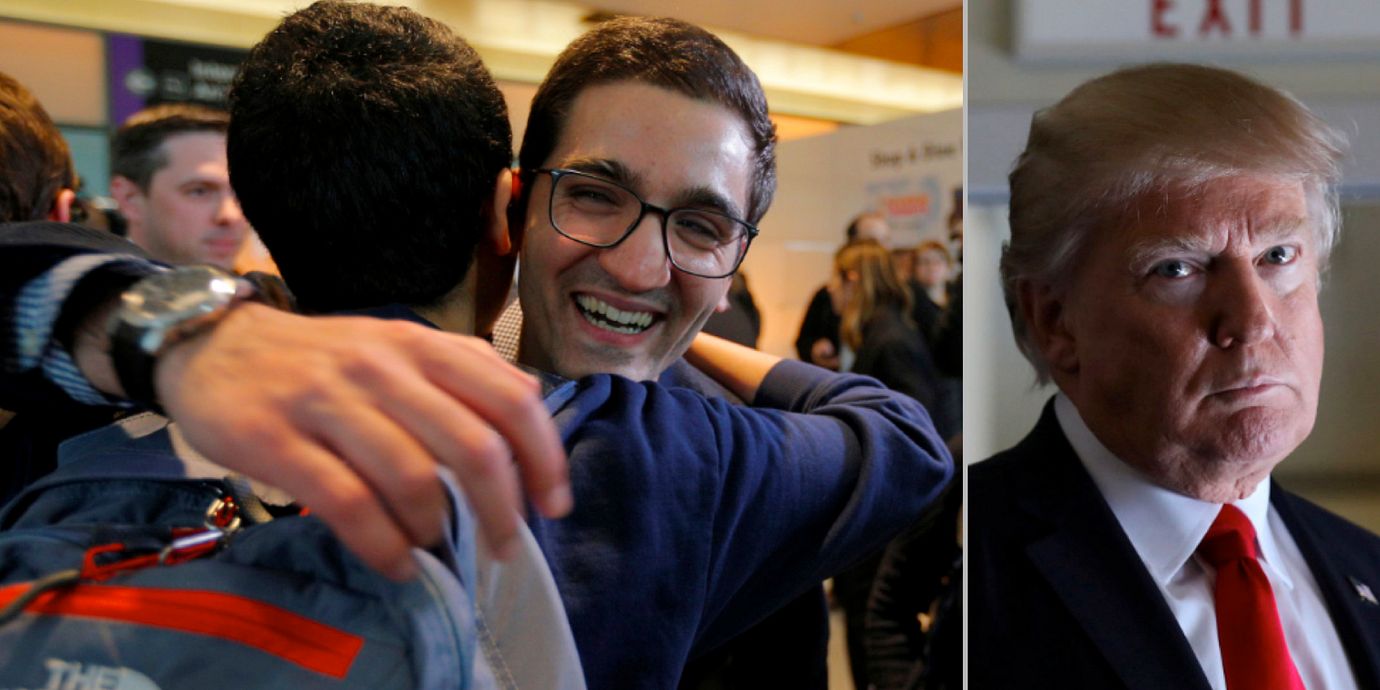
Resenärer som förbjudits att resa in i USA under Donald Trumps inresestopp har börjat anlända i USA efter att beslutet utmanats i det amerikanska rättssystemet.
En iransk student vid Worcester Polytechnic Institute, Behnam Partopour, flög till Boston från Frankfurt tillsammans med en grupp på flera personer som tidigare förbjudits inresa, skriver tidningen.
Flygbolag ska ha informerats av den amerikanska regeringen att de kan återgå till det tidigare systemet och tillåta resenärer från de sju länderna att åter gå ombord på plan till USA, skriver New York Times. Invånare från Irak, Iran, Libyen, Somalia, Sudan, Syrien och Jemen hade tidigare blockerats från inresa i landet.
bakgrund
Trumps inreseförbud
Wikipedia (en)
Executive Order 13769 —entitled "Protecting the Nation from Foreign Terrorist Entry into the United States"— is an executive order signed by U.S. President Donald Trump on January 27, 2017. The order, part of Trump's immigration-related campaign promises, established several provisions regarding entry into the United States, under the basis that measures taken by the government "did not stop attacks by foreign nationals who were admitted to the United States."
The order's most prominent provisions suspended the entry of certain foreign nationals into the U.S. Specifically, the order suspended the U.S. Refugee Admissions Program (USRAP) for 120 days, after which the program will be conditionally resumed for individual countries, while potentially prioritizing people of minority religions who are fleeing religious persecution (which various commentators described as a religious test). The order also indefinitely suspended the entry of refugees fleeing from Syria. Further, the order suspended the entry—regardless of valid non-diplomatic visas, which have all been revoked—of alien nationals from seven countries for 90 days, after which the list of countries will be updated. The initial seven countries are Iraq, Iran, Libya, Somalia, Sudan, Syria and Yemen, which were previously affected by a Congressional act during the Obama administration. The order allows exceptions to these suspensions on a case-by-case basis. Based on this allowance, the Department of Homeland Security exempted U.S. lawful permanent residents (green card holders), citing national interest provisions in the executive order.
The order also had other immediate and long-term effects. Immediately after the order's enactment, dozens of travelers were detained and held for hours without access to family, friends, or legal assistance. According to The Washington Post, the travel suspensions can potentially impact around 90,000 people, which is the number of immigrant and non-immigrant visas issued to people from the seven affected countries in fiscal year 2015. On 3 February, the U.S. Justice Department said that at least 100,000 visas were revoked in the first week following the order, in response to a question from a judge in court. On the same day, the State Department put the number at "fewer than 60,000".
Reactions to the order were mixed. Several lawsuits were filed, which argued that the order violated the U.S. Constitution, multiple federal statutes, and American treaty obligations. In response, several federal courts issued emergency orders halting detentions and expulsions pending final rulings. A seven day restraining order issued by a court in Boston, that allowed lawful immigrants from the seven barred nations be notified that they may enter the U.S. through Logan Airport, is set to expire on February 5, 2017. After the Boston ruling, the Department of Homeland Security said that it would continue to enforce all of the executive order and that "prohibited travel will remain prohibited." Plaintiffs in a court ruling in Virginia said that the government was in contempt of court and not following its orders. Domestically, the order also prompted criticism from Democratic and Republican members of Congress and from American universities, business leaders, Catholic bishops, and Jewish organizations. Some 1,000 U.S. diplomats signed a dissent cable opposing the executive order, setting a record. Public opinion was divided on the subject, with initial national polls yielding inconsistent results. Protests against the order erupted in several U.S. airports and cities.
Internationally, the order prompted broad condemnation, including from longstanding U.S. allies, although some international figures expressed support for it. The travel ban and suspension of refugee admissions was criticized by top United Nations officials and by a group of 40 Nobel laureates and thousands of other academics. Dozens of medical and scientific groups protested the order as well.
Omni är politiskt obundna och oberoende. Vi strävar efter att ge fler perspektiv på nyheterna. Har du frågor eller synpunkter kring vår rapportering? Kontakta redaktionen