Sudans oppositionelle ledare död
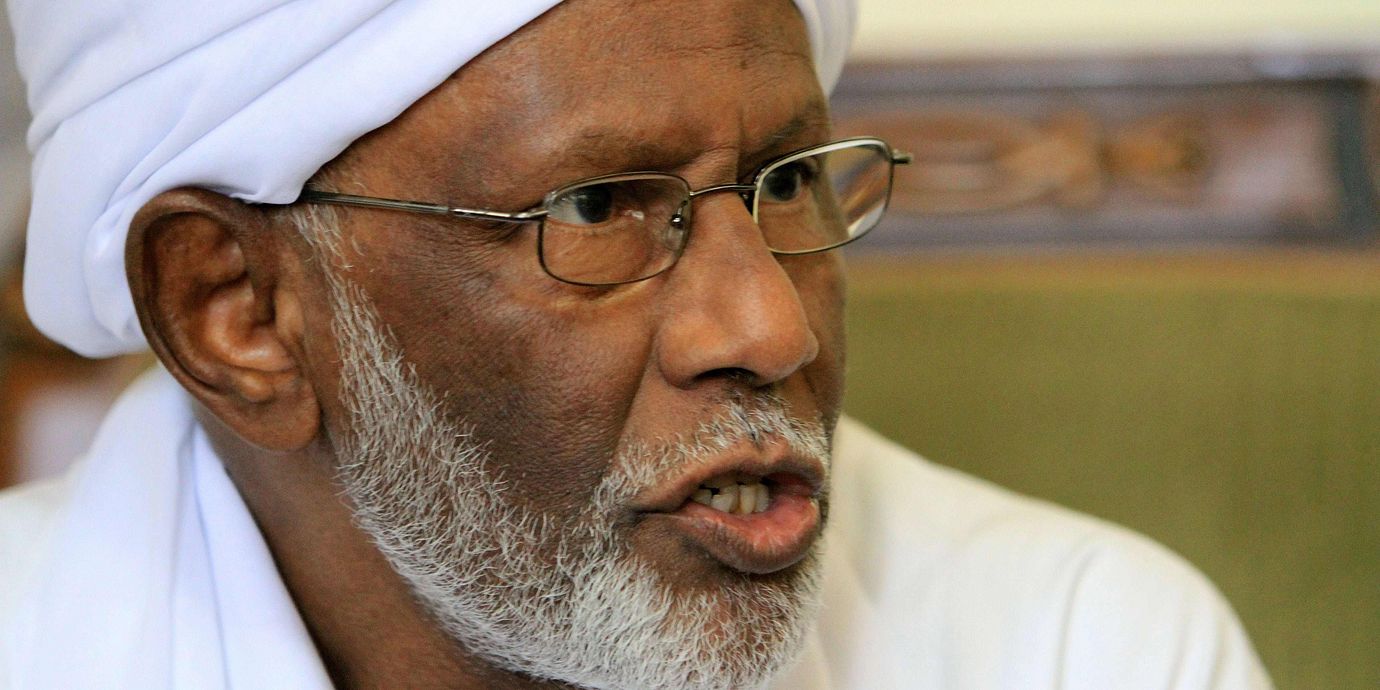
Den sudanesiske oppositionspolitikern Hassan al-Turabi dog på lördagen, 84 år gammal. Islamistledaren Turabi var en av de fränaste kritikerna av president Omar al-Bashirs regim, skriver AFP.
Efter beskedet att landets andlige ledare dött i en hjärtattack i huvudstaden Khartum avbröt den statliga televisionen sin sändning och sände i stället verser ur Koranen för att hedra honom.
bakgrund
Omar al-Bashir
Wikipedia (sv)
Omar Hassan Ahmad al-Bashir (arabiska: عمر حسن احمد البشير), född 1 januari (officiellt datum, verkligt datum okänt) 1944 i Hosh Bonnaga i nordöstra Sudan, är Sudans president sedan 30 oktober 1993. Han är ledare för Nationella kongresspartiet. Al-Bashir studerade på militärakademin i Kairo där han utbildades till fallskärmsjägare, och deltog i Oktoberkriget mellan Egypten och Israel 1973.
Al-Bashir kom till makten 1989 då han som överste i Sudans armé ledde en grupp officerare i en oblodig militärkupp som störtade premiärminister Sadiq al-Mahdis regering. Han var president för Revolutionära kommandorådet för nationens räddning mellan 30 juni 1989 och 16 oktober 1993.
I oktober 2004 förhandlade al-Bashirs regering fram ett slut på det andra sudanesiska inbördeskriget, ett av de längsta och dödligaste krigen under 1900-talet, genom att ge begränsad autonomi till Sydsudan. Sedan dess har dock hans regering kritiserats för dess roll i Darfurkonflikten, där folkmord mot den icke-arabiska befolkningen har lett till dödstal på mellan 200 000 och 400 000. Hans styre har lett till våldsamma strider mellan Janjaweedmilisen och rebellgrupper som Sudanesiska folkets befrielsearmé (SPLA), Sudans befrielserörelse (SLA) och Justice and Equality Movement (JEM) i form av gerillakrig i Darfurregionen. Inbördeskriget har lett till att över 2,5 miljoner drivits på flykt, och de diplomatiska relationerna mellan Sudan och Tchad befinner sig i kris.
I juli 2008 anklagade Internationella brottmålsdomstolens åklagare, Luis Moreno-Ocampo, al-Bashir för folkmord, brott mot mänskligheten och krigsförbrytelser i Darfur. Domstolen begärde den 4 mars 2009 al-Bashir häktad för krigsförbrytelser och brott mot mänskligheten, men bedömde att det inte fanns tillräcklig bevisning för att åtala honom för folkmord.
Arresteringsordern ska överlämnas till Sudans regering, som troligen inte kommer att verkställa den. Al-Bashir är den första sittande statschefen som någonsin blivit åtalad av Internationella brottmålsdomstolen.
^ ”FACTBOX - Sudan's President Omar Hassan al-Bashir”. 2008-07-14. http://www.reuters.com/article/topNews/idUKL1435274220080714. Läst 16 juli 2008.
^ BBC NEWS World Africa | Q&A: Sudan's Darfur conflict
^ The Genocide in Darfur — Briefing Paper Save Darfur
^ ”AUF Ineffective, Complain Refugees in Darfur”. Washingtonpost.com. http://www.washingtonpost.com/wp-dyn/content/article/2006/10/15/AR2006101500655.html. Läst 4 mars 2009.
^ http://news.bbc.co.uk/2/hi/africa/7394422.stm
^ Internationella brottmålsdomstolen (2008-07-14). ”ICC Prosecutor presents case against Sudanese President, Hassan Ahmad AL BASHIR, for genocide, crimes against humanity and war crimes in Darfur”. Arkiverad från originalet den 2008-07-15. http://web.archive.org/web/20080715053620/http://www.icc-cpi.int/press/pressreleases/406.html. Läst 17 juli 2008.
^ Internationella brottmålsdomstolen (4 mars 2009). PDF. Hämtad 4 mars 2009.
^ [a b c] BBC News, 4 mars 2009. Warrant issued for Sudan's Bashir . Hämtad 4 mars 2009.
^ Anna Koblanck (2009-03-04). ”Sudan protesterar mot att presidenten ska gripas”. Dagens nyheter. http://www.dn.se/nyheter/varlden/sudan-protesterar-mot-att-presidenten-ska-gripas-1.813077. Läst 2009-03-05.
bakgrund
Hassan al-Turabi
Wikipedia (en)
Hassan 'Abd Allah al-Turabi (born c.1932 in Kassala) died 3-2016 is a religious and Islamist political leader in Sudan. He has been called "one of the most influential figures in modern Sudanese politics", and a "longtime hard-line ideological leader". In particular he may have been instrumental in institutionalizing sharia Islamic law in the northern part of the country. He has been frequently imprisoned in Sudan, but these "periods of detention" have been "interspersed with periods of high political office".
Al-Turabi was leader of what was called the National Islamic Front (NIF) (which changed its name to National Congress in the late 1990s), a political movement that developed considerable political power in Sudan while never obtaining significant popularity among Sudanese voters. It embraced a "top down" approach to Islamisation of placing party members in high posts in the government and security services. Turabi and the NIF reached the peak of their power from 1989 following a military coup d'état, until 2001, as what observers have called "the power behind the throne", head of the only Sunni Islamist movement to take state control of a state.
Turabi oversaw highly controversial policies such as the creation of the "NIF police state" and associated NIF militias which consolidated Islamist power and prevented a popular uprising, but reportedly committed many human rights abuses, including "summary executions, torture, ill treatment, arbitrary detentions, denial of freedoms of speech, assembly, and religion, and violations of the rules of war, particularly in the south".
Turabi was a leader of opposition to the American-Saudi "coalition forces" in the Gulf War, establishing in 1990-1 the Popular Arab and Islamic Congress (PAIC), a regional umbrella for political Islamist militants, headquartered in Khartoum.
After 1996, al-Turabi and his party's "internationalist and ideological wing" saw a decline in influence in favor of more pragmatic leaders, brought on by the imposition of UN sanctions on Sudan in punishment for Sudan's assistance to Egyptian terrorists in their attempt to assassinate Egyptian President Hosni Mubarak.
As of 2015 Turabi and the NIF's fortunes have waned. Sudan has lost at least a third of its land and nearly all its oil fields as a result of the cession of South Sudan, and Turabi is out of power leading a splinter group of the National Congress known as the Popular (or People's) National Congress. His most recent imprisonment was 17 January 2011 for nine days, following civil unrest across the Maghreb.
bakgrund
Politiken i Sudan
Wikipedia (en)
Officially, the politics of Sudan takes place in the framework of a presidential representative democratic consociationalist republic, where the President of Sudan is Head of State, Head of Government and Commander-in-Chief of the Sudanese Armed Forces in a multi-party system. Legislative power is vested in both the government and in the two chambers, the National Assembly (lower) and the Council of States (upper), of the bicameral National Legislature. The judiciary is independent and obtained by the Constitutional Court. However, following a deadly civil war and the ongoing genocide in Darfur, Sudan is widely recognized as an authoritarian state where all effective political power is obtained by President Omar al-Bashir the ruling National Congress Party (NCP).
The political system of the Republic of Sudan was restructured following a military coup on 30 June 1989, when Omar al-Bashir, then a colonel in the Sudanese Army, led a group of officers and ousted the government of Prime Minister Sadiq al-Mahdi. Under al-Bashir's leadership, the new military government suspended political parties and introduced an Islamic legal code on the national level. He then became Chairman of the Revolutionary Command Council for National Salvation (a newly established body with legislative and executive powers for what was described as a transitional period), and assumed the posts of chief of state, prime minister, chief of the armed forces, and minister of defense. Further on, after institutionalizing Sharia law in the northern part of the country along with Hassan al-Turabi, al-Bashir issued purges and executions in the upper ranks of the army, the banning of associations, political parties, and independent newspapers and the imprisonment of leading political figures and journalists. In 1993, Sudan transformed into an Islamic totalitarian one-party state as al-Bashir abolished the Revolutionary Command Council and created the National Islamic Front (NIF) with a new parliament and government obtained solely by members of the NIF, and proclaimed himself President of Sudan. As a result, the Second Sudanese Civil War with the Sudan People's Liberation Army (SPLA) would only escalate in the following years.
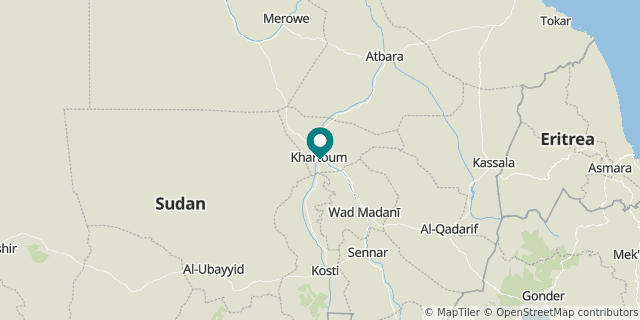
Khartum:
Omni är politiskt obundna och oberoende. Vi strävar efter att ge fler perspektiv på nyheterna. Har du frågor eller synpunkter kring vår rapportering? Kontakta redaktionen