bakgrund
”Gyllene kupolen”
Wikipedia (en)
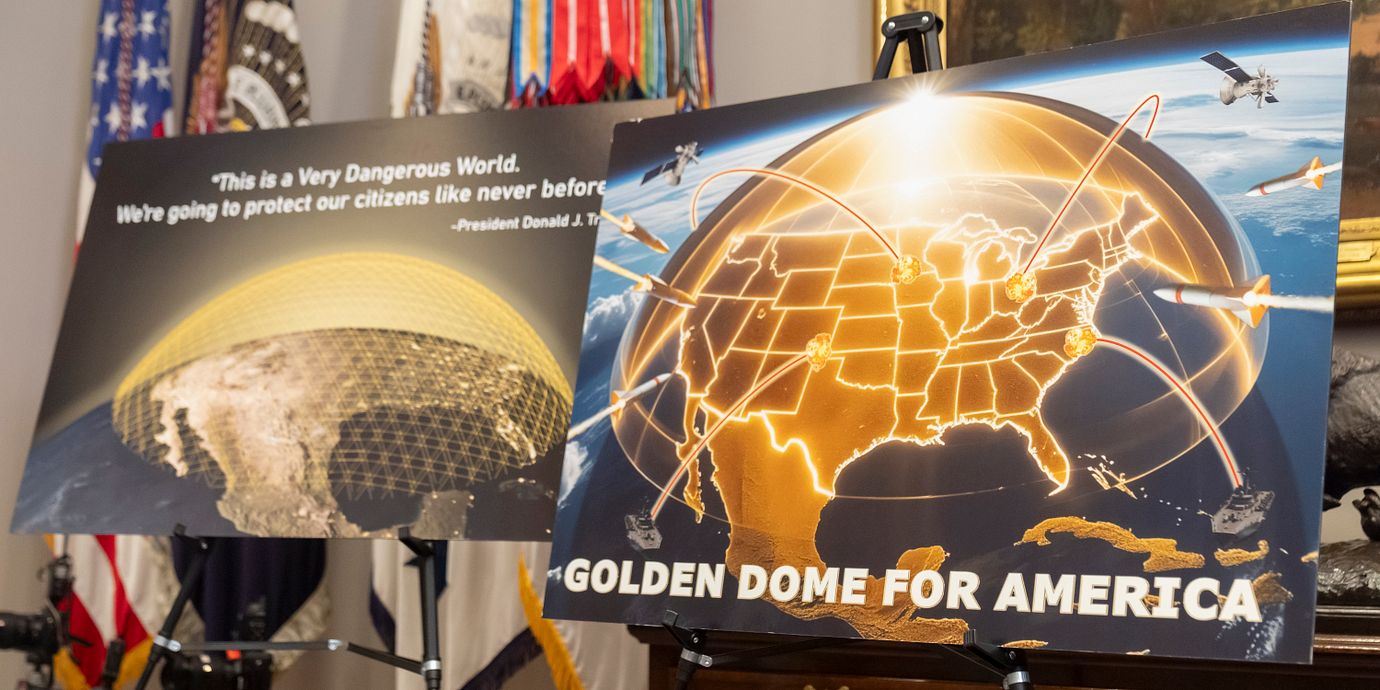
The Golden Dome is a proposed multi-layer missile defense system for the United States, intended to detect and destroy ballistic, hypersonic, and cruise missiles before they launch or during their flight.
On January 27, 2025, President Donald Trump signed an executive order directing the United States Armed Forces to construct the Iron Dome for America—later, Golden Dome—before the end of his term. The initial name alluded to Israel's short-range Iron Dome system, but the Golden Dome would encompass the entire Earth, more like the Strategic Defense Initiative proposed by President Ronald Reagan in 1983.
The system would employ a constellation of thousands of satellites equipped with sensors and interceptors that would be the first U.S. space weapons in orbit. Data centers in space would provide automated command and control through a cross-domain artificial intelligence-enabled network. Interceptors would fly in rapid orbit just outside the atmosphere, with only a small fraction available at the right time and place to act on any given threat—a flaw that critics argue makes the concept less efficient than traditional regional missile defenses such as Iron Dome. In 2019, Donald Trump said the satellites would also carry offensive weapons.
Cost estimates for the Golden Dome program range from $175 billion (White House), to $831 billion (Congressional Budget Office), to $3.6 trillion (American Enterprise Institute) depending on the architectural details. The wide range largely hinges on the number of space-based missiles and the cost of replacing satellites whose low orbits decay quickly due to atmospheric drag. Some $24.4 billion in federal funding was directed to Golden Dome in the One Big Beautiful Bill Act in 2025, with another $13 billion allocated for FY2026, totaling 2.2% of the federal discretionary budget during that year.
As of December 2025, the U.S. government has not publicly announced any contract awards for Golden Dome, though the Wall Street Journal has reported that SpaceX is "set to receive" a $2 billion contract to build a 600-satellite constellation for missile targeting. This came after Elon Musk's earlier denials of involvement, saying he was focused on Mars. Much smaller contracts for space-based interceptors were reportedly awarded "in secret" in late November. Awardees include Anduril Industries, Lockheed Martin, Northrop Grumman, and True Anomaly (a firm backed by JD Vance venture capital). In December, more than 1,000 "qualifying offerors" were deemed eligible for future awards.