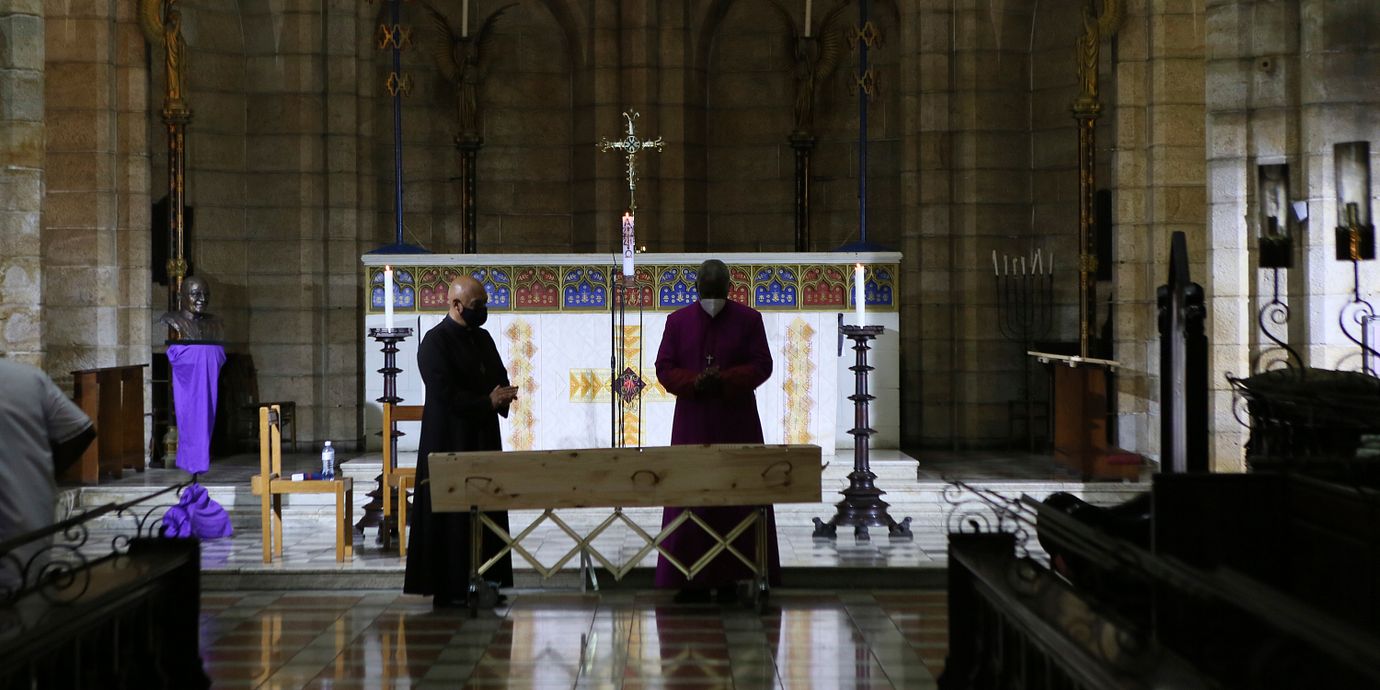
Tutus kropp förd till katedral för ett sista farväl
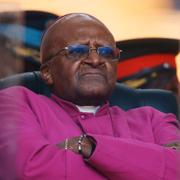
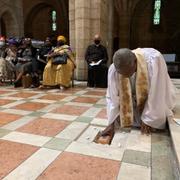
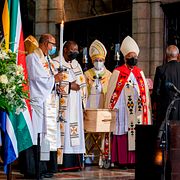
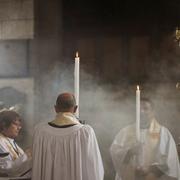
Ärkebiskop Desmond Tutus kropp har nu förts till katedralen St George i Kapstaden i Sydafrika, rapporterar AFP. En enkel furukista, med en liten bukett nejlikor på, bars fram av sex anglikanska präster.
Själva begravningen av Tutu kommer att hållas i helgen, och fram till dess kommer sydafrikaner kunna ta farväl av anti-apartheidikonen. Kistan kommer att stå uppställd i katedralen i två dagar.
Desmond Tutu dog den 26 december. Han blev 90 år.
bakgrund
Desmond Tutu
Wikipedia (en)
Desmond Mpilo Tutu (7 October 1931 – 26 December 2021) was a South African Anglican bishop and theologian, known for his work as an anti-apartheid and human rights activist. He was Bishop of Johannesburg from 1985 to 1986 and then Archbishop of Cape Town from 1986 to 1996, in both cases being the first black African to hold the position. Theologically, he sought to fuse ideas from black theology with African theology.
Tutu was born of mixed Xhosa and Motswana heritage to a poor family in Klerksdorp, South Africa. Entering adulthood, he trained as a teacher and married Nomalizo Leah Shenxane in 1955, with whom he had four children, including Mpho Tutu van Furth. In 1960, he was ordained as an Anglican priest and in 1962, he moved to the United Kingdom to study theology at King's College London. In 1966 he returned to Africa, teaching at the Federal Theological Seminary in South Africa, and then the University of Botswana, Lesotho and Swaziland. In 1972, he became the Theological Education Fund's director for Africa, a position based in London but necessitating regular tours of the African continent. Back in southern Africa in 1975, he served first as dean of St Mary's Cathedral in Johannesburg and then as Bishop of Lesotho.
From 1978 to 1985, Tutu was general-secretary of the South African Council of Churches. He emerged as one of the most prominent opponents of South Africa's apartheid system of racial segregation and white minority rule. Although warning the National Party government that anger at apartheid would lead to racial violence, as an activist he stressed non-violent protest and foreign economic pressure to bring about universal suffrage.
In 1985, Tutu became Bishop of Johannesburg and in 1986 the Archbishop of Cape Town, the most senior position in southern Africa's Anglican hierarchy. In this position, he emphasised a consensus-building model of leadership and oversaw the introduction of female priests. Also in 1986, he became president of the All Africa Conference of Churches, resulting in further tours of the continent. After President F. W. de Klerk released the anti-apartheid activist Nelson Mandela from prison in 1990 and the pair led negotiations to end apartheid and introduce multi-racial democracy, Tutu assisted as a mediator between rival black factions. After the 1994 general election resulted in a coalition government headed by Mandela, the latter selected Tutu to chair the Truth and Reconciliation Commission to investigate past human rights abuses committed by both pro and anti-apartheid groups. Following apartheid's fall, Tutu campaigned for gay rights and spoke out on a wide range of subjects, among them his support of Palestinians in the Israeli–Palestinian conflict (alongside his simultaneous belief in Israel's right to exist), his opposition to the Iraq War, and his criticism of South African presidents Thabo Mbeki and Jacob Zuma. In 2010, he retired from public life.
As Tutu rose to prominence in the 1970s, different socio-economic groups and political classes held a wide range of views about him, from critical to admiring. He was popular among South Africa's black majority and was internationally praised for his work involving anti-apartheid activism, resulting in him receiving a range of awards including the Nobel Peace Prize. He also compiled several books of his speeches and sermons.

BBC sammanfattar Desmond Tutus liv
Omni är politiskt obundna och oberoende. Vi strävar efter att ge fler perspektiv på nyheterna. Har du frågor eller synpunkter kring vår rapportering? Kontakta redaktionen