Wikipedia (en)
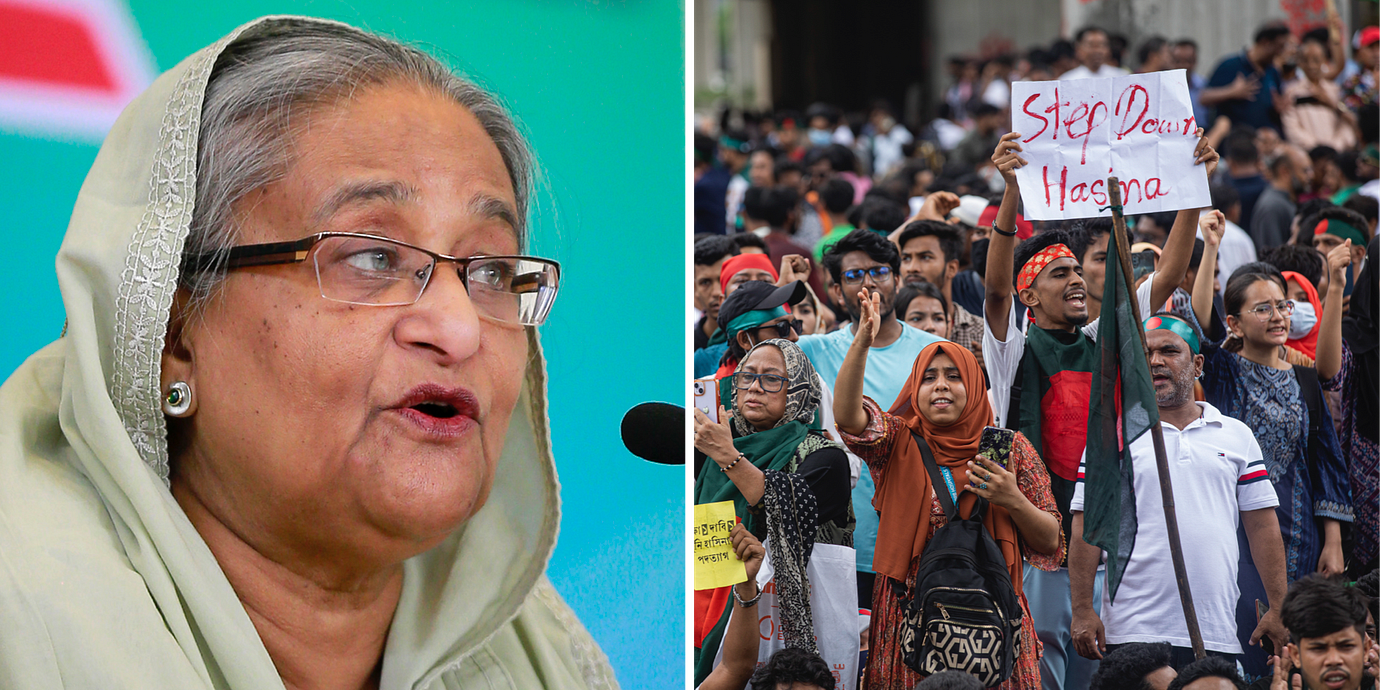
Sheikh Hasina Wazed (born 28 September 1947) is a Bangladeshi politician who served as the tenth prime minister of Bangladesh from June 1996 to July 2001 and later from January 2009 to August 2024. She is the daughter of Sheikh Mujibur Rahman, the founding father and first president of Bangladesh. Having served for a combined total of over 20 years, she was the longest serving prime minister in the history of Bangladesh. Before leaving office in 2024, she was the world's longest-serving female head of government.
As the autocratic regime of Hussain Muhammad Ershad came to an end, Hasina, leader of the Awami League (AL), lost the 1991 election to Khaleda Zia, with whom she had collaborated against Ershad. As leader of the opposition, Hasina accused Zia's Bangladesh Nationalist Party (BNP) of electoral dishonesty and boycotted the parliament, which was followed by violent demonstrations and political turmoil. Zia resigned to a caretaker government, followed by Hasina becoming prime minister after the June 1996 election. While the country began to experience economic growth and a reduction in poverty, it remained in political tumult during her first term, which ended in July 2001 after an electoral defeat from Zia. This was the first full five-year term for a Bangladeshi prime minister since it became an independent country.
During the 2006–2008 political crisis, Hasina was detained on extortion charges. After her release from jail, she won the 2008 election. In 2014, she was re-elected for a third term in an election that was boycotted by the BNP and criticised by international observers. In 2017, after nearly a million Rohingya entered the country, fleeing genocide in Myanmar, Hasina received credit and praise for giving them refuge and assistance. She won her fourth term after the 2018 election, which was marred with violence and widely criticised as being rigged.
Under her tenure as prime minister, Bangladesh has experienced democratic backsliding. Human Rights Watch documented widespread enforced disappearances and extrajudicial killings under her government. Many politicians and journalists have been systematically and judicially punished for challenging her views. In 2021, Reporters Without Borders gave a negative assessment of Hasina's media policy for curbing press freedom in Bangladesh since 2014. Hasina was among Time's 100 most influential people in the world in 2018, and was listed as being one of the 100 most powerful women in the world by Forbes in 2015, 2018, and 2022.