Tyska partiet AFD fortsatt misstänkt högerextremt
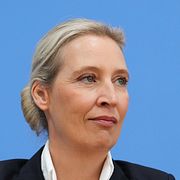
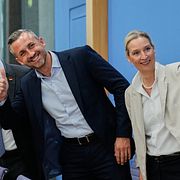
Högernationalistiska Alternativ för Tyskland (AFD) kommer fortsatt definieras som ”misstänkt högerextremt” av författningsskyddet som granskar extremistiska rörelser i landet. Det slog en tysk domstol fast på måndagen, rapporterar internationella medier.
Beslutet betyder att författningsskyddet får övervaka AFD, som väntas överklaga domen till den högsta förvaltningsdomstolen i Tyskland.
AFD har för tillfället runt 20 procent av det nationella väljarstödet i Tyskland, skriver Deutsche Welle.
bakgrund
Alternativ för Tyskland (AFD)
Wikipedia (en)
Alternative for Germany (German: Alternative für Deutschland, AfD; German pronunciation: [aːʔɛfˈdeː] ) is a right-wing populist political party in Germany. AfD is known for its Euroscepticism, as well as for opposing immigration to Germany. Described as a party of the far-right, the AfD is commonly positioned on the radical right, a subset of the far-right within the family of European political parties that generally does not reject democracy.
Established in April 2013, AfD narrowly missed the 5% electoral threshold to sit in the Bundestag during the 2013 German federal election. The party won seven seats in the 2014 European Parliament election in Germany as a member of the European Conservatives and Reformists (ECR). After securing representation in 14 of the 16 German state parliaments by October 2017, AfD won 94 seats in the 2017 German federal election and became the third-largest party in the country, as well as the largest opposition party; its lead candidates were the co-vice chairman Alexander Gauland and Alice Weidel, the latter having served as the party group leader in the 19th Bundestag. In the 2021 federal election, AfD dropped to being the fifth-largest party. Since 2023 polling shows AfD as the second most popular party.
AfD was founded by Gauland, Bernd Lucke, and former members of the Christian Democratic Union of Germany (CDU) to oppose the policies of the Eurozone as a right-wing and moderately Eurosceptic alternative to the centre-right but pro-European CDU. The party presented itself as an economically liberal, Eurosceptic, and conservative movement in its early years. AfD subsequently moved further to the right, and expanded its policies under successive leaderships to include opposition to immigration, Islam, and the European Union. Since 2015, AfD's ideology has been characterised by German nationalism Völkisch nationalism and national conservatism, with policy focus on anti-Islam, anti-immigration, welfare chauvinism and Euroscepticism. The AfD is the only party represented in the Bundestag whose environmental and climate policy is based on the denial of human-caused climate change.
Several state associations and other factions of AfD have been linked to or accused of harboring connections with far-right nationalist and proscribed movements, such as PEGIDA, the Neue Rechte, and the Identitarian movement, and of employing historical revisionism, as well as xenophobic rhetoric. They have been observed by various state offices for the protection of the constitution since 2018. AfD's leadership has denied that the party is racist and has been internally divided on whether to endorse such groups. In January 2022, party leader Jörg Meuthen resigned his party chairmanship with immediate effect and left the AfD, as he came to acknowledge that the party had developed very far to the right with totalitarian traits and in large parts was no longer based on the liberal democratic basic order.
The party is the strongest in the areas of the former German Democratic Republic, especially the states of Saxony and Thuringia, largely due to economic and integration issues that still continue to persist post-reunification, in addition to the East German voters' perceived propensity for a strongman rule. In the 2021 federal elections, AfD fell from third to fifth place overall but made gains in the eastern states (the former East Germany). In the former East Berlin it came in second after SPD with 20.5% of the vote, while in the west it came in fifth with 8.4% of the vote.
Omni är politiskt obundna och oberoende. Vi strävar efter att ge fler perspektiv på nyheterna. Har du frågor eller synpunkter kring vår rapportering? Kontakta redaktionen