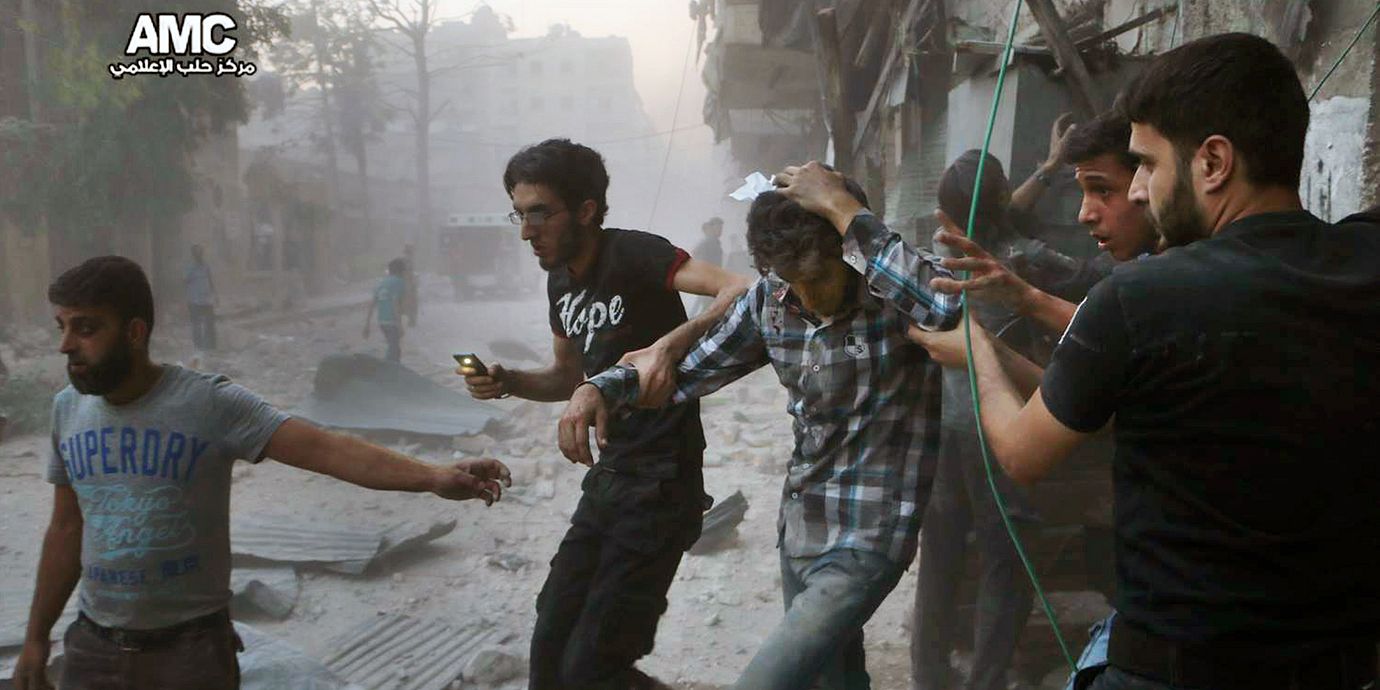
Aleppobor flyr bombningar på tisdagen. (Uncredited / TT NYHETSBYRÅN)

Uppgift: Fem döda i giftgasattack i Aleppo

Två attacker med giftgas uppges ha ägt rum i Syrien på tisdagen. Den ena ska ha tagit fem liv i Aleppo och regimen anklagar ”terrorister” för att ligga bakom dådet, skriver CNN.
– Fem civila dödades och åtta fick andningssvårigheter på grund av en terroristattack där man använde bomber som innehöll giftig gas, säger stadens hälsochef Mohamad Hazouri till statliga nyhetsbyrån Sana.
Tidigare på tisdagen uppgav en aktivistgrupp att en helikopter dumpat giftig gas över det rebellkontrollerade område i norra Syrien där en rysk militärhelikopter sköts ner i går.
Minst 33 personer ska ha skadats av gasen, varav flera kvinnor och barn i byn Saraqeb i Idlibprovinsen, enligt frivilligorganisationen Syrian Civil Defense.
Regimen har tidigare anklagats för att använda giftgas i inbördeskriget.

bakgrund
 
Syrian Civil Defense
Wikipedia (en)
ٍSyria Civil Defense (Arabic: الدفاع المدني السوري‎‎, SCD), also known as the White Helmets, is a grassroots, volunteer civil defense organization that operates throughout opposition-controlled Syria. It emerged in early 2013, primarily as a response to indiscriminate bombardment of civilian communities in rebel-held areas by the Syrian Arab Air Force. Since then, it has grown to a national organization of over 2850 volunteers operating from 114 local civil defense centers across 8 provincial directorates (Aleppo, Idlib, Latakia, Hama, Homs, Damascus, Damascus Countryside, and Daraa). SCD is credited with having rescued over 41,000 people from the rubble of destroyed buildings in the aftermath of airstrikes, artillery shelling, missile attacks and other forms of bombardment.
bakgrund
 
Kemiska vapen i syriska inbördeskriget
Wikipedia (en)
Use of chemical weapons in the Syrian Civil War has been confirmed by the United Nations. The deadliest attacks were the Ghouta attack in the suburbs of Damascus in August 2013 and the Khan al-Assal attack in the suburbs of Aleppo in March 2013. Several other attacks have been alleged, reported and/or investigated. A U.N. fact-finding mission and a UNHRC Commission of Inquiry have simultaneously investigated the attacks. The U.N. mission found likely use of the nerve agent sarin in the case of Khan Al-Asal (19 March 2013), Saraqib (29 April 2013), Ghouta (21 August 2013), Jobar (24 August 2013) and Ashrafiyat Sahnaya (25 August 2013). The UNHRC commission later confirmed the use of sarin in the Khan al-Asal, Saraqib and Ghouta attacks, but did not mention the Jobar and the Ashrafiyat Sahnaya attacks. The UNHRC commission also found that the sarin used in the Khan al-Asal attack bore "the same unique hallmarks" as the sarin used in the Ghouta attack and indicated that the perpetrators likely had access to chemicals from the Syrian Army's stockpile.
Omni är politiskt obundna och oberoende. Vi strävar efter att ge fler perspektiv på nyheterna. Har du frågor eller synpunkter kring vår rapportering? Kontakta redaktionen