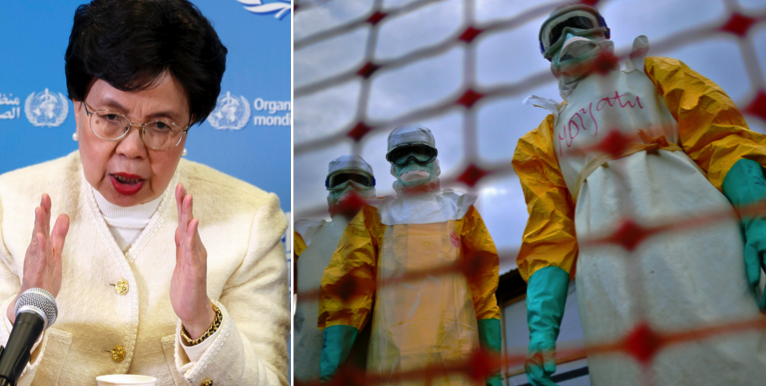
WHO: Hotet från ebola över
Ebolautbrottet i Västafrika är inte längre ett hot mot folkhälsan. Det sa WHO:s generalsekreterare professor Margaret Chan på tisdagen.
Därmed rekommenderar WHO att alla reserestriktioner till Guinea, Sierra Leone och Liberia ska lyftas.
Samtidigt har en ny variant av viruset återuppstått i Guinea.
Ebola krävdes 11 300 människors liv under de 20 månader som utbrottet i Västafrika pågick.
bakgrund
Epidemin i Västafrika
Wikipedia (en)
The most widespread epidemic of Ebola virus disease (commonly known as "Ebola") in history began in Guinea in December 2013 and has continued for over two years, resulting in significant loss of life and social disruption across the region. As of 2016, although the epidemic is no longer out of control, the World Health Organization (WHO) has warned that flare-ups of the disease are likely to continue for some time. A flare-up in January 2016 in Sierra Leone had resulted in one death, one patient being treated, and over 100 people being quarantined. As of March 2016, the Sierra Leone flare-up has been declared over, but a new flare-up has been reported in Guinea.
The epidemic has been centered on the West African nations of Liberia, Guinea and Sierra Leone, with minor outbreaks elsewhere. It has caused significant mortality, with reported case fatality rates of up to 70% and specifically 57–59% among hospitalized patients. Ebola virus disease was first described in 1976 in two simultaneous outbreaks in South Sudan and Democratic Republic of the Congo; this is the first Ebola outbreak to occur in the West African subcontinent. The outbreak began in Guinea in December 2013 and then spread to Liberia and Sierra Leone. Small outbreaks occurred in Nigeria and Mali, and isolated cases occurred in Senegal, the United Kingdom and Sardinia. Imported cases in the United States and Spain led to secondary infections of medical workers but did not spread further. As of 17 March 2016, the World Health Organization and respective governments have reported a total of 28,638 suspected cases and 11,315 deaths, though the WHO believes that this substantially understates the magnitude of the outbreak. The WHO has warned that further small outbreaks of the disease may occur in the future, and vigilance should be maintained.
This is the first Ebola outbreak to reach epidemic proportions; past outbreaks were brought under control within a few weeks. Extreme poverty, a dysfunctional healthcare system, a distrust of government officials after years of armed conflict, and the delay in responding to the outbreak for several months all contributed to the failure to control the epidemic. Other factors included local burial customs of washing the body after death and the unprecedented spread of Ebola to densely populated cities. As the outbreak spread, many hospitals, short on both staff and supplies, became overwhelmed and closed, leading some health experts to state that the inability to treat other medical needs may have been causing "an additional death toll [that is] likely to exceed that of the outbreak itself". Hospital workers, who worked closely with the highly contagious body fluids of the diseased, were especially vulnerable to catching the disease. In August 2014, the WHO reported that ten percent of the dead had been healthcare workers. In September 2014, it was estimated that the countries' capacity for treating Ebola patients was insufficient by the equivalent of 2,122 beds; by December there were a sufficient number of beds to treat and isolate all reported Ebola cases, although the uneven distribution of cases was resulting in serious shortfalls in some areas. On 28 January 2015, the WHO reported that for the first time since the week ending 29 June 2014, there had been fewer than 100 new confirmed cases reported in a week in the three most-affected countries. The response to the epidemic then moved to a second phase, as the focus shifted from slowing transmission to ending the epidemic. On 8 April 2015, the WHO reported a total of only 30 confirmed cases, and the weekly update for 29 July reported only seven new cases. On 7 October 2015, all three of the most seriously affected countries recorded their first joint week without any new cases, however, as of late 2015, while the large-scale epidemic had ended, sporadic new cases were still continuing to emerge, frustrating hopes that the epidemic could be declared over.
On 8 August 2014, the World Health Organization declared the outbreak a public health emergency of international concern. The WHO has been widely criticised for its delay in taking action to address the epidemic. By September 2014, Médecins Sans Frontières/Doctors Without Borders (MSF), the non-governmental organization (NGO) with the largest working presence in the affected countries, had grown increasingly critical of the international response. Speaking on 3 September, the president of MSF spoke out concerning the lack of assistance from the United Nations member countries saying, "Six months into the worst Ebola epidemic in history, the world is losing the battle to contain it." In a 26 September statement, the WHO said, "The Ebola epidemic ravaging parts of West Africa is the most severe acute public health emergency seen in modern times" and the Director-General, Margaret Chan, called the outbreak "the largest, most complex and most severe we've ever seen". In March 2015, the United Nations Development Group reported that due to a decrease in trade, closing of borders, flight cancellations, and foreign investment and tourism activity fuelled by stigma, the epidemic had resulted in vast economic consequences in both the affected areas in West Africa and even in other African nations with no cases of Ebola.
On 31 July 2015, the WHO announced "an extremely promising development" in the search for an effective vaccine for Ebola disease. While the vaccine has shown 100% efficacy in individuals, more conclusive evidence is needed on its capacity to protect populations through herd immunity.
In August 2015, after substantial progress in reducing the scale of the epidemic, the WHO held a meeting to work out a "Comprehensive care plan for Ebola survivors" and identify research needed to optimize clinical care and social well-being. Saying "the Ebola outbreak has decimated families, health systems, economies, and social structures", the WHO called the aftermath "an emergency within an emergency." Of special concern is recent research that shows some Ebola survivors experience so-called Post-Ebola Syndrome, with symptoms so severe that survivors may require medical care for months and even years. As the main epidemic was coming to an end in December 2015, the United Nations announced that 22,000 children had been orphaned, losing one or both parents to Ebola.
Omni är politiskt obundna och oberoende. Vi strävar efter att ge fler perspektiv på nyheterna. Har du frågor eller synpunkter kring vår rapportering? Kontakta redaktionen