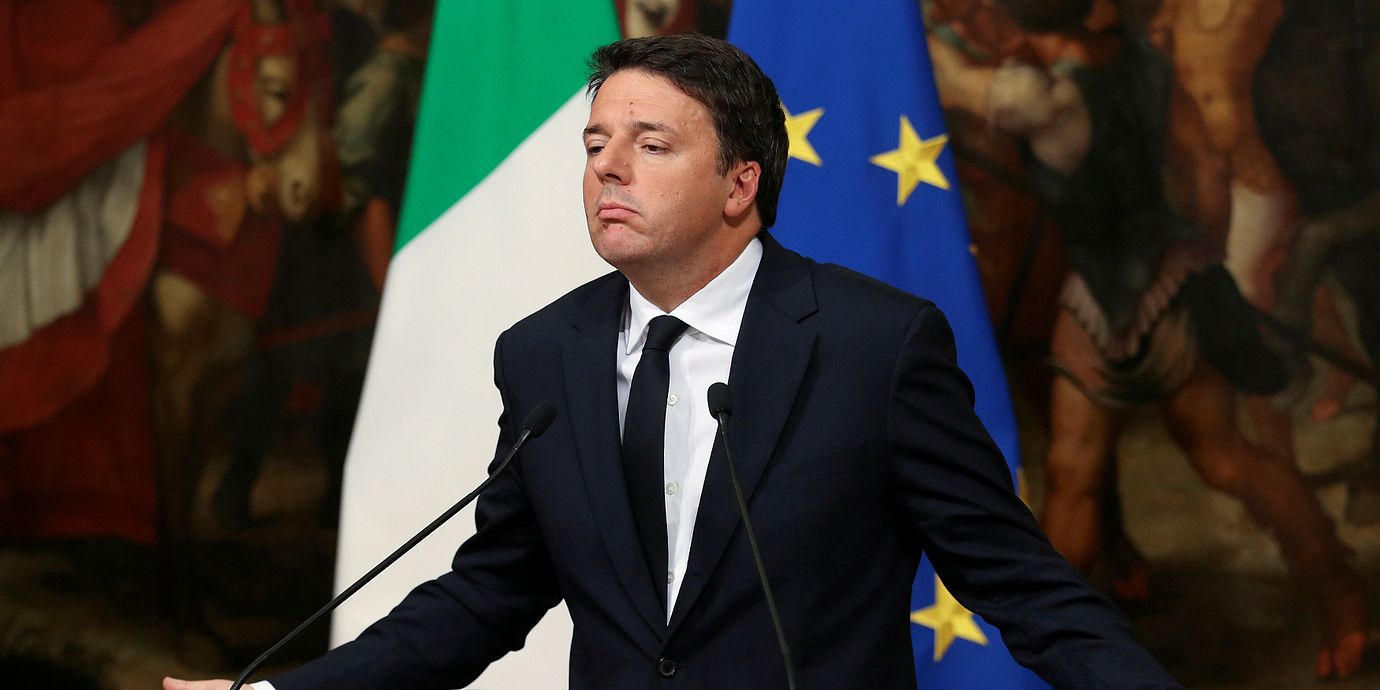
Soffliggare i söder kan bli Matteo Renzis räddning
För två veckor sedan släpptes den sista opinionsundersökningen inför söndagens folkomröstning i Italien. Mätningarna visade då att fler italienare tänkte rösta emot premiärminister Matteo Renzis förslag om att förändra grundlagen, skriver Reuters.
Det största motståndet uppges finnas i landets södra delar, där invånarna alltmer tappat förtroendet för politiken. Men det är också därifrån Renzi kan få oväntat ”stöd”, säger analytikern Carlo Buttaroni. De södra regionerna har nämligen också lägst valdeltagande i landet, enligt nyhetsbyrån.
bakgrund
Matteo Renzi
Wikipedia (en)
Matteo Renzi (Italian pronunciation: [matˈtɛːo ˈrɛntsi]; born 11 January 1975) is an Italian politician who has been the Prime Minister of Italy since 22 February 2014 and Secretary of the Democratic Party since 15 December 2013. He was President of the Province of Florence from 2004 to 2009 and Mayor of Florence from 2009 to 2014.
At the age of 39 years and 42 days upon assuming office, Renzi became the youngest Italian Prime Minister, 52 days younger than Benito Mussolini, who took office in 1922. He is also the first serving Mayor to become Prime Minister. Now the youngest leader in the G7, Renzi has been described as the de facto leader of the Party of European Socialists, in opposition to Angela Merkel's People's Party; the two leaders are together often referred to as Merkenzi. In 2014 he was ranked as the third most influential person under 40 in the world by the American magazine Fortune, and listed as one of the Top 100 Global Thinkers by Foreign Policy. Moreover, Renzi is nicknamed Il Rottamatore (The Scrapper) due to his ambition of renovating the Italian political establishment.
Since coming to office, Renzi's Government has implemented numerous reforms, including changes to the electoral system, a relaxation of labour and employment laws with the intention of boosting economic growth, a deep reformation of the public administration, the simplification of the civil trial, the introduction of same-sex civil unions, and the abolition of many small taxes.
bakgrund
Grundlagsomröstningen i Italien
Wikipedia (en)
A constitutional referendum will be held in Italy on Sunday 4 December 2016. Voters will be asked whether they approve of amending the Italian Constitution to reform the appointment and powers of the Parliament of Italy, as well as the partition of powers of State, Regions, and administrative entities.
The bill, proposed by Prime Minister Matteo Renzi and his centre-left Democratic Party, was first introduced by the government in the Senate on 8 April 2014. After several amendments by both the Senate and the Chamber of Deputies, the bill received its first approval on 13 October 2015 (Senate) and 11 January 2016 (Chamber), and, eventually, its second and final approval on 20 January 2016 (Senate) and 12 April 2016 (Chamber).
In accordance with Article 138 of the Constitution, a referendum was called because the constitutional amendment had not been approved by a qualified majority of two-thirds in each house of the Parliament in the second voting. The reform will not become law unless it receives a majority of "Yes" votes in the referendum. This will be the third constitutional referendum in the history of the Italian Republic: the other two were in 2001 (which was approved) and 2006 (which was rejected).
Should the voters approve the bill, it would achieve the most extensive constitutional reform in Italy since the end of the monarchy, not only influencing the organization of the Parliament, but also improving, according to its proponents, on the poor government stability of the country. Opposition parties have harshly criticised the bill, claiming that it is badly written and that it will make the government too powerful.
Omni är politiskt obundna och oberoende. Vi strävar efter att ge fler perspektiv på nyheterna. Har du frågor eller synpunkter kring vår rapportering? Kontakta redaktionen