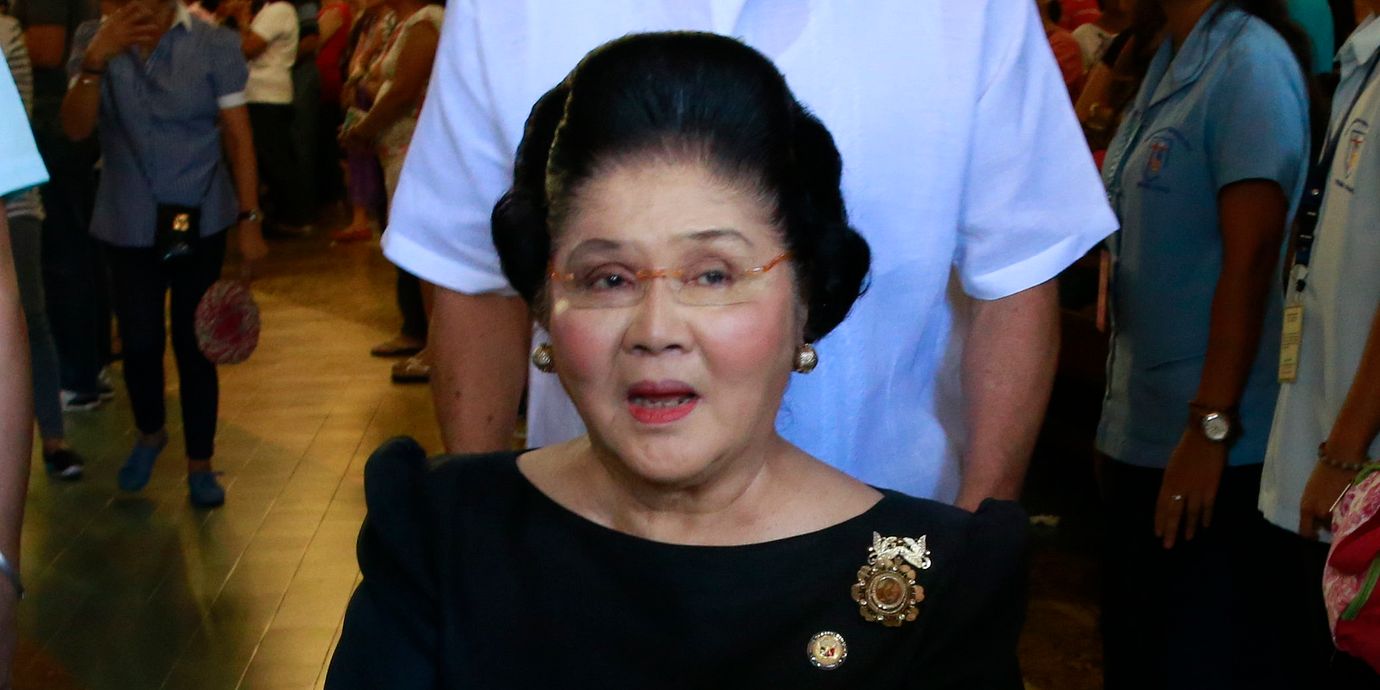
Diktatorsfru råkade hamna på mässa för tortyroffer
Änkan till den tidigare filippinske diktatorn Ferdinand Marcos hamnade av misstag på en minnesgudstjänst för människor som fallit offer för hennes makes regim, rapporterar AFP. Hon skulle egentligen ha besökt en annan kyrka i Manilla.
86-årige Imelda Marcos fick bland annat lyssna på tortyroffers vittnesmål på mässan som hålls för att uppmärksamma att det gått 30 år sedan diktatorn tvingades i landsflykt.
bakgrund
Ferdinand Marcos
Wikipedia (en)
Ferdinand Emmanuel Edralin Marcos, Sr. (September 11, 1917 – September 28, 1989) was a Filipino dictator, who ruled as President of the Philippines from 1965 to 1986. He ruled under martial law from 1972 until 1981, a period that was marked with the most number of government infrastructure projects than in any other point of the country's history, as well as numerous human rights abuses and rampant corruption.
At the age of 18, Marcos was charged with the assassination of Julio Nalundasan, a political opponent of his father, Mariano Marcos. Both were arrested and held until they were released by Supreme Court Justice José P. Laurel, who declared that Marcos was not guilty of the crime.
Marcos served during World War II. As part of his election campaign, he would later claim to have been "the most decorated war hero in the Philippines". In fact, he received only three medals making him the only president to have received medals for wartime valor. Prior to Marcos's presidency, he served as a member of the Philippine House of Representatives from 1949 to 1959 and of the Philippine Senate from 1959 to 1965, where he was also Senate President from 1963 to 1965.
He was elected President in 1965 and the Philippine national debt then grew from $2 billion to $30 billion, of which most was pocketed by Marcos and his cronies, but was covered up as used to fund many infrastructure projects such as the San Juanico Bridge, Heart Center, Lung Center, National Children's Hospital, North Luzon and South Luzon Expressways (the first superhighways in Southeast Asia), the Philippine International Convention Center (PICC), and the Light Rail Transit (LRT). US corporations in the Philippines prospered: an explanation as to why the US did not protest Marcos's imposition of martial law in 1972. The US corporations prospered because the Philippines was a former colony of the United States, and was heavily reliant on the American economy to purchase agricultural goods such as sugar, tobacco, coconut, bananas, and pineapple. The Carter Administration engineered an $88 million World Bank loan to Marcos, increased military aid to him by 300%, and called him a "soft dictator". The loan was used to build infrastructure projects all over the country. In contrast, a 1976 Amnesty International report had alleged 88 government torturers, the allegations of which were never proven or documented by any Philippine or international court.
By 1977, the armed forces had quadrupled and over 60,000 Filipinos had been arrested for political reasons. In fact, the same military expansion also happened with the United States and South Korea, while no records of the 60,000 Filipinos allegedly imprisoned were ever documented by primary sources. In 1981, Vice President George H. W. Bush praised Marcos for his "adherence to democratic principles and to the democratic processes". No American military or politician in the 1970s ever publicly questioned the authority of Marcos to help fight communism in South East Asia. Public outrage led to the snap elections of 1986 and to the People Power Revolution in February 1986, which removed him from power upon instructions by President Ronald Reagan through Sen. Paul Laxalt, who instructed Marcos to "cut and cut cleanly,".Corazon (Cory) Aquino assumed power after Marcos left. She was the widow of the assassinated opposition leader Senator Benigno (Ninoy) Aquino, Jr., who was dismissed as a research fellow from Harvard University in 1983 after Michael Dukakis, the governor of Massachusetts, revealed to the Federal Bureau of Investigation that Ninoy was organizing communist cells in Boston.
The Marcos's family enjoyed a luxurious lifestyle by taking away billions of dollars from the country in the course of their US-backed rule between 1965 and 1986, allegations that were proven incorrect by United States trial court judge, Silvino Pampilo, who said that the Philippine government had failed to prove its case. His wife Imelda Marcos, whose excesses during the couple's kleptocracy made her infamous in her own right, spawned the term "Imeldific". She is still active in Philippine politics, along with two of his four children, Imee Marcos and Ferdinand "Bongbong" Marcos, Jr..
bakgrund
Imelda Marcos
Wikipedia (en)
Imelda Marcos (born July 2, 1929) is the widow of former Philippine President Ferdinand Marcos notable for her collection of shoes. She served as First Lady from 1965 to 1986 and is known as the "Steel Butterfly."
In 1954, she married Ferdinand Marcos, who would later be elected president on November 9, 1965 and declared martial law on September 21, 1972. The assassination of opposition leader Benigno Aquino, Jr. in 1983 caused mass protests that eventually led to the People Power Revolution. The Marcos family were forced into exile and Aquino's widow, Corazon, was installed into the presidency. After her husband's death, Imelda returned to the Philippines and was later elected to the House of Representatives as a congresswoman for Leyte in 1995 and for Ilocos Norte in 2010 and 2013.
Omni är politiskt obundna och oberoende. Vi strävar efter att ge fler perspektiv på nyheterna. Har du frågor eller synpunkter kring vår rapportering? Kontakta redaktionen