Ryssland: Massgravar upptäckta i Aleppo
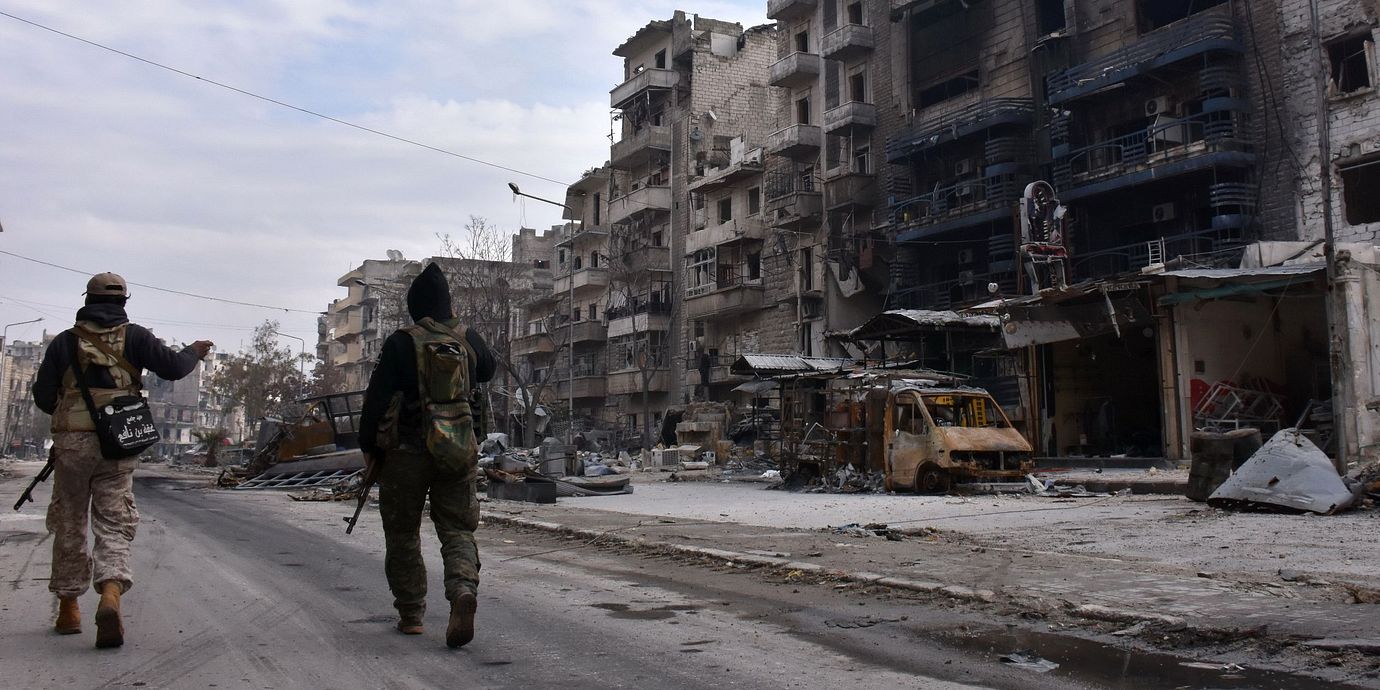
Massgravar med kroppar som bär spår av tortyr har upptäckts av ryska styrkor i Aleppo, säger Rysslands försvarsministerium enligt AP.
Flera dussin kroppar ska ha hittats, enligt talesmannen för ministeriet, Igor Konashenkov. Samtidigt anklagar den syriska regimen rebeller för att ha avrättat 21 civila som hittats i ett fängelse i Aleppo, skriver AFP.
Ryssland hjälpte tidigare i december Syriens President Bashar al-Assad att återta Aleppo från de rebeller som hade kontrollerat staden sedan 2012. Det oppositionella Syriska människorättsobservatoriet bekräftar enligt AFP att kroppar har hittats på gatorna i östra Aleppo, men säger att det är oklart hur de har dödats.
bakgrund
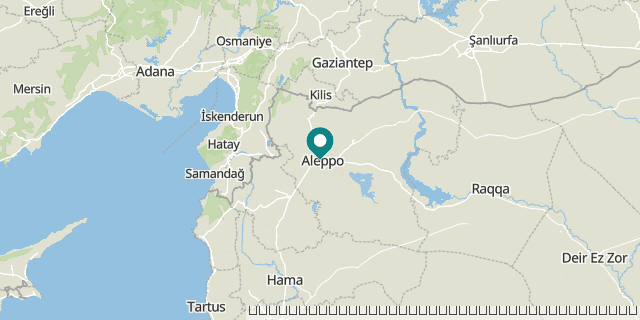
Aleppo
Wikipedia (en)
Aleppo (/əˈlɛpoʊ/; Arabic: ﺣﻠﺐ / ALA-LC: Ḥalab, IPA: [ˈħalab]) is a city in Syria, serving as the capital of the Aleppo Governorate, the most populous Syrian governorate. For centuries, Aleppo was the Syrian region's largest city and the Ottoman Empire's third-largest, after Constantinople and Cairo. With an official population of 2,132,100 (2004 census), it was Syria's largest city and also one of the largest cities in the Levant before the advent of the Syrian Civil War.
Aleppo is an ancient metropolis, and one of the oldest continuously inhabited cities in the world; it may have been inhabited since the 6th millennium BC. Excavations at Tell as-Sawda and Tell al-Ansari, just south of the old city of Aleppo, show that the area was occupied by Amorites since at least the latter part of the 3rd millennium BC; and this is also when Aleppo is first mentioned in cuneiform tablets unearthed in Ebla and Mesopotamia, in which it is a part of the Amorite state of Yamhad, and noted for its commercial and military proficiency. Such a long history is attributed to its strategic location as a trading center midway between the Mediterranean Sea and Mesopotamia (i.e. modern Iraq).
The city's significance in history has been its location at one end of the Silk Road, which passed through central Asia and Mesopotamia. When the Suez Canal was inaugurated in 1869, trade was diverted to sea and Aleppo began its slow decline. At the fall of the Ottoman Empire after World War I, Aleppo ceded its northern hinterland to modern Turkey, as well as the important railway connecting it to Mosul. In the 1940s, it lost its main access to the sea, Antioch and Alexandretta, also to Turkey. Finally, the isolation of Syria in the past few decades further exacerbated the situation. This decline may have helped to preserve the old city of Aleppo, its medieval architecture and traditional heritage. It won the title of the "Islamic Capital of Culture 2006", and has had a wave of successful restorations of its historic landmarks.
Since the Battle of Aleppo started in 2012, the city has suffered massive destruction, and has been the worst-hit city in the Syrian Civil War. In December 2016, the Syrian government achieved full control of Aleppo following a successful offensive.
Aleppo
Omni är politiskt obundna och oberoende. Vi strävar efter att ge fler perspektiv på nyheterna. Har du frågor eller synpunkter kring vår rapportering? Kontakta redaktionen